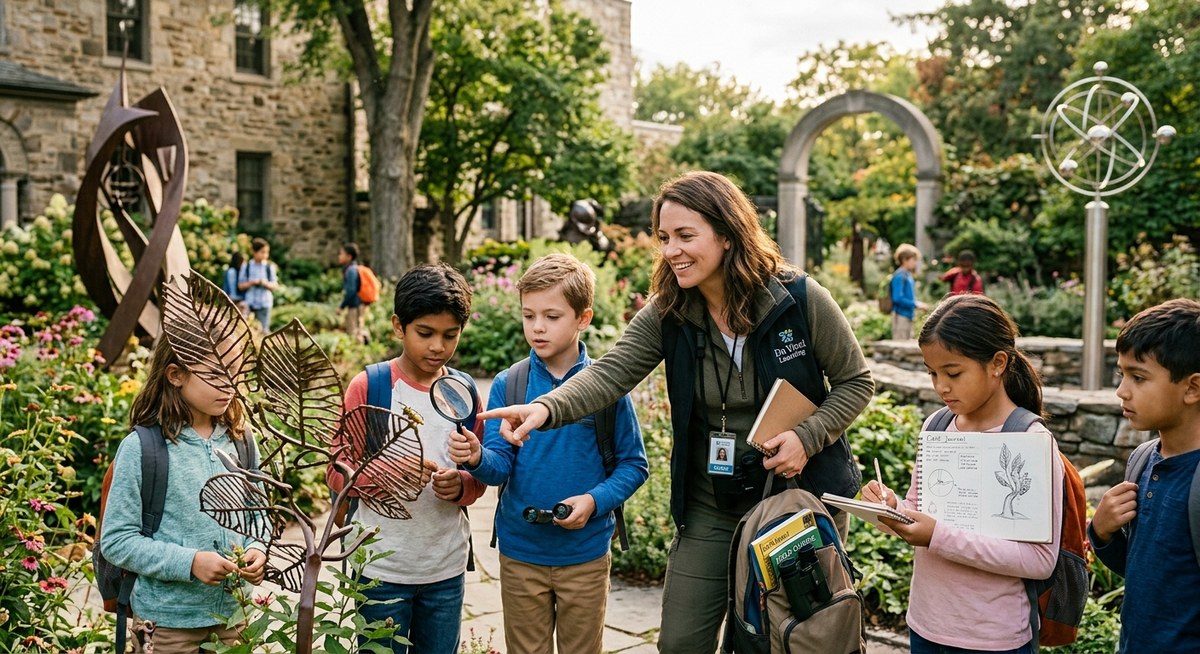
Picture a group of fifth graders standing in a historic arboretum. One student kneels to examine a fallen leaf. Another sketches the pattern of bark on a sycamore. A third starts asking out loud why some trees lose their leaves earlier than others. No one is rushing them. No one is handing out worksheets. The learning is alive, chaotic, and deeply personal. That is the power of an inquiry based field trip.
Teachers can turn any field trip into an inquiry based learning experience by shifting from scripted tours to student driven questions. This guide offers a practical framework: pre trip curiosity building, on site open ended tasks, and post trip reflection that connects art, science, and real world problems. Use it to design interdisciplinary field trips that stick with students long after the bus ride home.
Why Interdisciplinary Field Trips Spark Deeper Inquiry
A traditional field trip often feels like a checklist. Visit the museum. Listen to a guide. Answer ten questions on a worksheet. Compare that to an inquiry based field trip. Students arrive with questions they formed in class. They decide what to investigate. They collect evidence across subjects. A trip to a wetland can blend biology with poetry. A visit to a sculpture garden can blend geometry with art history. When you intentionally connect disciplines, you give students permission to see the world the way it really works: messy, interconnected, and full of puzzles.
This is not just a nice idea. Research from 2026 continues to show that interdisciplinary learning boosts critical thinking and retention. For more on the theory behind blending subjects, read our article on exploring the power of inquiry based learning across disciplines.
The Three Phase Framework for an Inquiry Based Field Trip
You do not need to overhaul your entire curriculum to make a field trip inquiry driven. Instead, focus on three phases: before, during, and after. Each phase builds on the last to create a full learning arc.
Phase 1: Before the Trip Build Anticipation and Questions
The magic starts in the classroom. At least one week before the trip, introduce the location and its big ideas. But do not give students all the answers. Instead, do this:
- Show a provocative image or short video from the site without explanation. Ask: What do you wonder about this place? Record every student question on a sticky note.
- Group the questions into categories connected to different disciplines. For a trip to a natural history museum, categories might be biology, geology, art, and storytelling.
- Have students pick one question they want to answer during the trip. This becomes their personal mission.
- Teach a mini lesson on observation techniques. For example, show students how to use their senses beyond sight, how to sketch an object, and how to take field notes that include measurements and feelings.
“I used to think field trips were about covering content. Now I treat them as opportunities for students to practice asking better questions. The difference is night and day.”
- Ms. Alvarez, 4th grade teacher in Portland, Oregon
Phase 2: During the Trip Encourage Student Directed Exploration
On site, your role shifts from tour leader to facilitator. Prepare a few structured activities, but leave room for detours. Here is a bulleted list of strategies that work:
- Use a “question passport”: a small booklet where students record observations and new questions as they move through the site.
- Set a minimum number of “I notice” and “I wonder” statements before lunch. This keeps inquiry alive without forcing everyone to use the same checklist.
- Pair students across disciplines: have one science minded student partner with one arts minded student. They teach each other what they see.
- Provide open ended prompts like “Find three things that change over time” or “Find one example of human impact and sketch it.”
- Include a quiet reflection station: a bench or corner where students can sit alone for five minutes and write whatever comes to mind.
If the site has a guided tour, negotiate with the docent in advance. Ask for time after the tour for students to follow their own questions. Most museums are happy to accommodate.
Phase 3: After the Trip Connect Discoveries to Broader Learning
Back in the classroom, the real synthesis happens. Students need to process what they found and link it to larger ideas. Try these steps:
- Host a “question share” circle: each student shares one new question that emerged from their observations. Write them all on the board.
- Create a class artifact: a collaborative poster, a digital story, or a short film that combines everyone’s findings. This forces students to weave disciplines together.
- Assign a choice based reflection: students can write a scientific report, create a piece of art, compose a poem, or record a podcast. The only rule is that it must show how at least two subjects were connected during the trip.
- Connect back to the curriculum: ask students how their question from before the trip changed after seeing the real thing. Then use that to launch a new unit.
For a deeper look at how to design this kind of project from scratch, check out our guide on how to design interdisciplinary projects that ignite student curiosity in 2026.
Common Mistakes and Best Practices
Even experienced teachers stumble when shifting to inquiry based field trips. The table below compares the old habits with the new approach.
| Common Mistake | Inquiry Based Best Practice |
|---|---|
| Handing out a fill in the blank worksheet | Giving students a question passport with open prompts |
| Keeping the whole group together for every stop | Allowing small groups to pursue different interests |
| Treating the field trip as a standalone event | Building pre trip and post trip lessons around it |
| Asking only factual questions (What is this?) | Asking comparative questions (How is this different from what we learned?) |
| Focusing only on one subject (e.g., science only) | Requiring evidence from two or more disciplines per observation |
| Evaluating students on correct answers | Evaluating students on the quality of their questions and observations |
A Practical Example: An Interdisciplinary Trip to a Local River
Let us bring the framework to life. Suppose you teach a combined 6th grade science and language arts block. You decide to take students to a nearby river. Here is how the inquiry might unfold.
Before the trip: In class, students watch a one minute video of the river at different seasons. They brainstorm questions. Carlos asks: “Why does the water look brown after rain?” Maya asks: “How do artists capture the feeling of moving water?” You group these into science questions and art questions. Each student picks one.
During the trip: At the river, students use their question passport. Carlos measures turbidity with a simple jar. Maya sketches the way light reflects off ripples. They trade observations. A third student, Jamal, notices a heron and starts asking about food chains. He switches his focus on the spot. You let him.
After the trip: Back in class, the students compile their data. Carlos writes a short lab report about sediment. Maya creates a watercolor painting. Jamal writes a poem about the heron. Then the whole class discusses one big question: “Is this river healthy?” They use scientific evidence and artistic interpretations to argue their points. The unit ends with a letter to the city council about river conservation.
This kind of interdisciplinary field trip does more than teach facts. It teaches students that knowledge is not divided into subjects. For more ideas on merging art and science in your classroom, see our resource on innovative methods to integrate art and science in inquiry based education.
How to Get Started Next Week
You do not need a big budget or a perfect location to try this. Start small. Pick one upcoming field trip, even if it is just a walk around the schoolyard. Use the three phase framework. Ask students to bring a notebook. Focus on one interdisciplinary connection, such as math and nature (counting leaf veins) or history and architecture (comparing building styles).
If your school does not have the budget for field trips, consider virtual options. Many museums offer live virtual tours where students can ask questions in real time. The same principles apply: build questions before, encourage exploration during, and synthesize after.
Here are three actionable steps to take this week:
- Step 1: Choose one learning objective that naturally crosses subjects. For example, “Students will analyze how local plants adapt to seasonal changes using both scientific measurement and artistic documentation.”
- Step 2: Reach out to the field trip venue and explain that you want an inquiry based approach. Ask for a preview of the site to plan your prompts.
- Step 3: Create a simple question passport template. Print it on folded paper. Model how to use it during a practice observation in the classroom.
For even more structure, read our 7 step guide on 7 steps to launch an interdisciplinary project that captivates students in 2026.
Transforming Field Trips into Lasting Inquiry Habits
The most memorable learning experiences are the ones that leave students with more questions than answers. When you design a field trip around inquiry, you send a powerful message: your curiosity matters. You also show students that the real world does not sort itself into neat boxes labeled science, history, or art. The river is all of those things at once.
Start with one trip. Use the framework above. Let go of the need to control every moment. Trust your students to follow their questions. You will watch them become sharper observers, more creative thinkers, and more engaged learners. And you will likely enjoy the trip more yourself.
If you want to explore this topic further, check out our companion piece on harnessing curiosity in the classroom to foster interdisciplinary inquiry. It offers additional strategies for making every day, not just field trips, a little more inquiry driven.
Now go plan that next trip. Your students are waiting to wonder.