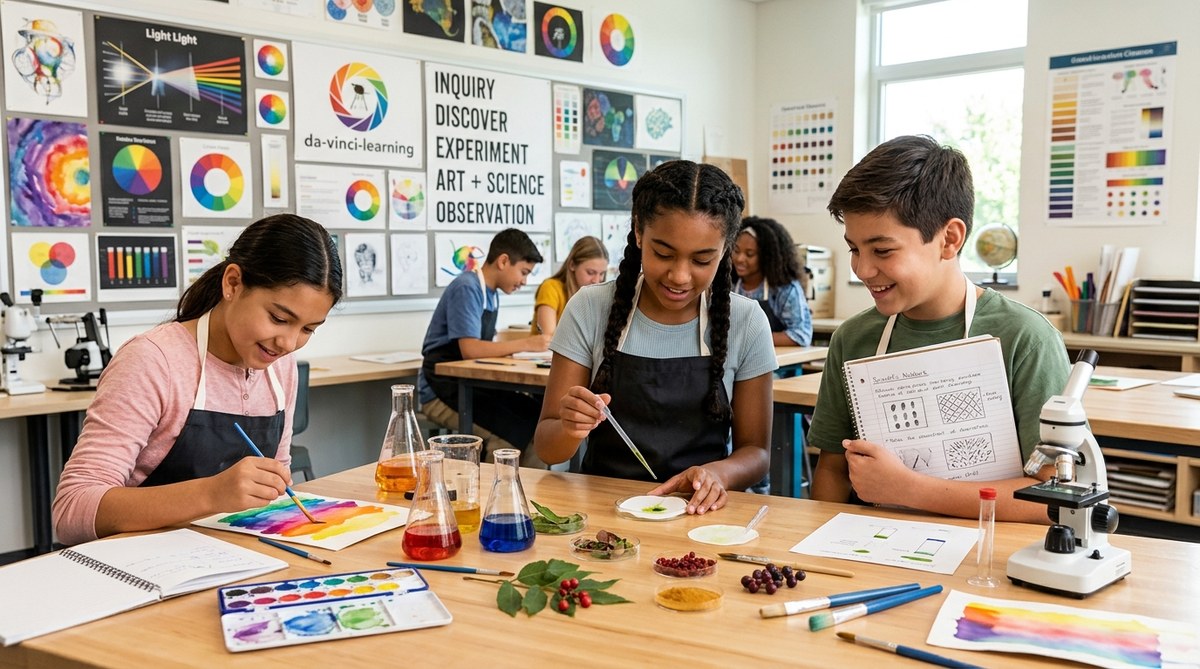
In a middle school classroom outside Chicago, a student mixes cornstarch and water, watching it turn from solid to liquid under her fingers. She is not just doing a science experiment. She is preparing to paint with a substance that behaves like both a solid and a liquid. Her teacher asked one question: “What if the texture of your paint could tell a story about change?” That question opened a door. The student spent the next week exploring non-Newtonian fluids, color theory, and the emotional weight of transformation. That is the power of inquiry-based learning art in action.
Inquiry-based learning art blends student-driven questions with hands-on experimentation, where scientific principles become tools for creative expression. This guide shows educators how to design interdisciplinary lessons that honor both the artist’s instinct and the scientist’s method. You will learn practical steps, common pitfalls, and classroom-tested techniques for 2026.
Why Inquiry and Art Belong Together
Art and science share more than most educators realize. Both disciplines start with observation. Both require experimentation. Both thrive on curiosity. When you step back and look at how a painter studies light or how a biologist sketches cells, the line between the two worlds gets blurry.
Inquiry-based learning asks students to drive their own learning through questions. Instead of giving students a formula to memorize, you give them a problem to solve. Instead of telling them how to mix colors, you let them discover color relationships through trial and error. This approach works especially well when you pair artistic expression with scientific principles.
Students who struggle with traditional science labs often find a way in through art. And students who feel intimidated by art classes sometimes gain confidence when they see the structure that science provides. By blending the two, you create a classroom where every student can find their entry point.
What Inquiry-Based Learning Looks Like in an Art and Science Classroom
In a traditional classroom, the teacher holds the answers. In an inquiry-based classroom, the teacher holds the questions. The shift is subtle but powerful.
Instead of saying “Today we will learn about color mixing,” you might say “How can we create a color that looks like it is moving?” Instead of “Here is how refraction works,” you might ask “Can you use water to make a drawing appear to move?”
The goal is to let students wrestle with ideas. They might fail. They might need to try again. That is the point. The process of failing, adjusting, and retrying is where real learning happens.
Here are the core principles that guide this approach:
- Student questions drive the lesson, not the curriculum outline
- Materials are introduced as tools for exploration, not as finished products
- Mistakes are treated as data, not as failures
- Reflection is built into every stage of the process
- Teachers act as facilitators, not as lecturers
When these principles are in place, something shifts in the room. Students stop waiting for instructions and start proposing their own experiments. They stop asking “Is this right?” and start asking “What if I try this?”
A Step-by-Step Process for Designing Inquiry-Based Art and Science Lessons
Building a lesson that blends inquiry-based learning art with scientific principles does not need to be complicated. The following steps give you a reliable framework. You can adapt them for any grade level or topic.
-
Start with an open question that connects a scientific principle to an artistic outcome. For example: “How can we use the chemistry of light to create a painting that changes color during the day?” This question invites both scientific investigation and creative problem solving.
-
Introduce materials without giving instructions. Place pigment, binders, pH test strips, and natural dyes on a table. Let students touch, smell, and observe. Ask them what they notice and what they wonder.
-
Let students form their own hypotheses. Have them write or sketch their predictions. What do they think will happen if they mix an acid with a plant-based dye? How does that compare to mixing a base?
-
Give time for open experimentation. This stage can feel messy. Let it be messy. Students need space to try things that do not work. That is where the learning lives.
-
Pause for a structured reflection. Ask students to document what they observed, what surprised them, and what new questions emerged. This reflection turns experience into understanding.
-
Connect their findings to larger scientific and artistic concepts. Once students have experimented, you can introduce vocabulary like pH, refraction, or complementary colors. The terms now have meaning because students have experienced them.
-
Let students create a final piece that expresses their new understanding. This could be a painting, a sculpture, a photograph, or a digital work. The medium matters less than the intention behind it.
This seven step process works because it respects the student’s natural curiosity. It does not force learning. It creates conditions where learning happens naturally.
Common Mistakes and How to Avoid Them
Even experienced educators can stumble when combining inquiry-based learning with art and science. The table below outlines common mistakes and practical solutions.
| Common Mistake | What It Looks Like | How to Fix It |
|---|---|---|
| Overdirecting the inquiry | You give step by step instructions that leave no room for discovery | Offer materials and one open question. Step back and let students find their own path. |
| Skipping the reflection step | Students finish a project and move on without processing what they learned | Build in 10 minutes for journaling or group discussion after every experiment |
| Focusing too much on the final product | You grade the artwork instead of the thinking process | Create rubrics that value process, documentation, and revision over polish |
| Using vocabulary too early | You introduce terms like “oxidation” before students have seen rust form | Let students experience the phenomenon first. Name it after they notice it. |
| Not preparing for mess | You feel anxious about spills, stains, or materials being used in unexpected ways | Set clear boundaries for safety, then relax into the chaos. Designate cleanup time. |
Avoiding these mistakes comes down to one thing: trust. Trust that students will ask good questions. Trust that the process will lead somewhere meaningful. Trust that a messy classroom is often a learning classroom.
Why This Approach Works for Different Age Groups
Inquiry-based learning art is not limited to one grade level. The approach adapts naturally to different developmental stages.
For elementary students, the questions are concrete and sensory. “How does salt change the way watercolor dries?” lets young students explore crystallization and texture while creating art. Their investigations are short and hands on. The science is embedded in the doing.
For middle school students, the questions become more conceptual. “Can we engineer a paint that changes color with temperature?” introduces thermochromic pigments and phase changes. Students at this age can handle more complex variables and longer investigations.
For high school students, the questions can push into abstract territory. “How does the structure of a polymer affect the way light passes through a sculpture?” connects materials science with visual design. Advanced students can design their own experiments and create portfolios that document their process.
The beauty of this method is that it scales up and down without losing its core. The questions get deeper, the materials get more sophisticated, and the reflections get richer. But the foundation stays the same: curiosity first, answers second.
A Classroom Example That Brings It All Together
Let us walk through a real example from a 2026 classroom. A high school teacher wanted to teach her students about chemical reactions and color theory. Instead of handing out a worksheet, she set up stations with cabbage juice, turmeric, baking soda, vinegar, and paper.
She asked one question: “How can you create a full color palette using only natural indicators and acids?”
Students spent the first class period testing combinations. They dipped paper into cabbage juice and then brushed it with vinegar. They watched the color shift from purple to pink. They mixed turmeric paste with baking soda and saw it turn from yellow to orange. They kept notes. They made mistakes. They tried again.
By the third day, each student had developed a personal palette. Some focused on warm tones. Others found ways to create greens by layering yellow and blue indicators. One student realized that the concentration of acid changed the intensity of the color. She started measuring pH with strips and adjusting her mixtures.
The final project asked each student to create a piece of art that represented a chemical concept. One student painted a landscape where the sky shifted from pink to purple, representing a pH gradient. Another created abstract forms that showed how acids and bases interact.
The teacher did not lecture. She did not hand out a rubric with specific colors. She asked a question, provided materials, and trusted the process. The results were more creative and more scientifically rigorous than anything she had planned.
“When you let students ask their own questions, you get back more than you could have assigned. The art is better. The science is deeper. And the students remember what they learned because they discovered it themselves.” – Marissa Chen, high school art and science educator, 2026
How to Assess Inquiry-Based Work Without Killing the Curiosity
Assessment is often the trickiest part of inquiry-based learning art. Traditional grading systems reward correct answers and polished products. But inquiry values process, experimentation, and iteration.
Here are three strategies that preserve curiosity while still holding students accountable:
First, use process portfolios. Ask students to document their entire journey: initial questions, failed attempts, adjustments, breakthroughs, and final reflections. Grade the portfolio for depth of thinking, not for how “pretty” the final piece looks.
Second, host critique sessions where students present their work and explain their choices. Encourage peers to ask questions about the materials, the process, and the discoveries. This builds communication skills and reinforces scientific thinking.
Third, use a simple rubric that values risk taking. Award points for trying a new technique, for persisting through a failure, and for making unexpected connections between art and science. Reward the behaviors you want to see more of.
When students know that their thinking matters more than their final product, they take bigger risks. And bigger risks lead to bigger learning.
Bringing Inquiry into Your Classroom Tomorrow
You do not need a full redesign of your curriculum to start using inquiry-based learning art. You can begin with one lesson, one question, one experiment.
Pick a topic that your students already find interesting. Maybe it is color. Maybe it is texture. Maybe it is light. Then find one scientific principle that connects to that topic. Refraction. Crystallization. Oxidation. Buoyancy.
Design one open question that invites both scientific investigation and artistic expression. Gather simple materials. Let your students take the lead.
Watch what happens.
You will see students who usually hang back suddenly step forward. You will see students who usually rush through assignments slow down and pay attention. You will see curiosity become a habit, not a requirement.
The most innovative classrooms in 2026 are not the ones with the fanciest technology. They are the ones where students ask the best questions. And the best questions happen when art and science sit down at the same table.
If you are ready to take the next step, look at how to design interdisciplinary projects that ignite student curiosity in 2026. The journey from asking a good question to building a full inquiry-based curriculum is exciting. And it starts with one small change.
Tomorrow, try asking a question instead of giving an answer. See where your students take it.