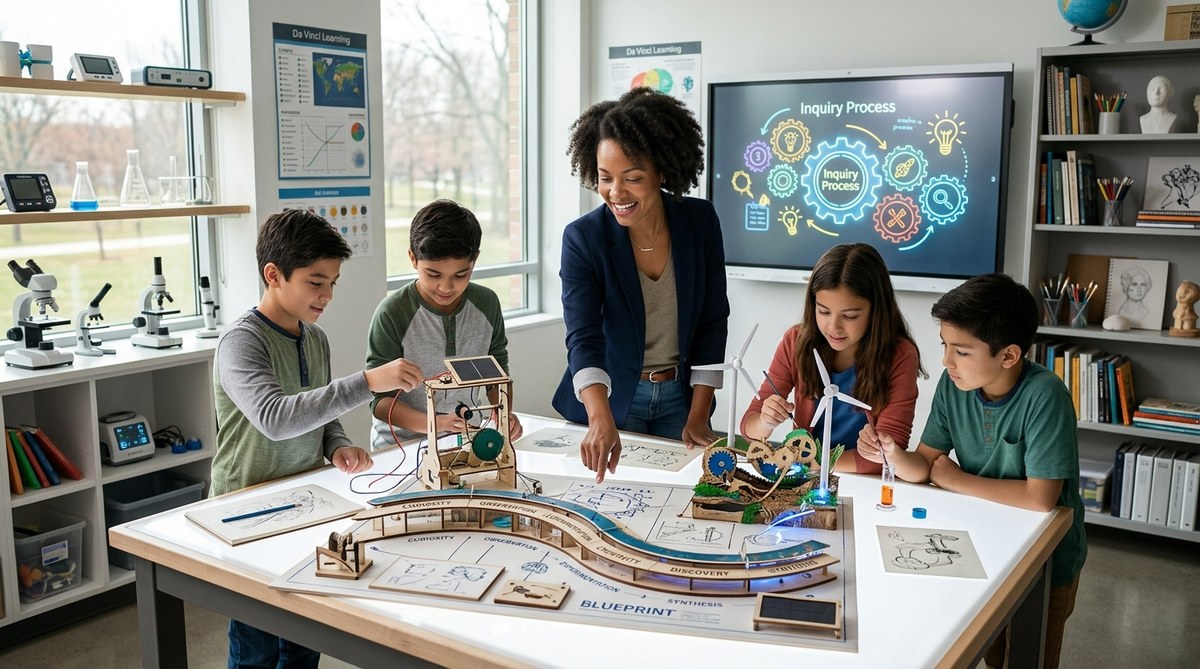
The classroom of 2026 no longer treats art and science as separate worlds. Students who mix paint to test chemical reactions, or who sketch biological specimens to understand anatomy, are building connections that stick. When you treat the science lab like a studio and the art room like a discovery space, something shifts. Kids stop asking “When will I use this?” because they see the answer in every project. They become curious, not compliant. This blueprint shows you how to build that classroom, one inquiry at a time.
Integrating art and science in education works best through inquiry-based projects where students ask their own questions. Start with a shared theme like patterns or light. Let students choose whether to investigate through a painting, a model, or an experiment. Use the five-step process below to plan your first unit. This approach builds creative problem-solving skills that last beyond any single lesson.
Why This Blend Works Better Than Separate Subjects
Think about how a real scientist or artist works. A biologist draws detailed field sketches. An architect balances structural physics with aesthetic design. A musician understands wave frequencies. The boundary between art and science is artificial, and students sense that. When you force subjects into silos, you lose the magic that happens at the intersection.
The National Science Teaching Association now recommends interdisciplinary approaches as a core strategy for deeper learning. And it makes sense. When a student designs a sculpture that demonstrates kinetic energy, they are not just memorizing a formula. They are living it. The hands-on nature of art makes abstract scientific concepts tangible. The precision of science gives artistic work a foundation in reality.
What the Research Says
Studies from 2025 show that students in integrated STEAM programs score higher on creative problem-solving assessments. They also show greater persistence when faced with difficult tasks. Why? Because they learn that failure is part of both the scientific method and the artistic process. A canvas that does not work becomes a new experiment. A hypothesis that fails becomes data.
The Five-Step Process for Your First Integrated Unit
Here is a numbered list of steps to build a unit that blends disciplines without overwhelming you or your students. Use this as your starting point.
-
Choose a unifying theme. Pick something broad like “Growth,” “Patterns,” “Light,” or “Transformation.” The theme should feel natural in both a biology textbook and a painting studio. Avoid topics that are too narrow, like “Photosynthesis only” or “Impressionism only.” You want room for student exploration.
-
Design a central inquiry question. Frame the unit around a question that has no single right answer. For a theme of “Light,” ask: “How does light shape what we see and how we understand it?” This question invites both a physics investigation into refraction and an art project on shadow and color.
-
Provide choice in medium and method. Let students decide whether they want to build a model, write a report, create a painting, film a short video, or design a digital simulation. The goal is the same, but the path is theirs. This ownership drives engagement.
-
Build in reflection points. After each phase, ask students to write or talk about what they noticed. How did the science inform their art? How did the art change their understanding of the science? This metacognition is where the real learning lives.
-
Showcase and critique. End the unit with a public exhibition. Invite other classes, parents, or local community members. Students present their work and answer questions. This mirrors both a science fair and an art opening.
A Practical Framework for Planning
Use this table to map out your first integrated lesson. It compares common approaches with the mistakes teachers often make, so you can avoid the pitfalls.
| Approach | What Works | What to Avoid |
|---|---|---|
| Theme selection | Pick a concept that appears in both art and science, like “Symmetry” | Choosing a theme that only fits one subject, like “Acids and Bases” |
| Student choice | Offer 3 to 4 project formats (painting, model, video, writing) | Giving unlimited options that overwhelm students |
| Assessment | Use a rubric that values process, creativity, and accuracy | Grading art solely on technical skill or science solely on correct answers |
| Timing | Allow 2 to 3 weeks for a full inquiry cycle | Rushing through in one week without time for revision |
| Collaboration | Pair students with different strengths together | Letting friends always work together without mixing skills |
Simple Activities to Try This Week
You do not need a full unit to start. These bulleted activities work as warm-ups or standalone lessons.
- Nature journaling. Take students outside to sketch a leaf, a cloud, or an insect. Ask them to label parts, note colors, and record observations. This blends scientific field notes with artistic drawing.
- Color mixing as chemistry. Give students primary paints and ask them to create a specific color. Have them record the ratios like a lab experiment. Discuss why some mixtures produce mud while others create vibrant hues.
- Sound wave visualization. Use a smartphone app that shows sound frequencies. Let students sing or play an instrument while watching the waveform. Then have them draw what they see. Connect the visual pattern to the physics of sound.
- Paper tower challenge. Give students a stack of newspaper and tape. Ask them to build the tallest tower that can hold a tennis ball. After the first attempt, discuss structural engineering principles. Then let them redesign. This is pure inquiry with a tangible artistic outcome.
“The most powerful learning happens when students do not know whether they are in art class or science class. That confusion is a sign that you are doing it right.” — Dr. Elena Marchetti, curriculum specialist and author of Inquiry Across Boundaries (2025)
Common Mistakes When Blending Art and Science
Even experienced teachers stumble here. Watch out for these traps.
Forcing the connection. Not every science topic needs an art component. And not every art lesson needs a science label. If the link feels stretched, students will see it as gimmicky. Let the connection emerge naturally from the inquiry question.
Prioritizing one subject over the other. If you treat art as the “fun” part and science as the “serious” part, you undermine both. Give each discipline equal weight. A beautifully painted diagram that gets the science wrong is not a success. A scientifically accurate sketch that lacks creativity is also incomplete.
Skipping the feedback loop. Students need time to revise their work based on what they learn. If they paint a cell structure and then realize the proportions are wrong, let them repaint. That revision is where deep understanding happens.
How to Handle Pushback from Administrators or Parents
Some stakeholders will question why you are “mixing subjects.” Be ready with a clear answer.
Frame the approach as preparation for the real world. Modern careers in fields like biomedical visualization, sustainable architecture, and user experience design all require both creative and analytical thinking. Colleges and employers are looking for students who can think across disciplines.
Show evidence. Share student work. Invite skeptics to the exhibition at the end of the unit. When they see a fifth grader explaining the physics of a mobile sculpture they built, the resistance usually fades.
Building a Year-Long Integration Plan
You can start small and grow. Here is a suggested timeline for the 2026 school year.
First quarter. Pick one theme and run one integrated unit. Use the five-step process above. Keep it simple.
Second quarter. Add a second unit with a different theme. Encourage students to suggest the inquiry question. Let them take more ownership.
Third quarter. Collaborate with another teacher. If you teach science, partner with the art teacher down the hall. Plan a joint project that meets both of your standards.
Fourth quarter. Host a school-wide STEAM fair. Let every grade level present an integrated project. Invite local artists and scientists to judge and give feedback.
The Tools You Need (and the Ones You Do Not)
You do not need a fancy lab or expensive art supplies to make this work. Basic materials like paper, paint, clay, string, and found objects are enough. Digital tools can help, but they are optional.
- A microscope paired with a drawing pad lets students sketch what they see.
- A simple camera allows them to document changes over time.
- Free online tools like Canva or Google Drawings work for digital projects.
The most important tool is your willingness to let go of control. Inquiry-based learning means students ask questions you might not have answers for. That is okay. Say “I do not know, let us find out together.” That sentence is more powerful than any lesson plan.
Why This Matters More in 2026
The world students are inheriting does not have neat subject boundaries. Climate change, public health, and technology ethics all require thinking that blends data with human values. By teaching students to integrate art and science, you are giving them the mental flexibility to face problems that do not yet exist.
This is not about making every student an artist or a scientist. It is about making every student a thinker who can look at a problem from multiple angles. That skill is the foundation of innovation.
Your Next Step Starts Tomorrow
Pick one activity from the bulleted list above. Try it with your class this week. Notice how students react. Watch for the moment when a quiet kid lights up because they finally see the connection. That spark is your proof.
If you want more structured guidance, check out our guide on unlocking creativity by merging art and science in your classroom. It includes ready-to-use templates and rubrics.
You already have everything you need: a curious mind, a willingness to try, and a classroom full of students waiting to be surprised. Go make something.