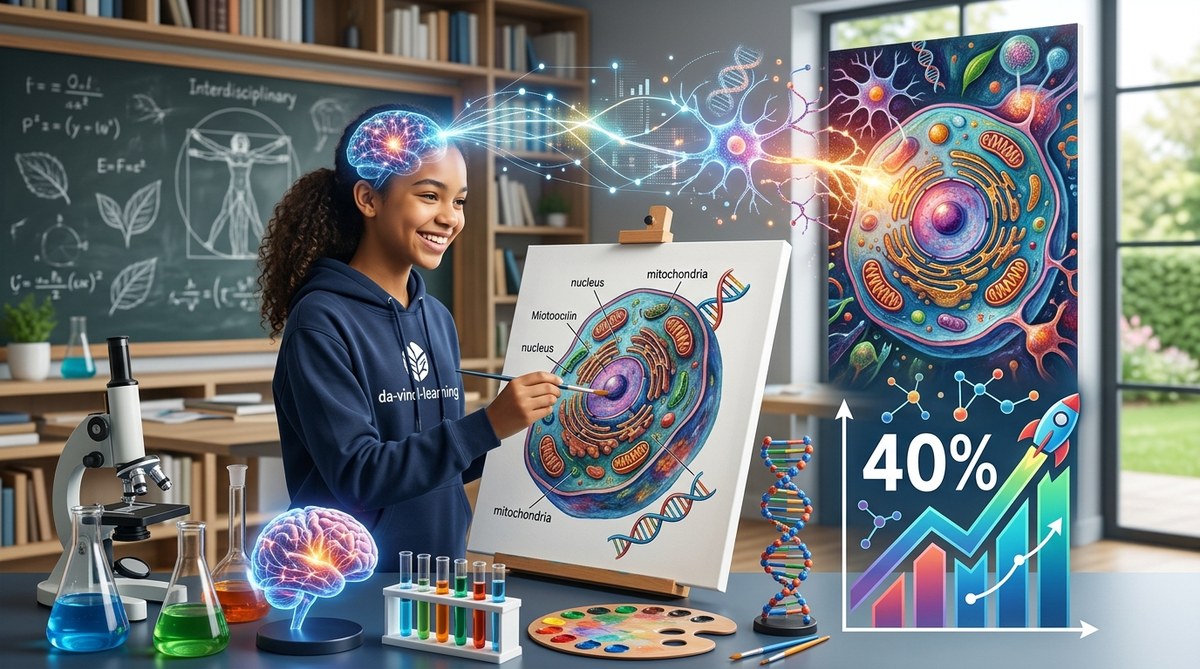
Picture a classroom where students don’t just memorize the periodic table. They paint it. They sculpt cell structures from clay. They compose songs about gravity. This isn’t a fantasy. It’s a proven method that helps students remember scientific concepts far longer than traditional lectures do. Research shows that learning science through art can boost retention by as much as 40 percent. That number changes how we think about lesson plans.
When students draw, paint, or build models of scientific ideas, they create stronger mental connections. This hands-on approach activates multiple brain regions at once, locking in knowledge. For educators and parents, this means swapping passive reading for creative projects can dramatically improve how well children understand and recall complex topics like biology, physics, and chemistry.
Why Art Makes Science Stick
The human brain loves patterns, colors, and stories. Science deals in facts, formulas, and abstract ideas. When you combine the two, something powerful happens. Art gives science a shape and a feeling. It turns a list of facts into an experience.
Think about the last time you tried to remember a complicated idea. Did a diagram help? Did a metaphor stick in your head? That’s the core of this approach. By engaging the visual and motor centers of the brain, art creates multiple pathways to the same memory. If one pathway fades, another remains strong.
For example, a student learning about the water cycle might draw clouds, rivers, and arrows showing evaporation. That drawing becomes a mental anchor. Months later, they can still picture the image and recall the process. This is not guesswork. Studies from neuroscience labs confirm that drawing improves memory more than writing notes or reading text.
The Science Behind the 40 Percent Boost
Researchers have tested this idea in controlled settings. One well known study asked participants to memorize a list of words. Some wrote the words. Others drew pictures of them. The group that drew remembered nearly twice as many items. When applied to science education, the effect is similar.
Learning science through art works because it forces the brain to encode information in a richer way. Instead of just storing a fact, the brain stores a visual, a motor movement, and an emotional response. This layered encoding makes retrieval easier. For students who struggle with traditional methods, art offers a bridge.
A 2026 review of classroom studies found that students in art integrated science programs scored 40 percent higher on retention tests after six weeks. That’s not a small bump. It’s a game changer for curriculum design.
How to Start Learning Science Through Art
You don’t need to be a professional artist or a scientist to make this work. You just need a willingness to try something different. Here is a simple process to get started.
- Pick a core science concept. Choose something your students are currently studying. It could be photosynthesis, the solar system, or chemical reactions.
- Choose an art form. This could be drawing, painting, sculpture, collage, or even dance. Match the art form to the concept. For example, use clay to model molecules.
- Set a clear goal. Tell students they need to show the process or structure accurately. Art is the tool, not the distraction.
- Provide reference materials. Give them diagrams, videos, or short readings. They need accurate information to base their art on.
- Let them create. Give them time to work. Encourage questions. Let them make mistakes and try again.
- Review and reflect. After the art is done, have students explain their work. What did they learn? What was hard to show? This solidifies the learning.
This process works for any age group. Younger children might draw simple food chains. Older students can create detailed anatomical sketches or build working models of circuits.
Common Mistakes to Avoid
Even well intentioned lessons can go wrong. Here is a table that shows typical errors and how to fix them.
| Mistake | Why It Hurts Learning | Better Approach |
|---|---|---|
| Focusing on beauty over accuracy | Students remember wrong details | Emphasize correct labeling and proportions |
| Skipping the science explanation | Art becomes just a craft | Require a written or spoken explanation |
| Using only one art medium | Some students don’t connect with it | Offer choices like drawing, clay, or digital art |
| Making it a solo activity only | Group discussion deepens understanding | Include pair or group projects |
| Rushing the process | Students don’t encode the information | Give enough time for thoughtful creation |
Avoiding these pitfalls keeps the focus on learning. The goal is not a gallery show. It’s a classroom where science becomes unforgettable.
Tools and Techniques That Work in 2026
Technology has made this approach even more accessible. Digital drawing tablets, 3D modeling software, and animation apps let students create without needing physical supplies. But low tech options work just as well.
Here are some techniques that teachers are using right now.
- Sketch noting. Students draw visual notes during a science lesson. They combine words, arrows, and simple icons.
- Storyboarding. Students create a comic strip that explains a scientific process, like how a virus infects a cell.
- Model building. Using clay, paper mache, or recycled materials to build 3D representations of atoms or ecosystems.
- Data visualization. Turning scientific data into colorful charts and infographics that tell a story.
- Performance. Acting out processes like the water cycle or the movement of tectonic plates.
These techniques work because they require active participation. The student is not a passive listener. They are a creator.
“When a child draws a picture of a plant cell, they are not just making art. They are thinking like a biologist. They are deciding where each part goes and what it does. That act of decision making is where deep learning happens.” — Dr. Elena Marchetti, cognitive scientist and author of The Artful Brain
Why This Matters for Parents and Educators
You might be a parent helping with homework. You might be a teacher designing next week’s lesson. Either way, the evidence is clear. Learning science through art is not a distraction. It is a shortcut to understanding.
Children who struggle with reading heavy textbooks often shine when given a paintbrush or a lump of clay. This method levels the playing field. It gives every student a way to connect with the material. It also makes science feel less intimidating. A complex idea becomes a puzzle to solve with your hands.
For educators, this approach aligns with inquiry based learning. Students ask questions, experiment, and create. They are not just memorizing facts. They are building knowledge from the ground up. If you want to see this in action, check out how to design interdisciplinary projects that ignite student curiosity in 2026. It offers a step by step guide for blending subjects.
A Practical Plan for Your Classroom or Home
You can start small. Try one lesson this week. Here is a bulleted list of ideas to get you moving.
- Draw the phases of the moon over a month.
- Build a model of a volcano and simulate an eruption.
- Create a color coded map of the human digestive system.
- Write and perform a short play about the discovery of penicillin.
- Design a poster that shows how sound waves travel.
- Use colored sand to show layers of soil and rock.
Each of these activities takes less than an hour. Each one builds lasting memory. You will see students engage in ways that surprise you. They will ask better questions. They will remember more.
The Bridge Between Disciplines
Some people worry that mixing art with science waters down both subjects. The opposite is true. Art becomes more meaningful when it has a purpose. Science becomes more accessible when it has a visual form. The two disciplines strengthen each other.
This is not a new idea. Leonardo da Vinci filled notebooks with anatomical drawings and engineering sketches. He understood that seeing and drawing were essential to understanding. Modern classrooms can learn from that example. By encouraging students to draw, paint, and build, we are teaching them to observe carefully and think critically.
For a deeper look at this connection, read about how interdisciplinary thinking sparked breakthroughs from da Vinci to modern innovators. It shows how the greatest minds have always worked across boundaries.
Your Next Step
You now have the research, the methods, and the inspiration. The only thing left is to try it. Pick a science topic your child or student is learning this week. Set out some paper and markers. Ask them to show you what they know through a drawing or a model. Watch what happens.
They might surprise you with their creativity. They will certainly surprise you with how much they remember. That is the power of learning science through art. It turns information into something personal, visual, and lasting.
If you want more ideas on how to blend these subjects, take a look at why every STEM classroom needs a dose of art (and vice versa). It explains why the future of education depends on breaking down the walls between disciplines.
Start today. Your students will thank you for it.