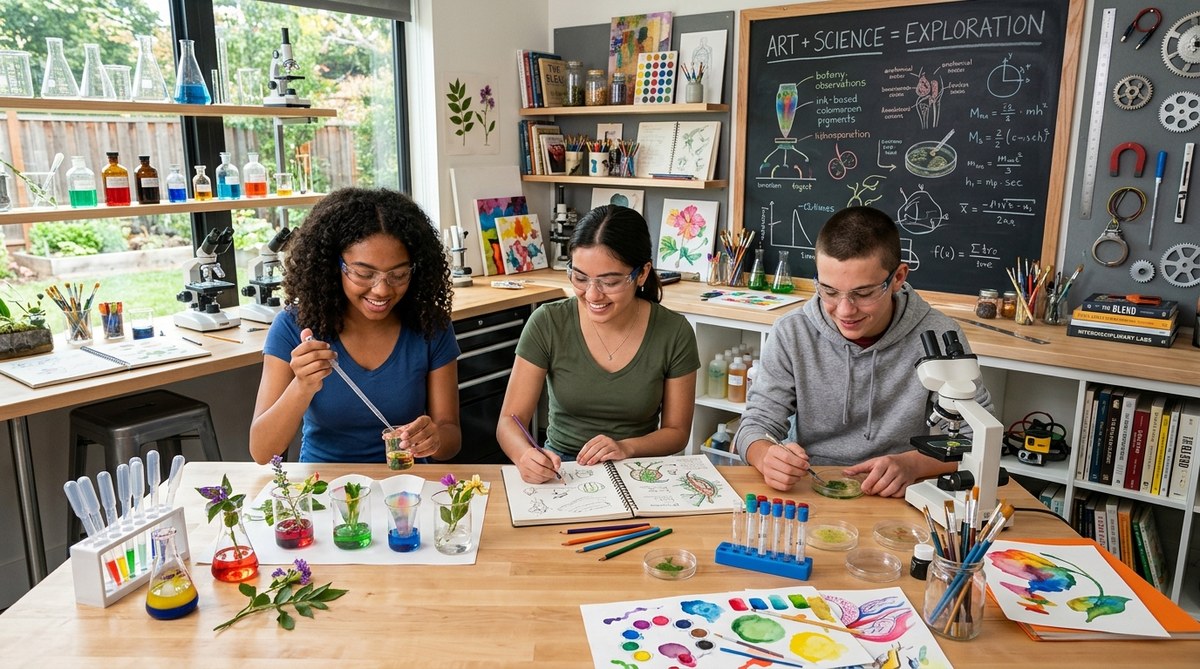
Imagine a room where a microscope sits next to a paintbrush. Where a circuit board becomes a canvas. Where a child asks “what happens if I mix this pigment with iron filings?” and then actually tries it. This is the magic of a curiosity lab a space designed to tear down the wall between art and science. In 2026, more educators, museum curators, and makerspace organizers are realizing that the most powerful learning happens when you let those two worlds collide. But building a lab that truly merges them takes more than just putting beakers and easels in the same room. It takes intention, flexibility, and a willingness to let go of traditional categories.
A successful curiosity lab is not about teaching art and science side by side. It is about creating a single environment where observation, experimentation, and expression feed each other. Start with a guiding question, choose flexible furniture, gather open ended materials, and train facilitators to ask “what if” instead of “that is the right answer”. Every element should invite messy, joyful inquiry.
What a Curiosity Lab Really Is
A curiosity lab is a physical or digital space where people investigate questions that don’t belong to a single discipline. It is not a science classroom with art projects sprinkled in. It is not an art studio with science facts on the wall. Instead, it is a place where a student might build a sculpture that lights up based on air quality data, or where a group of adults might create a visual map of local soil microbes using watercolor and microscope slides.
The goal is to foster what the educator John Dewey called “genuine thinking” the kind that starts with a real problem and then reaches for any tool, any method, any material to solve it. When you merge art and science in a curiosity lab, you are telling learners that creativity belongs in the lab and that logic belongs in the studio.
If you want to see how this thinking applies to regular classrooms, check out our guide on unlocking creativity by merging art and science in your classroom.
Five Steps to Build Your Own Curiosity Lab
Here is a practical process to get from idea to open doors. Adapt these steps to your space, budget, and audience.
-
Start with a big, fuzzy question. Do not begin by buying equipment. Begin by deciding what kind of curiosity you want to spark. For example, “How does light shape our world?” That question leads to optics experiments, color mixing, shadow puppetry, photography, and studies of plant growth. Write your question on the wall. It will guide every decision.
-
Choose furniture that moves and transforms. Forget rows of desks. Use wheeled tables, stackable stools, and rolling carts. You want the ability to reconfigure the lab in minutes. A workshop on sound waves might need a clear floor for movement. A session on pigments might need sturdy tables for grinding and mixing. Flexible furniture makes both possible.
-
Stock materials that blur boundaries. Gather items that are equally at home in a science lab and an art studio. Think: LED lights, conductive thread, copper tape, modeling clay, natural dyes, prisms, magnifying glasses, sensors, scrap wood, and found objects. Do not separate “science supplies” from “art supplies”. Label everything by property: shiny, bendable, magnetic, translucent, conductive, absorbent. Let learners choose based on what they want to test or create.
-
Train facilitators to ask “what do you notice?” The most important tool in a curiosity lab is the facilitator. They should resist giving answers. Instead, they encourage observation. When a child mixes baking soda and vinegar, the facilitator might say “I see bubbles. What else do you see? What do you wonder?” This mirrors the inquiry based learning approach that works across all disciplines.
-
Design for visible process, not just final product. Keep work in progress on display. Use clipboards, whiteboards, and clear bins so that half finished experiments and sketches are celebrated. Let learners document their process with photos and notes. The lab should feel like a workshop, not a gallery.
Common Mistakes and Better Techniques
Many well intentioned labs fail because they treat art and science as separate stations. The table below shows what to avoid and what to try instead.
| Mistake | Better Technique |
|---|---|
| Separate zones for science and art | Intertwined stations: one table might have circuitry materials next to paintbrushes |
| Prescribed experiments with one correct outcome | Open challenges like “design a device that changes color when you breathe on it” |
| Clean, sterile look that discourages mess | Visible storage of raw materials; wipeable surfaces; a “materials wall” where kids grab what they need |
| Adult led demonstrations | Learner led tinkering with facilitators as co learners |
| Timed rotations between activities | Free flow choice periods where learners decide how long to spend on an idea |
When you allow learners to move between tools and ideas on their own, you are practicing the kind of interdisciplinary learning that sparks breakthroughs. Da Vinci himself drew anatomy and designed flying machines in the same notebook.
Essential Materials to Get You Started
You do not need a huge budget. The best curiosity labs are built on simple, versatile items. Here is a starter list:
- Conductive materials: copper tape, LED bulbs, coin cell batteries, alligator clips
- Natural materials: leaves, flowers, soil samples, rocks, shells, food coloring
- Marking tools: charcoal, pastels, watercolor, markers, whiteboard pens
- Observation tools: handheld microscopes, magnifying glasses, scales, thermometers, color cards
- Construction items: cardboard, recycled containers, tape, string, hot glue guns, clay
- Reference items: field guides, color wheels, periodic table posters, art books, nature prints
Put all of these in clear bins on open shelves. Label each bin with a question like “What can you connect?” or “What can you measure?” This invites exploration without a worksheet.
“In a curiosity lab, the materials are the teacher. When you give a child a magnet and a pile of iron filings, you do not need to say a word. The material asks the question. Our job is to make sure the space is ready for that conversation.” Dr. Maria Chen, science education researcher and former museum director
Keeping the Lab Alive Over Time
A curiosity lab is never finished. It evolves with the people who use it. Schedule regular “lab refreshes” where you swap out materials based on seasonal themes or current events. In 2026, for example, you might tie activities to the solar maximum or to a major art biennial. Invite local artists and scientists to co host sessions. Let learners suggest new questions.
If you feel stuck on how to generate ideas that truly blend art and science, our guide on harnessing curiosity to integrate art and science in education offers dozens of project starters.
Also consider creating a “failure wall” where people post what did not work and what they learned from it. This normalizes experimentation and reduces fear of mistakes. It is one of the most powerful ways to sustain a culture of curiosity.
From One Room to a Movement
You do not need a dedicated building to start. A corner of a library, a cart that rolls between classrooms, or a pop up space at a community event can all become a curiosity lab. The key is the mindset: every activity, every material, every question should invite the overlap of art and science.
Start small. Pick one question and gather five materials. Invite a few learners to play. Watch what happens when they are free to combine, test, and create without boundaries. Then build from there.
The world needs more people who can think like artists and scientists at the same time. Building a curiosity lab is your chance to grow them.