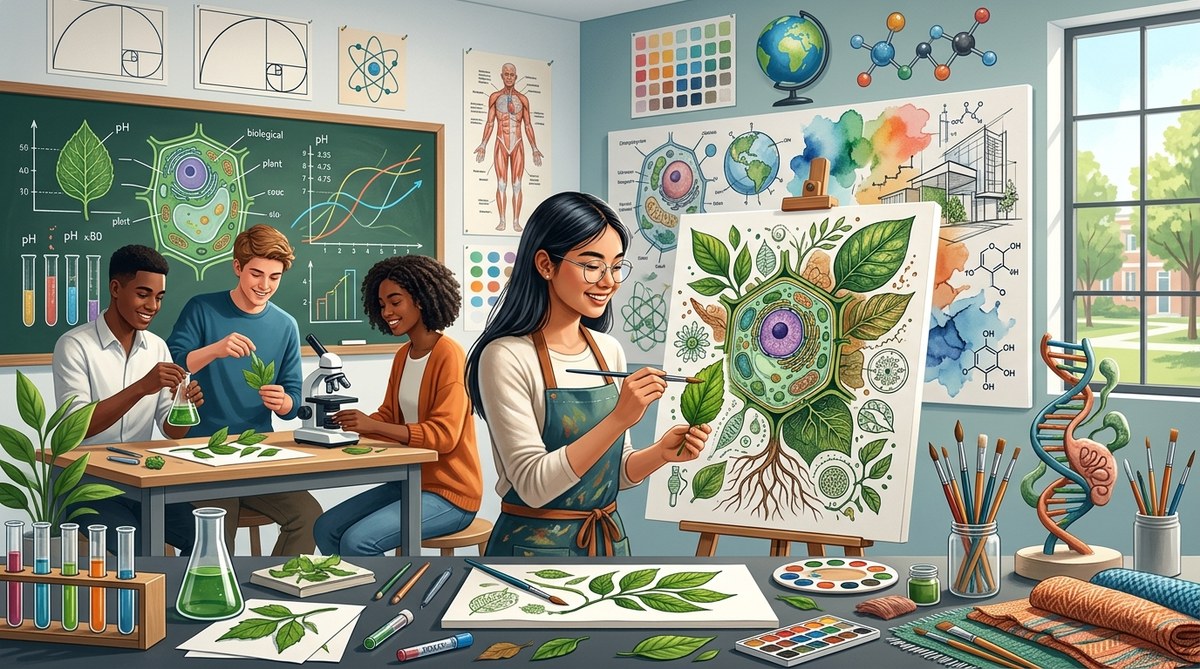
For a long time, schools treated art and science as distant cousins who rarely speak at family reunions. One classroom was all about beakers and formulas, while down the hall students mixed paints and explored emotion. But the truth is, the two disciplines have always shared a secret language: observation, experimentation, and creativity. Leonardo da Vinci knew it. Modern innovators know it. And in 2026, more educators are realizing that combining art and science in lesson plans is not just possible, it is powerful. When you bring these subjects together, students see the world in color AND in data. They ask deeper questions and build richer answers. Here is how you can start.
Art and science are natural partners in learning. By blending hands-on creativity with scientific inquiry, you help students develop critical thinking, visual literacy, and a growth mindset. This guide offers practical steps, real-world examples, and a table of common mistakes so you can confidently design lesson plans that unite both worlds.
Why Combining Art and Science in Lesson Plans Works
When you put a paintbrush next to a pipette, something clicks. Students who struggle with abstract science concepts often find clarity through visual representation. A diagram of a cell becomes a watercolor painting. The phases of the moon become a stop-motion animation. This cross-pollination does more than make class fun. It supports deeper learning.
Research shows that interdisciplinary instruction boosts retention and engagement. When students create something tangible, they own the knowledge. They are not just memorizing facts; they are interpreting, designing, and communicating. That is the heart of combining art and science in lesson plans. It turns passive listeners into active explorers.
Plus, this approach mirrors how the real world works. Architects use physics and aesthetics. Medical illustrators need anatomy and drawing skills. Product designers blend engineering with user experience. By mixing art and science early, you prepare students for careers that do not exist yet. And you give them permission to be curious in more than one way.
How to Start Blending Art and Science in Your Classroom
You do not need a full STEAM overhaul. Start small. Here are five steps to guide you. Each step builds on the last, so you can move at your own pace.
-
Pick a scientific concept that naturally invites visuals. Look for topics like symmetry in biology, color mixing in chemistry, or sound waves in physics. These areas have built-in artistic potential. For example, teaching about light refraction? Have students create a prism painting using water and oil pastels.
-
Choose an art medium that matches the concept. Think beyond crayons. Use clay for modeling molecules, photography for documenting erosion, or digital drawing for mapping the solar system. The medium should help explain the science, not distract from it. When combining art and science in lesson plans, the art should serve the inquiry.
-
Design a guiding question that links both disciplines. Instead of “draw a butterfly,” ask “How does the pattern on butterfly wings help it survive, and how can you illustrate that with pattern and color?” This pushes students to think scientifically and artistically at the same time.
-
Create a simple rubric that values both process and product. Assess scientific accuracy alongside artistic expression. A beautiful poster with wrong facts gets partial credit. A messy sketch that perfectly explains photosynthesis gets high marks for concept. This balance encourages students to care about both.
-
Reflect as a class. After the project, ask: What did you learn about the science? What did you learn about the art? How did one help you understand the other? This reflection cements the connection and shows students that you value the blend.
For more structured support, check out our guide on how to design interdisciplinary projects that ignite student curiosity in 2026. It walks you through planning a full unit from start to finish.
Examples of Combined Art and Science Lessons
Here are three classroom-tested ideas. Each one works for different grade levels and can be adapted to your curriculum.
-
Watercolor ecosystems (Grades 3-6): Students study a local habitat, then paint a layered watercolor scene showing the food chain. They mix colors to represent different species and include written labels with scientific names and roles. This reinforces ecology and color theory at the same time.
-
Sound wave sculptures (Grades 7-10): Using a speaker, a thin membrane, and sand, students visualize sound frequencies. Then they take inspiration from those patterns to create wire sculptures. This links physics with 3D design and helps visual learners grasp wave properties.
-
Geometric nature journaling (Grades 9-12): Students photograph natural objects (leaves, shells, crystals) and trace the geometric forms they see. They then create a series of drawings that combine the organic shape with mathematical grids. This connects geometry, biology, and observational drawing.
These examples show that combining art and science in lesson plans does not require expensive supplies or perfect alignment. It just requires a willingness to let students explore.
Common Pitfalls When Merging Art and Science
Even with good intentions, some lesson plans fall flat. The table below shows frequent mistakes and how to avoid them.
| Pitfall | Why It Happens | How to Fix It |
|---|---|---|
| Art becomes an afterthought | Teachers prioritize scientific content and treat the art activity as a short filler. | Give the art component equal planning time and clear learning goals. Use a rubric that weights both. |
| Science accuracy gets lost | Students focus on making something pretty and forget the facts. | Require a written or oral explanation of the scientific concept alongside the artwork. |
| Materials overwhelm the lesson | Too many supplies lead to chaos and little learning. | Choose one medium per project and prepare a demo. Limit options to foster deeper focus. |
| Projects take too long | Combining disciplines naturally extends time, but schedule pressure kills the experience. | Break the project into smaller phases: one day for research, one for sketching, one for final art. |
| Students see no purpose | Without a clear connection, they think “we are just making crafts.” | Start with a driving question and refer to it throughout the lesson. Show real-world examples. |
Avoiding these pitfalls will make your interdisciplinary lessons stronger and more rewarding for everyone.
Expert Advice: A Teacher’s Take
“I used to think art and science were separate boxes. Then I tried having my eighth graders paint the phases of mitosis. The students who could not memorize the steps suddenly remembered them because they had mixed the colors for each phase and placed them in order on a canvas. Art gave them a mental hook. Now I look for every excuse to combine the two.”
— Jessica Tran, middle school science teacher, Austin, TX
That quote captures the heart of this approach. When students create, they remember. When they see beauty in data, they care more. And when they realize that a scientist can also be an artist, their own identity expands.
If you want to read more about how this shift in mindset can transform a classroom, see our article on why every STEM classroom needs a dose of art (and vice versa).
Moving Forward: Build Your Own Interdisciplinary Lessons
You now have the why, the how, and the what. The next step is action. Pick one lesson from next month’s curriculum and ask yourself: “Where could art live here?” It might be a data visualization, a comic strip, a diorama, or a song. Start with that single moment. See how your students respond. You will likely notice more engagement, better questions, and a classroom that hums with creative energy.
Remember, combining art and science in lesson plans is not about turning every class into an art studio. It is about honoring both ways of knowing. It is about showing students that the world is not divided into left brain and right brain. It is whole. And so are they.
For even more ideas, you might enjoy our collection of 5 interdisciplinary activities that turn students into creative problem-solvers. Each activity is ready to use and adaptable to your grade level.
Go ahead. Mix the paint and the pipette. See what happens. Your students will thank you.