Key Takeaway
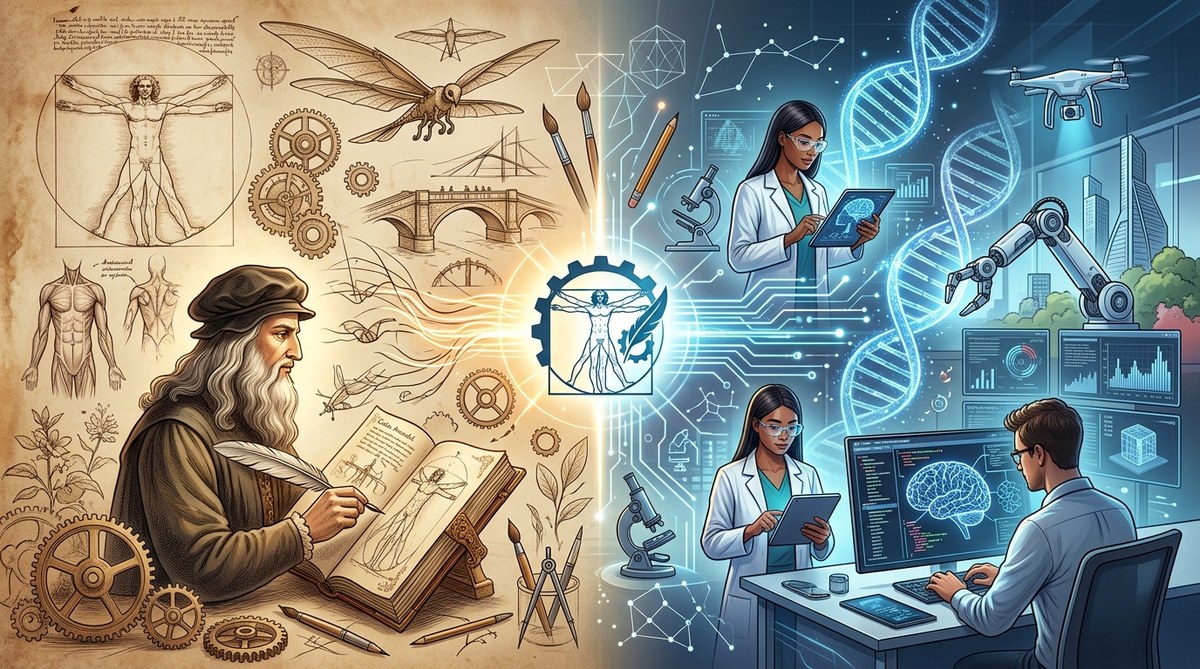
Leonardo da Vinci’s interdisciplinary thinking allowed him to make breakthroughs by combining art, science, anatomy, and engineering. His approach shows that innovation happens when we cross traditional boundaries. This article looks at three habits that fueled his genius, common misconceptions about interdisciplinary learning, and practical steps to apply this thinking in your own work or studies. By following his example, you can connect ideas across different fields and spark your own unique creative breakthroughs.
## The Da Vinci Mindset: Why He Saw No Boundaries Between Art and Science
Leonardo lived during a time when knowledge was still largely separated by guilds and universities. Painters studied color and composition. Engineers focused on mechanics. Doctors dissected bodies. But Leonardo refused to stay in one lane. He believed that understanding the human body was essential for an artist. He thought that studying light and shadow meant understanding physics. So he filled over 7,000 pages of notebooks with observations that blurred the lines between disciplines.
His most famous work, the Mona Lisa, shows this blend. The subtle smile is painted using sfumato, a technique that requires a deep understanding of how light scatters on skin. That understanding came from both artistic practice and scientific study of optics. The Vitruvian Man, another iconic drawing, merges art with mathematics and anatomy. Leonardo didn’t just draw a man. He illustrated the proportional relationships that Vitruvius, a Roman architect, had described centuries earlier.
In every project, Leonardo asked questions that crossed fields. Why do birds flap their wings a certain way? How does blood flow through the heart? What causes fossils to end up on mountain tops? Each question pulled him into a different discipline. And each answer informed his other work.
## Three Habits That Fueled His Interdisciplinary Genius
1. **Relentless observation of nature.** Leonardo spent hours watching water flow, leaves move in the wind, and muscles contract. He wrote down everything he saw, often with sketches. This habit turned natural phenomena into a library of patterns he could apply anywhere. A engineer designing a bridge might study how a river carves its bank. A painter might watch how light changes on a face at different times of day. Observation became his bridge between fields.
2. **Asking “why” across domains.** Most people accept that the sky is blue. Leonardo asked why. He also asked why the heart has four chambers, why trees grow in rings, and why a bird’s wing is shaped the way it is. By never settling for surface answers, he uncovered principles that applied to art, science, and engineering alike. The same curiosity led him to design war machines, study geology, and paint the Last Supper. Each “why” opened a new door.
3. **Connecting disparate ideas on purpose.** Leonardo actively looked for links between things that seemed unrelated. He noticed that the spirals in a snail’s shell and the swirl in a whirlpool followed the same pattern. He saw how the muscles in a horse’s leg and the cables in a crane both transfer force. These connections often sparked inventions. When he needed to design a flying machine, he studied bird anatomy, bat wings, and even kites. By connecting ideas he formed solutions that others missed.
## How You Can Adopt This Approach Today
You do not need to be a genius to think like Leonardo. You just need to stretch your curiosity across fields. Here are some simple ways to start:
– Keep a notebook of observations. Write down things you notice in nature, technology, or daily life. Include sketches or diagrams.
– Read one article each week from a field outside your own. If you’re in tech, read about biology. If you’re an artist, read about physics.
– Ask someone from a different profession how they solve problems. A musician might approach rhythm in a way that helps a project planner.
– Look for patterns. Do you see spirals, branches, or waves in more than one place? Record them and think about why they repeat.
– Combine two hobbies. If you like woodworking and gardening, build a raised bed that mimics a natural ecosystem.
When you approach learning this way, you train your brain to make connections. Over time, these connections become automatic.
## Common Misconceptions About Interdisciplinary Learning
Many people think they have to be an expert in everything to blend fields. That is not true. Leonardo was not an expert in all areas he studied. He made mistakes. Some of his engineering designs never worked. But he learned from each failure and kept moving. The table below shows a few common mistakes and what works better.
| Mistake | Better Approach |
|———|—————-|
| Thinking you must master one subject before trying another | Start with beginner level in multiple areas and let them inform each other |
| Believing creativity and logic are separate | Treat creativity as a tool for generating ideas and logic as a tool for testing them |
| Waiting for the perfect time or project to blend fields | Start small: pose a question that requires two disciplines to answer |
| Sticking only to books or formal courses | Use hands on experience: build, draw, experiment |
The goal is not to become a Renaissance person overnight. It is to develop a habit of looking at problems from multiple angles.
## What Modern Innovators Can Learn from Da Vinci
> “His genius was not that he knew more than everyone else. It was that he connected what he knew in ways no one else did.”
> — Walter Isaacson, biographer of Leonardo da Vinci
Isaacson’s quote captures the essence of interdisciplinary thinking. In 2026, this skill matters more than ever. Problems like climate change, healthcare access, and digital privacy cannot be solved by one field alone. Engineers need ethicists. Biologists need designers. Artists need data scientists.
Take the example of medical imaging. Radiologists rely on physics to capture images, biology to interpret them, and often design thinking to present results clearly to patients. The best innovations happen when someone with a background in one area brings fresh eyes to another. A musician might notice patterns in heart sounds that a cardiologist overlooks. A painter might create a visualization that makes complex data understandable.
By studying Leonardo’s method, you give yourself permission to explore beyond your job title or major. That exploration often leads to breakthroughs.
## Practical Ways to Blend Disciplines in Your Work or Studies
Here is a four step process you can use this week:
1. **Pick a problem you care about.** It could be a project at work, a class assignment, or a personal hobby. Write it down.
2. **List three fields that touch that problem.** For example, if you want to design a public park, you might list landscape architecture, sociology, and environmental science.
3. **Find one resource from each field.** Read a short article, watch a video, or talk to someone who works in that area. Take notes on ideas that seem relevant.
4. **Combine two of those ideas into a single concept.** Sketch it out. Discuss it with a friend. The goal is to produce something new, even if it is rough.
This process mirrors how Leonardo worked. He would take a principle from anatomy (like muscle movement) and apply it to mechanics. You can do the same with fields that interest you.
If you are an educator, you can use a similar structure in your classroom. Consider reading about how to design interdisciplinary projects that ignite student curiosity. Many schools in 2026 are shifting toward project based learning that combines subjects. The same principles apply.
## Bringing the Renaissance Spirit into 2026
Leonardo da Vinci died over 500 years ago, but his method of learning is more relevant today than ever. Information is everywhere. Specialization is common. Yet the most exciting discoveries still happen at the intersection of fields. When you let art inform science and science inspire art, you open doors that a single discipline cannot open alone.
Start small. Choose one thing you are curious about this week and look at it through a different lens. If you are a writer, study how musicians build tension. If you are a coder, look at how architects organize space. The connections you make will surprise you.
And remember: you do not need to be perfect. Leonardo left many projects unfinished. But every time he blended two subjects, he learned something new. You can too.
So grab a notebook. Ask a question that crosses boundaries. Let your curiosity lead you into unexpected places. That is how breakthroughs happen.
]]>