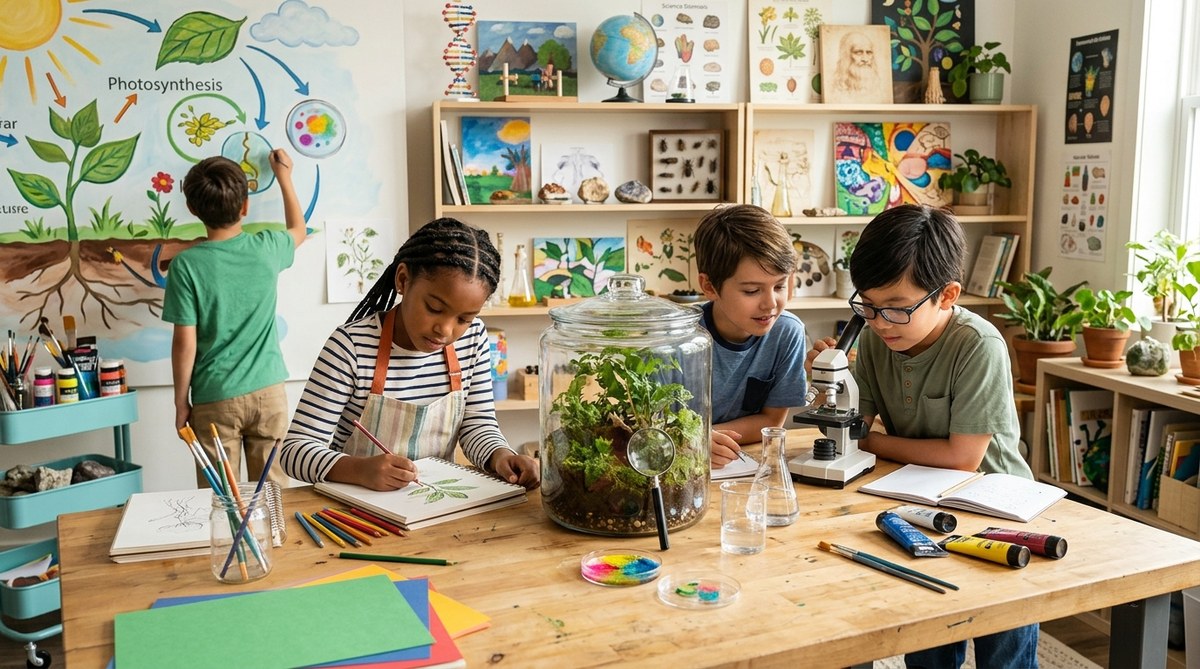
A third-grade student holds a magnifying glass over a sprouting bean seed. On the desk beside her, a watercolor sketch captures the exact curl of the root and the faint purple veins in the cotyledon. She is not just learning about germination. She is training her eye to see detail, training her hand to record data, and training her brain to connect two ways of knowing. This is what happens when you build a classroom ecosystem where art and science are not separate subjects but partners in discovery.
A classroom ecosystem that blends art and science does not require a complete curriculum overhaul. It starts with small, intentional shifts: using observation sketches in science journals, designing data visualizations that are both accurate and beautiful, and framing project-based learning around questions that demand both creative and analytical thinking. The result is deeper engagement and stronger retention for every student.
Why a Blended Classroom Ecosystem Works
The traditional model separates subjects into neat boxes. Science from 9:00 to 9:45. Art after lunch. But the brain does not learn that way. When students move from a dissection lab to a drawing studio, their brains carry the vocabulary and concepts across the hallway. A classroom ecosystem that keeps art and science in the same room allows those connections to happen organically.
Children in grades K-8 are naturally curious. They ask why the sky is blue and then try to mix that color with paint. A classroom ecosystem built on STEAM principles meets that curiosity head-on. Instead of saving creativity for Friday afternoon, you weave it into every investigation.
The Core Components of an Art-Science Ecosystem
Building this ecosystem means changing how you arrange your space, how you plan your lessons, and how you assess student growth. Here are the four pillars that support a thriving art-science classroom.
1. Observation as a Shared Skill
Scientists and artists both start with observation. A botanist studies the vein pattern on a leaf. A botanical illustrator draws it. The skill is the same: careful, patient looking.
- Set up a weekly “slow looking” routine where students spend 10 minutes examining a natural object (a shell, a feather, a rock) and then draw it from memory.
- Rotate objects from a collection bins. Include items tied to your science unit. During a weather unit, use cloud photographs. During a geology unit, use mineral samples.
- Let students compare their drawings across weeks. They will notice how their observation skills improve.
2. Data Visualization That Blends Accuracy and Beauty
Students in upper elementary and middle school often struggle to see data as meaningful. When you ask them to turn a bar graph into an artistic infographic, the numbers become personal.
| Technique | Common Mistake | Better Approach |
|---|---|---|
| Graph design | Using clip art that distracts from data | Let the data shape the art (e.g., bar height determines paint color gradient) |
| Color choice | Picking colors randomly | Use a color scale that reflects the data (cool blues for low numbers, warm reds for high) |
| Labels | Tiny, unreadable fonts | Hand-letter labels as part of the composition |
| Layout | Crowding all elements | Leave 20% white space for the eye to rest |
3. Project-Based Learning That Demands Both Disciplines
The best projects in a classroom ecosystem do not ask students to do art and science. They ask students to do art through science and science through art.
Here is a numbered process you can follow for any cross-curricular project:
- Start with a driving question that cannot be answered by one subject alone. For example: “How can we design a bird feeder that attracts the most species while using recycled materials?”
- Let students research the science of bird behavior and local ecosystems. They should take field notes and make quick sketches.
- Move to the design phase. Students sketch three different feeder prototypes. They label materials, dimensions, and placement strategies.
- Build and test. Students construct their feeders and collect data on which designs attract birds. They photograph and document the process.
- Create a final scientific illustration or infographic that explains the results. This is the art component. It must be accurate, but it can also be beautiful.
- Host a gallery walk where students present their feeders and their illustrations. Peers give feedback using both scientific and artistic criteria.
“The students who struggle with traditional tests often shine during a gallery walk. They can explain their thinking, defend their design choices, and point out details in their drawings that reveal deep understanding.” — Rebecca Reynandez, elementary STEAM coordinator.
Practical Lesson Ideas for Your Classroom Ecosystem
You do not need a dedicated makerspace or a big budget. These activities work with standard classroom supplies.
For Grades K-2: Color Mixing and Light
Set up a station with flashlights, colored cellophane, and white paper. Students predict what happens when they shine a red light through blue cellophane. They test their predictions and then create a “light painting” by layering cellophane shapes on a light table. This teaches the science of light absorption and color theory at the same time.
For Grades 3-5: Ecosystem Dioramas With a Data Twist
Instead of a standard shoebox diorama, ask students to build a 3D model of a local ecosystem that includes a “data key.” Each plant or animal in the diorama must have a small tag that shows its role in the food web and its population trend over the last decade. The art is the diorama. The science is the research and data representation.
For Grades 6-8: Scientific Illustration of Local Species
Partner with a local nature center or park. Students choose a native species to study. They research its habitat, life cycle, and conservation status. Then they create a full-page scientific illustration using watercolor or colored pencil. The illustration must include labeled diagrams, a scale bar, and a written field note. This project teaches biology, art technique, and technical writing.
For more structured guidance on setting up these routines, read our guide on how timed observation sketches teach scientific thinking in any grade.
Common Pitfalls and How to Avoid Them
Teachers who try to blend art and science often run into a few predictable problems. Knowing them in advance helps you plan around them.
- Pitfall: Treating art as decoration. If you ask students to “draw a plant” after a science lesson, the art is just a craft. Instead, ask them to draw the plant and label the parts that perform photosynthesis. The drawing becomes a thinking tool.
- Pitfall: Grading art on artistic skill. Not every student can draw well. Grade the scientific accuracy of the labels, the completeness of the observation, and the effort shown. Artistic skill improves with practice, but it should not be a barrier to participation.
- Pitfall: Running out of time. A blended lesson can take longer than a single-subject lesson. Plan for this by combining two 45-minute periods into one 90-minute block once a week. Use that time for your art-science project.
If you want to go deeper into how to structure these longer blocks, check out our article on how to design interdisciplinary projects that ignite student curiosity in 2026.
Assessing Learning in a Blended Ecosystem
Traditional tests often miss the depth of understanding that comes from art-science projects. Consider these assessment strategies instead.
- Portfolio review. Collect student sketches, data sheets, and final illustrations over a unit. Look for growth in observation detail, scientific vocabulary use, and design choices.
- Peer feedback sessions. Give students a simple rubric with two columns: “Scientific accuracy” and “Visual clarity.” Have them trade work and write one piece of feedback for each column.
- Self-reflection prompts. Ask students to write a short paragraph answering: “What did you learn about this topic by drawing it that you might not have learned by reading about it?”
Supplies That Support Both Art and Science
You do not need expensive equipment. Focus on versatile materials.
- Sketchbooks (one per student, used for both science observations and art practice)
- Colored pencils and watercolor sets (watercolor allows for layering and transparency, which mirrors scientific concepts)
- Magnifying glasses and hand lenses
- Clipboards for outdoor sketching
- A classroom collection of natural objects (leaves, seed pods, rocks, feathers)
- A light table or light box (can be DIY with a clear plastic bin and a string of LED lights)
A Note on Standards Alignment
Many teachers worry that blending subjects means missing standards. In reality, a well-designed art-science lesson can hit multiple standards at once.
- A lesson on symmetry in butterfly wings addresses both the NGSS standard on structure and function (4-LS1-1) and the National Core Arts Standard on structure in visual art (VA:Cr1.1.4a).
- A project building a model of a watershed covers NGSS on Earth systems (5-ESS2-2) while also addressing the art standard on using materials to create form (VA:Cr2.1.5a).
For a full breakdown of how to align your projects, see our resource on where visual art and math standards meet in the K-8 classroom.
Bringing the Ecosystem to Life With Student Questions
The most sustainable classroom ecosystem is one that runs on student curiosity. When a student asks a question during science time, write it down. Then ask the class: “How could we explore this question using art?” When a student notices a color mixing effect during art time, ask: “What scientific principle is causing that?”
This habit builds a culture where art and science are not scheduled events. They are lenses for seeing the world. Over time, students stop asking “Is this art or science?” They simply start investigating.
Your Next Step
Pick one small change for this week. Maybe you add a 10-minute observation sketch to the start of your science lesson. Maybe you let students create a visual data display instead of a worksheet. See how it feels. Watch how your students respond.
A classroom ecosystem where art and science thrive together does not appear overnight. It grows. One sketch at a time. One question at a time. One connection at a time. You already have everything you need to start.
For more ideas on building these routines, read about how art sketchbooks deepen student thinking in science investigations. And when you are ready to take the next step, our article on why inquiry-based learning is the key to mastering both art and science will help you go further.