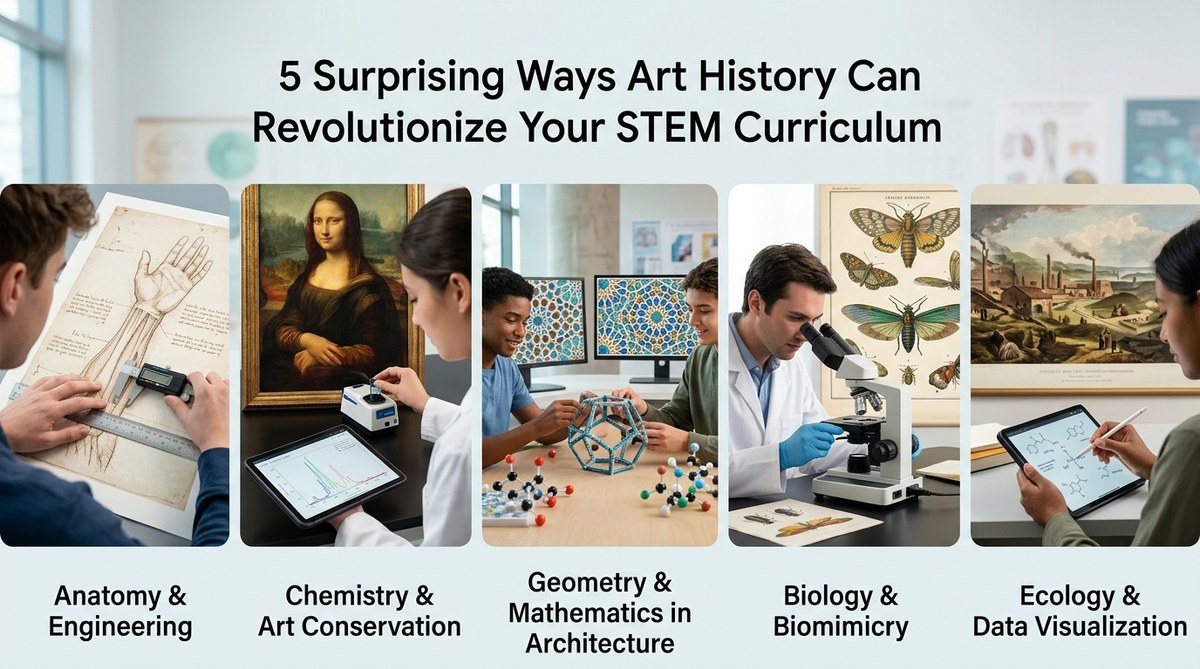
When you picture a STEM classroom, your mind probably lands on beakers, circuit boards, or rows of calculators. It does not usually land on a Renaissance painting or a Greek sculpture. But the most memorable learning happens when we cross those boundaries. Art history is not just a subject for museum visits. It is a powerful tool that can transform how students understand scientific concepts. By looking at how artists solved problems of light, structure, and material, students start to see science as a creative act. This approach makes abstract ideas feel concrete and human. And it turns a standard lesson into a discovery.
Integrating art history into STEM curriculum does not mean adding an extra subject. It means using works of art as primary sources for scientific inquiry. Students learn to observe closely, ask better questions, and see the human story behind every formula. This approach boosts engagement, deepens retention, and prepares students for a world that needs creative problem solvers.
Why Art History Belongs in Your STEM Classroom
The divide between art and science is a modern invention. For centuries, the greatest minds moved freely between both worlds. Leonardo da Vinci studied anatomy to paint more realistic figures. Isaac Newton studied optics and color theory. Today, we separate these fields in school, but the real world does not work that way. When you bring art history into your STEM lessons, you give students a reason to care. A painting becomes a data set. A sculpture becomes a physics problem. This is not about making science softer. It is about making it stick.
Think about the last time a student asked, “When will I ever use this?” Art history provides an answer. The geometry in a cathedral vault is the same geometry used in bridge design. The pigments in a Renaissance painting are chemistry in action. By grounding concepts in a visual story, you give students a hook for their memory. They remember the painting of the stormy sea, and suddenly they remember the wave patterns too.
The Science of Seeing: Observation Skills
One of the biggest challenges in STEM education is teaching students to observe carefully. Many students look at a specimen or a data table and see nothing unusual. They need to train their eyes. Art history is the perfect tool for this.
How to Use Visual Analysis in Science Class
- Start with a single artwork. Project a painting like “The Starry Night” by Vincent van Gogh. Ask students to describe what they see without using any interpretations. Only facts.
- Move to scientific observation. After five minutes of pure description, ask students to apply the same method to a scientific image. A cell under a microscope, a weather satellite photo, or a crystal formation.
- Compare the two. Students will notice that both tasks require the same skill: noticing details, measuring proportions, and questioning what they see.
- Repeat the cycle. Over time, this practice builds a habit of close looking that transfers to lab work and field studies.
This method works because it lowers the stakes. Students feel confident talking about a painting. That confidence carries over into their scientific observations. For more ideas on building this habit, read about how art sketchbooks deepen student thinking in science investigations.
A Practical Framework for Lesson Design
You do not need to be an art historian to use art in your STEM curriculum. You just need a simple structure. Here is a table that contrasts common mistakes with effective approaches.
| Common Mistake | Better Approach |
|---|---|
| Showing art as a decoration or reward | Using art as the central source of data |
| Asking students to “appreciate” the art | Asking students to measure, count, or analyze the art |
| Teaching art history separately from the STEM topic | Weaving the art history into the same lesson as the science |
| Assuming students have prior art knowledge | Providing a short context card for each artwork |
| Focusing only on famous paintings | Including sculptures, textiles, architecture, and prints |
When you design a lesson, start with your STEM goal. Then find a work of art that illustrates that concept. For example, if you are teaching about tensile strength, look at suspension bridges and compare them to the woven fiber structures in ancient Andean textiles. The students are still learning physics, but they are also seeing how people solved engineering problems without modern materials.
Three Surprising Connections That Work
Perspective and Geometry
The invention of linear perspective during the Renaissance was a mathematical breakthrough. Filippo Brunelleschi used mirrors and geometry to create the illusion of depth. When students learn about vanishing points and horizon lines, they are learning about proportional relationships. You can have them draw a simple city street using one-point perspective. Then ask them to calculate the ratios between the buildings. This activity connects directly to lessons on scale, proportion, and even coordinate geometry. For a deeper look at this connection, check out where visual art and math standards meet in the K-8 classroom.
Pigments and Chemistry
Every color in an old painting tells a chemical story. The vibrant blue in a medieval manuscript came from lapis lazuli, a stone ground into powder. The white lead used by Dutch painters was toxic and required careful handling. You can turn this into a chemistry lab. Have students research the chemical composition of historical pigments. Then try to recreate them using safe, modern substitutes. This activity teaches chemical formulas, reactions, and safety protocols. It also shows students that chemistry is not abstract. It is the reason we have color at all.
Anatomy and Sculpture
Michelangelo did not just sculpt the human form from imagination. He dissected cadavers to understand muscle and bone structure. His sculptures are essentially anatomical studies. In a biology class, you can use images of his sculptures to teach muscle groups. Ask students to identify which muscles are engaged in a particular pose. Then have them draw a simplified version of the same pose, labeling the major muscle groups. This approach is more engaging than a textbook diagram because it connects to a famous work of art. You can learn more about this technique in the guide on how timed observation sketches teach scientific thinking in any grade.
Common Pitfalls to Avoid
Even with the best intentions, some approaches fall flat. Here are the most common mistakes and how to avoid them.
- Forcing the connection. Not every STEM topic has a clear art history link. That is fine. Use art when it fits naturally. Do not stretch a lesson just to include a painting.
- Ignoring student context. Some students may feel intimidated by art. They might say “I am not an artist.” Remind them that this is not about making art. It is about looking and thinking.
- Using art as a reward. If you show a painting only after the “real” work is done, students will see it as a break. Instead, integrate it into the core activity.
- Neglecting non-Western art. Art history is global. Include examples from African, Asian, Indigenous, and Latin American traditions. This broadens the scientific knowledge base and shows diverse ways of thinking.
“The best science lessons feel like detective stories. Art history gives us the clues. It asks students to look at evidence, form a hypothesis, and test it against what they see. That is the heart of inquiry.” – Dr. Maria Santos, curriculum designer and STEAM specialist.
A Sample Lesson: The Physics of a Vaulted Ceiling
Let us put this into practice with a concrete example. This lesson works for grades 6 through 9.
Topic: Force distribution and arch structures
Art History Focus: Gothic cathedrals (Chartres, Notre Dame)
Materials: Images of cathedral interiors, cardboard strips, weights (small bags of rice or pennies), tape, and scissors.
Steps:
- Show students an image of a Gothic cathedral ceiling. Ask them what they notice about the shape. Guide them to see the pointed arches and the ribbed vaults.
- Explain that these arches distribute weight downward and outward. The flying buttresses on the outside were a structural solution to keep the walls from collapsing.
- Challenge students to build a simple arch using cardboard strips. They must test how much weight their arch can hold before it buckles.
- Compare results. Which shapes held the most weight? How does this relate to the design of the cathedral?
- Connect to modern engineering. Show images of bridges or airplane fuselages that use similar curved structures.
This lesson teaches physics through a cultural lens. Students see that engineering is not just about numbers. It is about solving real problems that people faced hundreds of years ago. For more project ideas like this, see how to design interdisciplinary projects that ignite student curiosity in 2026.
Why This Matters for Your Students Right Now
The world is changing. Problems like climate change, public health, and sustainable energy do not fit inside one subject. They require people who can think across disciplines. When you teach students to combine art history with STEM, you are teaching them to be flexible thinkers. You are showing them that creativity and logic are not opposites. They are partners.
Students also benefit from seeing themselves in the curriculum. Art history includes the work of people from every background. When a student sees a scientific principle applied in a piece of art from their own culture, they feel a sense of belonging. This is especially important in fields where certain groups have been historically underrepresented. By broadening the examples you use, you broaden the door for who can see themselves as a scientist or engineer.
A Toolkit for Getting Started
If you are ready to try this in your classroom, here is a list of actions you can take this week.
- Choose one STEM concept you are teaching in the next month. Find one work of art that illustrates it. Use Google Arts and Culture or a museum website.
- Print a high-quality image of the artwork. Display it during the lesson. Refer to it as a data source, not a decoration.
- Prepare three open-ended questions about the artwork that relate to your STEM topic. For example: “What forces are acting on this structure?” or “How was this material transformed?”
- Let students lead the discussion. Give them time to look and think before you provide answers.
- Reflect on what worked. Adjust for next time.
For a deeper look at how to build a whole unit around this idea, read about running art-integrated science lessons built around student questions.
Your Next Step Toward an Interdisciplinary Classroom
Integrating art history into your STEM curriculum does not require a new textbook or a budget increase. It requires a shift in perspective. You already have the scientific knowledge. You just need to add a few images and a willingness to let students make connections. Start small. Try one lesson this month. See how your students respond. You might be surprised by the questions they ask and the ideas they generate.
The goal is not to turn every STEM teacher into an art historian. The goal is to create curious, observant, and flexible thinkers. And that is something every teacher can do. If you want more guidance, consider reading about why inquiry-based learning is the key to mastering both art and science. It will give you a framework for building even deeper connections between the subjects.
You have the tools. You have the curiosity. Now go look at a painting and see what science is hiding inside it.