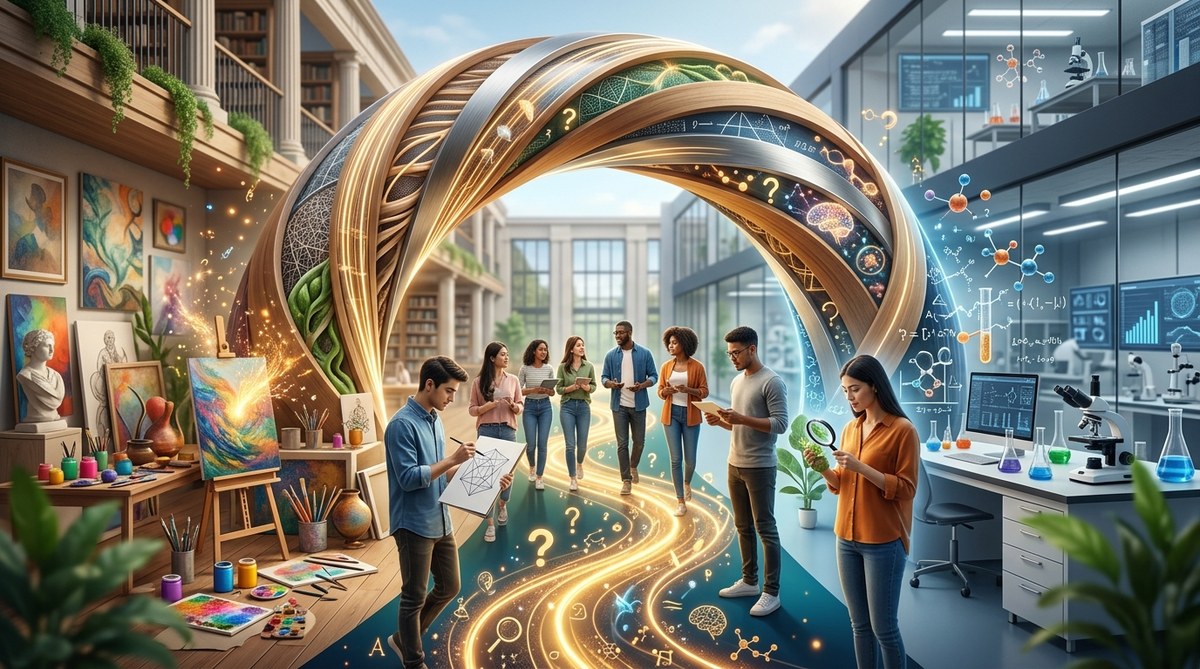
Picture a classroom where students aren’t just memorizing formulas or copying paintings. They’re asking their own questions. They’re mixing pigments to understand chemical reactions, or using geometry to design a sculpture. That’s the power of curiosity-driven learning in action. It doesn’t treat art and science as separate worlds. Instead, it uses the natural human urge to ask “why” and “how” as the bridge between them. For educators and creative professionals in 2026, this approach isn’t just a nice idea. It’s a practical way to build thinkers who can move between analytical problem-solving and creative expression without skipping a beat.
Curiosity-driven learning works because it mirrors how the brain naturally seeks patterns and meaning. When you let genuine questions guide the journey between artistic observation and scientific inquiry, students retain more, think more flexibly, and develop skills that serve them in any field. This guide shows you how to build that bridge.
Why Curiosity Is the Missing Link
Schools often teach art and science as if they live in different buildings. Art is for feeling. Science is for thinking. But that division ignores how real learning happens. When a child sees a rainbow and asks where it comes from, they’re doing both science and art at the same time. They’re noticing color, light, and beauty while wondering about refraction and wavelengths.
The brain doesn’t sort information into neat subject folders. It connects new ideas to existing ones based on interest and emotion. Curiosity is the engine that drives those connections. Research from neuroscience shows that when we’re curious, our brains release dopamine. That chemical signal makes us more receptive to new information and helps us remember it longer. It also primes the hippocampus, the part of the brain responsible for forming long-term memories.
This is why curiosity-driven learning is so effective at bridging art and science. It bypasses the artificial walls we’ve built between subjects and goes straight to the natural learning process. A student who wonders why certain colors evoke specific emotions is asking a question that touches on art history, psychology, and optics all at once.
What Happens When You Let Curiosity Lead
When you build learning around student questions instead of textbook chapters, something shifts. The learner becomes an active participant rather than a passive receiver. This is especially powerful at the intersection of art and science, where questions rarely fit into a single category.
Consider a classroom studying light. A traditional science lesson might explain the electromagnetic spectrum. An art lesson might talk about color theory. But a curiosity-driven approach starts with a question like “Why does the sky change color at sunset?” From there, students might paint the sky at different times of day, measure the angle of the sun, learn about atmospheric scattering, and study how painters like Monet captured those same changes.
The result is deeper learning that sticks. Students don’t just memorize facts about wavelengths. They understand how light behaves because they’ve seen it, painted it, and measured it. They’ve followed their own curiosity from art to science and back again.
“The most creative scientists and the most rigorous artists share one trait: they never stop asking questions. Curiosity is the common language they all speak.”
Dr. Maria Santos, Director of Interdisciplinary Studies at the Center for Applied Learning
Three Core Practices for Curiosity-Driven Learning
If you want to bring this approach into your classroom or your own learning practice, focus on these three areas.
1. Start with a Question, Not an Answer
Every lesson should begin with an open-ended question that sparks genuine curiosity. Not “What is photosynthesis?” but “How does a tree turn sunlight into food, and why are leaves green instead of blue?” That second question invites both scientific investigation and artistic observation.
2. Build Projects That Cross Boundaries
Design activities that require both analytical and creative thinking. A project about the Fibonacci sequence could involve drawing spirals, measuring natural objects, and writing a reflection on why nature repeats patterns.
3. Create Space for Wandering
Not every question leads to a neat answer. Some of the best learning happens when you follow a tangent. Give yourself or your students time to explore side questions. That’s often where the most interesting connections emerge.
A Practical Framework for Designing Curiosity-Driven Lessons
Here is a numbered list of steps you can use to plan any lesson or project that bridges art and science.
- Identify a compelling anchor question. Choose something that can’t be answered with a single Google search. “How do artists and scientists both use observation to understand the world?” is a good example.
- Map the art and science connections. List at least three art-related skills and three science-related skills that apply to the question. For the observation question, those could include drawing techniques, note-taking methods, and an understanding of how the eye processes light.
- Design a hands-on activity. Make sure students are doing something, not just listening. They could create detailed observational sketches of a natural object, then write a scientific description of the same object.
- Build in reflection time. Ask learners to write or talk about what they noticed. How did the artistic process inform their scientific understanding, and vice versa?
- Let the next question emerge. End each session by asking “What are you still wondering about?” Use those answers to plan the next lesson.
If you want to see this framework in action, check out this guide on designing interdisciplinary projects that ignite student curiosity in 2026.
Common Mistakes and Better Approaches
Even well-intentioned efforts to blend art and science can go wrong. Here is a table that shows common mistakes and what to do instead.
| Mistake | Why It Fails | Better Approach |
|---|---|---|
| Forcing connections where none exist | Students see the activity as gimmicky | Let the question guide the connection naturally. If it feels forced, skip it. |
| Treating art as decoration for science | Art becomes a secondary activity, not a thinking tool | Give art equal weight. Ask students to make artistic choices and explain them. |
| Ignoring the emotional side of learning | Lessons feel dry and academic | Include activities that evoke wonder, beauty, or surprise. Those feelings drive curiosity. |
| Sticking to one medium | Limits the kinds of questions students can ask | Offer multiple ways to explore: drawing, writing, building, measuring, performing. |
What the Research Tells Us
Studies from the last five years support what many teachers have suspected. Curiosity-driven approaches improve retention and transfer of knowledge. A 2024 study from the University of Chicago found that students who learned science concepts through art-integrated projects scored 23 percent higher on tests of conceptual understanding than students who learned through traditional methods. The effect was strongest for students who had previously struggled with science.
Another study from the National Academy of Sciences showed that curiosity activates the brain’s reward system more strongly than external rewards like grades or prizes. This means that when students are genuinely curious, they don’t need stickers or points to stay motivated. The learning itself becomes the reward.
For a deeper look at the research, this article on why inquiry-based learning is the key to mastering both art and science covers the evidence in more detail.
The Skills That Curiosity Builds
When you practice curiosity-driven learning at the intersection of art and science, you build more than subject knowledge. You develop a set of transferable skills that matter in any career.
- Pattern recognition: You learn to see connections that others miss.
- Tolerance for ambiguity: You get comfortable with questions that don’t have clear answers.
- Creative problem-solving: You draw from multiple disciplines to find solutions.
- Observational precision: You train yourself to notice details, whether in a painting or a data set.
- Resilience: You learn that not knowing something is the start of learning, not the end.
These skills are exactly what employers in 2026 are looking for. A LinkedIn analysis of job postings found that “interdisciplinary thinking” was one of the top five requested skills across creative and technical fields.
How to Start Tomorrow Morning
You don’t need a full curriculum overhaul to begin. Here are small actions you can take right away.
- Replace one worksheet with a question journal. Ask students to write three questions they have about the topic.
- Pair a science observation with a sketch. Have students draw what they see under a microscope, then label their drawings.
- Read a poem about a scientific concept. Discuss how the poet’s description compares to a textbook definition.
- Take a walk outside. Ask everyone to notice one thing that combines art and science, like the pattern of veins on a leaf or the way light filters through clouds.
For more ideas, you can read about 5 interdisciplinary activities that turn students into creative problem-solvers.
A Note for Lifelong Learners
This approach isn’t just for classrooms. If you’re a creative professional or a lifelong learner, you can apply the same principles to your own growth. Pick a topic you’re curious about. Find one book, one video, and one hands-on activity related to it. Make sure at least one of those resources comes from a field you don’t usually study. Then follow the questions that come up.
The goal isn’t to become an expert in everything. It’s to build the habit of connecting ideas across boundaries. That habit is what leads to innovation, whether you’re designing a building, writing a novel, or developing a new medical device.
Why This Matters More Than Ever in 2026
We live in a time of rapid change. Artificial intelligence can write essays and generate images. The problems we face, from climate change to public health, don’t fit neatly into one discipline. The people who will solve those problems are the ones who can think across boundaries. They can analyze data and tell a story. They can design a experiment and a sculpture. They can ask questions that no algorithm would think to ask.
Curiosity-driven learning is the training ground for that kind of thinking. It teaches us to be comfortable with not knowing, to ask better questions, and to find beauty in the patterns of the natural world. It reminds us that art and science were never really separate. They’re just different ways of asking the same question: What is this world, and how do we make sense of it?
To see how other educators are putting this into practice, take a look at this resource on creating a curiosity-driven classroom that bridges disciplines in 2026.
Your Next Step
Start small. Pick one question this week that you genuinely don’t know the answer to. Follow it wherever it leads. Draw something. Measure something. Write about it. Notice how the boundaries between art and science start to blur. That blur is where the real learning lives. And it’s available to anyone willing to stay curious.