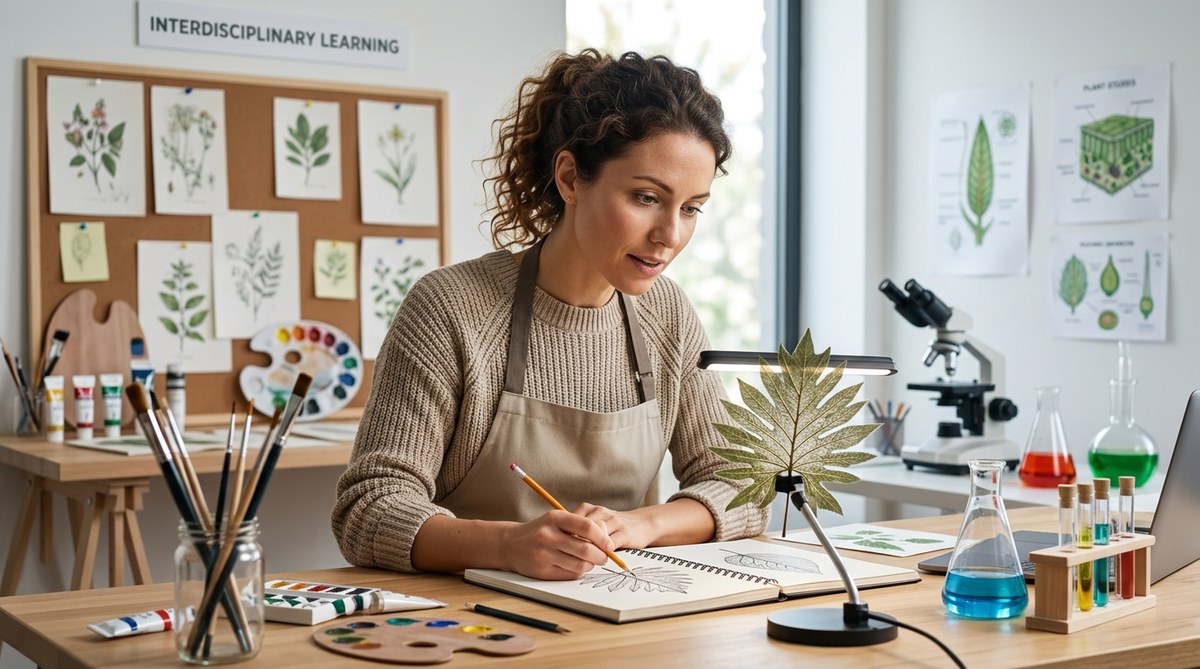
Artistic observation and scientific inquiry share a common foundation: the ability to see with intention. By training your eye through sketching, questioning, and comparing contexts, you can strengthen both creative and analytical thinking. This guide offers practical steps and historical examples to help teachers, students, and lifelong learners bridge the gap between disciplines.
The way a painter studies a landscape and a biologist examines a cell are not so different. Both require patience, precision, and a willingness to see what others miss. This shared skill set is at the heart of the art and science connection, a bond that has driven human understanding for centuries.
When you sit down to draw a leaf, you notice its veins, the way light catches the edge, the subtle gradient of green. When you conduct a lab experiment, you watch for color changes, measure temperature shifts, record every detail. Both acts demand focused attention. Both reward the curious mind. In 2026, classrooms and studios are rediscovering this ancient truth: the best discoveries happen when we stop rushing and start seeing.
The Shared Art of Noticing
Observation is not passive. It is an active, deliberate practice. Artists call it “learning to see.” Scientists call it “data collection.” But the core action is identical: you look, you notice patterns, you ask questions.
Take Leonardo da Vinci. He filled notebooks with sketches of human anatomy, water flow, and flying machines. His art informed his science, and his science made his art stunningly accurate. That is the art and science connection at its strongest. Da Vinci did not separate the two. He used drawing as a tool to understand the world.
Today, we often treat art and science as separate subjects. But research shows that students who practice drawing in science class develop better observation skills. They remember more details. They ask deeper questions. This is not just a nice idea. It is a practical strategy for improving learning.
Three Steps to Sharpen Your Observational Eye
You do not need to be a professional artist or a Nobel laureate to benefit from this connection. Here are three practical steps anyone can take.
-
Slow down and sketch. Pick an object: a flower, a rock, a tool. Spend five minutes drawing it without looking at the page. This is called blind contour drawing. It forces you to trace the edges with your eyes and translate every curve to your hand. Afterward, compare your drawing to the real object. Notice what you missed. That is where the learning happens.
-
Ask “what if” questions. After you observe, turn your attention to possibilities. What if this leaf grew in shade instead of sun? What if this rock was formed under different pressure? These questions mimic the scientific method. They push you to think beyond the surface.
-
Compare across contexts. Look at the same object in different light, at different angles, or after time has passed. A scientist does this with experiments. An artist does this with studies. By comparing, you train your brain to see change and constancy.
These three steps can be used in a classroom, a studio, or even a living room. They cost nothing but time and attention.
Common Missteps When Combining Art and Science
Even with good intentions, people sometimes fall into traps that weaken the art and science connection. The table below shows three frequent mistakes and how to fix them.
| Mistake | Why It Happens | Better Approach |
|---|---|---|
| Relying only on logical analysis | Fear that subjective feelings are unscientific | Let intuition inform your observations before drawing conclusions |
| Ignoring the role of aesthetics | Belief that beauty is irrelevant to truth | Use color, composition, and clarity to reveal patterns in data |
| Relyging only on one medium (writing or numbers) | Habit from traditional schooling | Add sketches, diagrams, or photographs to your notes |
Try this: next time you write a lab report, include a small drawing of your setup. Next time you create a painting, write down the physical reasons a pigment behaves a certain way. You will see the subject more fully.
Why This Matters for Educators and Students
When teachers blend art and science, students gain several benefits.
- Stronger memory: drawing a concept helps encode it in the brain.
- Greater curiosity: hands-on observation sparks questions that textbooks cannot answer.
- Better communication: visual skills help students explain complex ideas.
- Interdisciplinary confidence: students learn that creativity and rigor are not opposites.
- Inclusion: students who struggle with text-based learning often shine when drawing or building.
These benefits are not theoretical. Programs across the United States now use nature sketching, stop-motion animation, and scientific illustration to teach biology, chemistry, and physics. The results show higher engagement and improved test scores.
“When you draw something, you see it three times: once when you look, once when your hand moves, and once when you reflect on what you have made.”
— Dr. Maria Torres, neuroscientist and art educator at the University of Texas
This quote captures why the art and science connection works. It is not about making pretty pictures. It is about creating multiple pathways into understanding.
Bringing Observation into Your Classroom or Studio
You do not need fancy tools. A pencil and paper are enough. Start with a simple routine: before a lesson, ask students to draw what they expect to see. After the lesson, have them draw what they actually observed. Compare the two.
Another idea: use observation journals. Have students record a single plant or animal every day for a week. Note changes in appearance, behavior, and environment. This mimics field research and builds discipline.
For deeper integration, look into inquiry-based learning. Many teachers find that projects combining drawing with investigation lead to richer discussions. The https://da-vinci-learning.com/why-inquiry-based-learning-is-the-key-to-mastering-both-art-and-science/ explains how to structure such lessons.
If you want ready made projects, the https://da-vinci-learning.com/6-steps-to-blend-art-and-science-in-your-next-interdisciplinary-project/ gives a step by step plan. For those starting from scratch, https://da-vinci-learning.com/how-to-design-interdisciplinary-projects-that-ignite-student-curiosity-in-2026/ offers templates you can adapt.
The Surprising Reward of Seeing Twice
When you practice observation as both an artist and a scientist, something unexpected happens. You start to notice connections that others miss. A pattern in tree bark reminds you of a pattern in a data graph. The way light scatters through a window helps you understand a physics phenomenon. Your day becomes full of small discoveries.
This is not a special talent. It is a skill you can build. Every time you pause to look carefully, you strengthen the art and science connection in your own mind. That connection makes you a better thinker, a better problem solver, and a more engaged human being.
Go ahead. Pick an object near you right now. Look at it for a full minute. Then draw it, describe it, or ask a question about it. You have just taken the first step toward seeing the world the way da Vinci did: with eyes wide open and a mind ready to wonder.