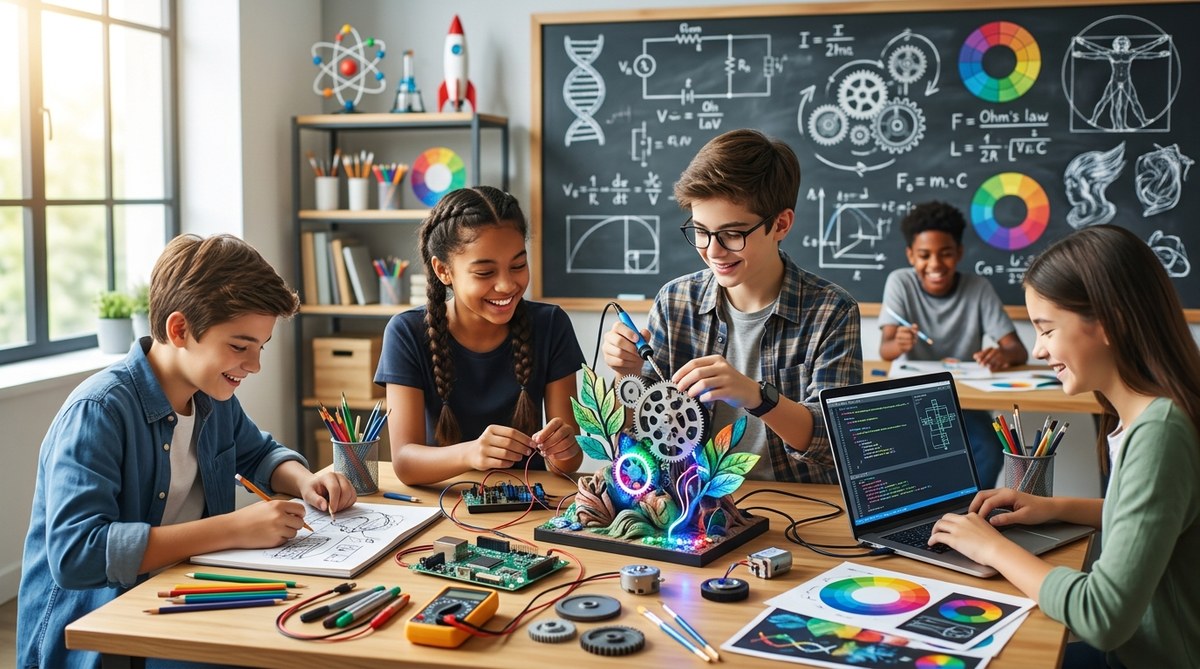
The idea that art and science exist in separate worlds is fading fast. In many classrooms across the United States, teachers are finding that the most engaged students are those who get to sketch, build, and design alongside their equations and experiments. This shift is not just a trend. It reflects a deeper understanding of how the brain learns best: through connection, expression, and hands-on creation. For educators and school administrators looking to boost student outcomes, integrating art into STEM education offers a path that is both evidence-based and exciting.
Art in STEM education transforms students from passive learners into active creators. When you add design thinking, visual storytelling, and creative prototyping to science and math lessons, students develop stronger problem-solving skills, greater persistence, and a willingness to take intellectual risks. This article provides ready-to-use strategies and examples for any grade level.
Why Art Makes STEM Lessons Stick
Students often ask, “When will I use this?” Art answers that question by giving science and math a tangible, human purpose. A student who struggles with geometry might suddenly understand angles when asked to design a set for a school play. A young engineer finds new motivation when she can shape a clay model of a bridge before testing its structural integrity.
The research supports this. A 2025 study from the National Endowment for the Arts found that students in STEAM programs scored 12 percent higher on creative problem-solving assessments than those in traditional STEM programs. More importantly, these students reported higher levels of class participation and lower rates of absenteeism. When kids see their imagination valued, they show up ready to work.
Art also lowers the intimidation factor of technical subjects. A student who feels lost in a physics lecture may feel confident designing a visual model of energy transfer using color and movement. That confidence carries over into the math and science part of the lesson. The result: fewer students give up before they start.
A Practical Framework for Blending Art and STEM
You do not need to redesign your entire curriculum overnight. Start small. The following numbered steps offer a repeatable process for adding artistic practices to any STEM lesson.
-
Begin with an inquiry-based question. Instead of “Calculate the velocity of a falling object,” ask “How could you show the beauty of gravity using both numbers and images?” This invites students to think about representation from the start. For more on this approach, see why inquiry-based learning is the key to mastering both art and science.
-
Introduce design thinking. Encourage students to empathize with an end user, define a problem, ideate solutions, build prototypes, and test. This process already lives in art classrooms. Import it into your science lab. A biology class might design a board game that teaches cellular respiration, blending rules, art, and content knowledge.
-
Create a visual journal requirement. Every STEM project should include a visual component: a diagram, a comic strip, a data visualization, or even a short video. Require students to document their thinking in both words and pictures. This forces them to process information twice.
-
Host a critique session. Art students regularly present work and receive feedback. Try that format in your engineering unit. Have students display their prototypes and explain their design choices. Peers ask questions and suggest improvements. This builds communication skills and resilience.
-
Celebrate iteration. Art teaches that a first draft is not a final product. In STEM, the same philosophy applies. Give students time to rework their designs after feedback. Reward the process of improvement, not just the final correct answer.
These steps work across grade levels. A third-grade teacher can use them as easily as a high school physics instructor. The key is to keep the artistic element meaningful, not decorative.
Common Mistakes When Adding Art to STEM
Even well-intentioned educators sometimes fall into traps that reduce the impact of their STEAM efforts. The table below shows typical mistakes and better alternatives.
| Mistake | Better Approach |
|---|---|
| Treating art as a reward after the “real” work is done | Integrate art into the core learning activity from the beginning |
| Using only “craft” projects (glitter, pipe cleaners) without deeper thinking | Choose artistic methods that require analysis and decision-making, like data illustration or narrative design |
| Ignoring the artistic skill level of students | Provide scaffolding: templates, examples, and step-by-step guides for the creative part |
| Assessing only the STEM content, not the artistic expression | Create a rubric that values both technical accuracy and creative communication |
| Assuming art means only drawing or painting | Include performance, music, digital media, writing, and movement |
Avoiding these errors keeps the focus on learning, not just on making things look pretty.
Real Classroom Examples That Work
Teachers across the country have found inventive ways to merge art and science. Here are a few that stand out:
- Middle school math class: Students created geometric mandalas using compass and protractor. They then calculated the area and perimeter of their designs. The project combined precision with personal expression.
- High school chemistry: Instead of a standard lab report, students wrote short science fiction stories about a molecule’s journey through the body. They had to accurately describe chemical reactions within a narrative frame.
- Elementary environmental science: First graders built model habitats using recycled materials. They then painted dioramas showing how animals adapt to seasonal changes. The teacher used the artwork to assess their understanding of ecosystems.
- Independent school STEAM elective: Students designed and built kinetic sculptures powered by simple circuits. The project required knowledge of electricity, physics, and sculpture technique.
These examples show that you do not need expensive equipment. Paper, markers, clay, and cardboard often suffice. The most important ingredient is a teacher who is willing to value both accuracy and imagination.
Advice From a Veteran STEAM Coordinator
“The biggest surprise was how much the art helped students who normally struggle in math. One girl spent a whole semester afraid of fractions. Then we did a unit on quilt patterns, and she realized she had been using fractions the whole time to plan her design. That moment of connection changed everything. Art gave her a reason to care about the numbers.”
— Rebecca Torres, K–8 STEAM Coordinator, Austin Independent School District
Ms. Torres’s experience highlights a crucial point: art in STEM education is not about making things easier. It is about making learning more meaningful. When students see the beauty in a graph, the story in a data set, or the design in a machine, they engage at a deeper level.
Building a Culture of Creative Risk-Taking
One of the strongest arguments for adding art to STEM is the effect on classroom culture. In a traditional STEM classroom, there is often a single correct answer. Mistakes feel like failures. Art classrooms, on the other hand, celebrate experimentation. A wrong brushstroke can be painted over. A broken sculpture can be rebuilt.
Bringing that mindset into STEM changes how students view challenges. They start to see wrong answers as data, not as dead ends. This shift is especially important in fields like engineering, where the real work is iteration and refinement. For a deeper look at fostering this kind of environment, check out innovative strategies to engage students in inquiry-based STEM projects.
Teachers can model this by showing their own messy process. Let students see you sketch out an idea, cross it out, and try again. Talk about a time you had to redo a project. When you demonstrate that creativity requires persistence, students feel permission to struggle.
Making STEAM Work With Limited Time and Budget
You might worry that adding art will eat into an already packed schedule. The truth is that you can blend art into existing lessons without adding extra class periods. Here are several ways to keep it manageable:
- Use short warm-up activities: a five minute “visual brainstorm” where students draw their prediction before a science demo.
- Replace a written summary with a comic strip or storyboard.
- Assign one creative project per quarter that ties into the unit.
- Collaborate with the art teacher on cross-disciplinary units. This shares the planning load and gives students a cohesive experience.
- Use free digital tools like Canva, Tinkercad, or Scratch for visual design and modeling.
School administrators can support this shift by offering professional development on STEAM pedagogy and by allocating small grants for materials. Even a modest investment in basic art supplies (clay, markers, drawing paper, glue) can transform a classroom.
When Art and Science Flow Together
The goal is not to turn every science teacher into an art teacher. It is to recognize that the two disciplines are natural partners. Both rely on observation, pattern recognition, and creative leaps. A mathematician sees shapes in a proof. A painter analyzes light and color. An engineer sketches before she builds. These are not separate skills; they are the same muscle.
By intentionally weaving art into STEM education, you prepare students for a world that demands both technical competence and human creativity. The jobs of tomorrow will need people who can design interfaces, tell data stories, and solve problems with empathy. That starts in the classroom today.
To keep building on this idea, take a look at how to integrate artistic creativity into STEM classroom activities for more ready-to-implement lesson ideas. And if you are planning a larger curriculum shift, the guide on fostering innovation through interdisciplinary approaches in education offers a roadmap for the whole school.
Your Next Step
Pick one lesson from your upcoming week. Find a place to add a visual or hands-on creative element. It could be a sketch, a short performance, or a model. Try it. Watch what happens to student energy and understanding. That small shift might be the start of a much larger transformation in your classroom.
Art and science belong together. In 2026, more educators than ever are proving that the combination works. The question is not whether to include art in STEM, but how to do it well. You now have the tools to begin.