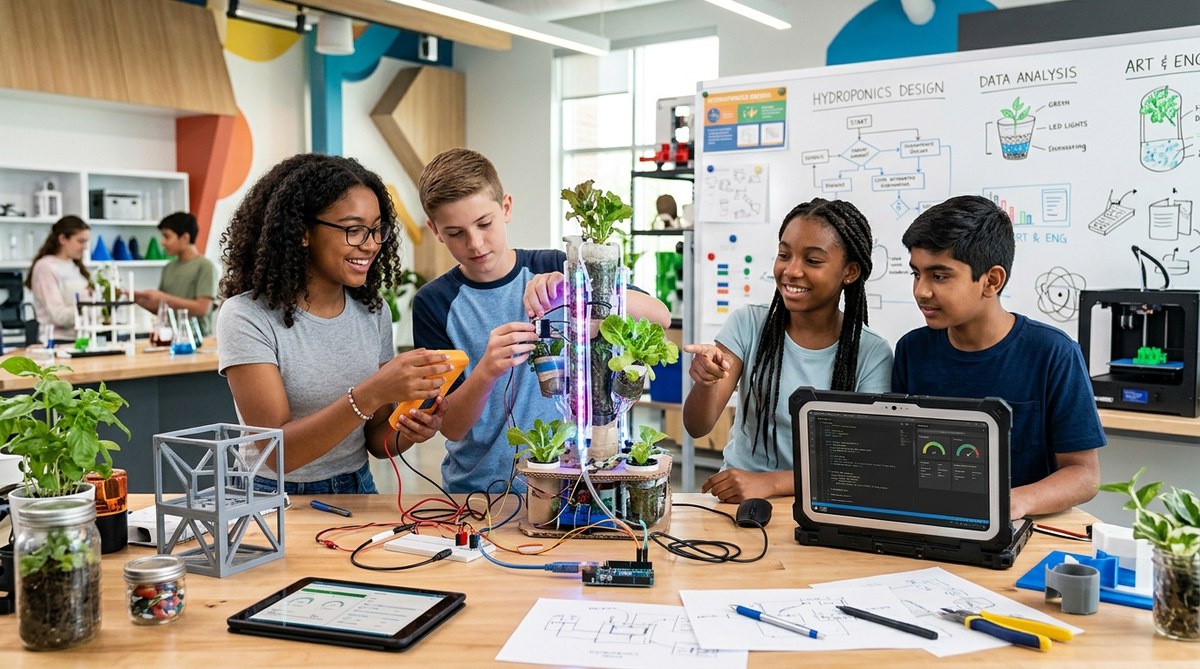
Thinking of ways to energize your STEM lessons? Inquiry-based strategies turn passive learners into active explorers. They ignite curiosity, develop critical thinking, and make learning science, technology, engineering, and math more meaningful. When students ask questions and investigate solutions, they become more invested in their education. These methods foster a classroom culture of discovery that prepares students for future challenges. Incorporating innovative inquiry-driven techniques can transform your STEM teaching approach dramatically.
Implementing inquiry-based STEM strategies encourages students to ask questions, investigate solutions, and develop critical thinking skills. These approaches make learning interactive and meaningful, fostering curiosity and deeper understanding that last beyond the classroom.
Understanding the power of inquiry in STEM education
Inquiry-based learning is more than just asking questions. It is a dynamic way of teaching that puts students at the center of their learning journey. In STEM classrooms, this means guiding students to explore concepts through investigation and experimentation rather than passively receiving information. By doing so, students develop skills like problem-solving, collaboration, and resilience. This approach aligns with modern educational standards and prepares learners for real-world challenges.
Practical ways to implement inquiry-based STEM strategies
Transforming your classroom with inquiry-driven methods involves deliberate steps. Here are three effective processes to consider:
-
Design open-ended projects
Create projects that do not have a single correct answer. For example, challenge students to design a water filtration system using available materials. Encourage them to hypothesize, test, and refine their designs. This promotes critical thinking and allows students to take ownership of their learning. -
Facilitate student-led investigations
Instead of delivering lectures, act as a guide. Let students generate questions based on a phenomenon or problem. For instance, after observing plant growth, students might investigate how light affects photosynthesis. Provide resources but let them plan and carry out experiments. -
Incorporate reflection and discussion
After investigations, hold reflection sessions. Ask students to articulate what they learned, challenges faced, and questions remaining. Use journals or group discussions to deepen understanding and develop communication skills.
Techniques to foster inquiry
- Use real-world problems to make lessons relevant.
- Encourage students to formulate hypotheses before experiments.
- Provide diverse resources for investigation.
- Promote peer collaboration to enhance ideas and solutions.
- Use formative assessments to guide and refine inquiry processes.
Common pitfalls and how to avoid them
| Technique | Mistake | Solution |
|---|---|---|
| Open-ended projects | Giving too little guidance | Offer clear criteria but allow flexible solutions |
| Student-led investigations | Lack of structure | Provide scaffolding and checkpoints |
| Reflection sessions | Superficial responses | Ask targeted questions to deepen insights |
“The key to successful inquiry-based STEM learning is balancing guidance with independence. Students need enough structure to succeed but enough freedom to explore and innovate.” — STEM education expert
Creating a classroom culture that supports inquiry
Building an environment where inquiry thrives requires intentional efforts. Establish routines that promote questioning and curiosity. Celebrate creative solutions and resilience after setbacks. Incorporate technology tools that facilitate investigation, such as virtual labs or simulation apps. By fostering a culture of curiosity, students will naturally become more engaged in their learning journeys.
Incorporating art and discovery into STEM strategies
Blending art with science can enhance inquiry-based learning. Artistic activities like visual data representation or crafting models help students process complex concepts creatively. For example, students might create infographics to communicate their findings or build physical models to test engineering ideas. This interdisciplinary approach encourages diverse ways of thinking and deepens understanding. To learn how to integrate art more seamlessly, see our guide on unlocking creativity by merging art and science.
Practical tips for designing inquiry-based STEM lessons
- Start with compelling questions that relate to students’ lives.
- Use prompts that challenge assumptions and foster deeper thinking.
- Plan for multiple solutions and pathways.
- Provide opportunities for peer review and collaborative problem solving.
- Use technology to simulate experiments or visualize data.
A comparison of techniques and common mistakes
| Technique | What to do | Common mistake | How to avoid it |
|---|---|---|---|
| Open-ended projects | Encourage student creativity | Overly complex tasks | Scaffold projects with clear milestones |
| Student-led investigations | Facilitate student questions | Lack of structure | Set clear goals and checkpoints |
| Reflection | Promote metacognition | Superficial responses | Ask specific, probing questions |
Expert advice on inquiry-driven STEM teaching
“The essence of inquiry-based learning is in guiding students to discover answers themselves. It’s about asking the right questions and giving them space to experiment and reflect.” — seasoned STEM educator
Making inquiry a natural part of your teaching
Creating an inquiry-rich environment doesn’t happen overnight. It requires patience, planning, and a willingness to shift from traditional methods. Start small by integrating inquiry into existing lessons. Use real-world problems that spark interest. Gradually, build a classroom culture where questions are valued as much as answers. Over time, students will develop confidence and independence in their learning process.
Final thoughts on fostering curiosity and critical thinking
Incorporating innovative inquiry-based STEM strategies can dramatically transform your teaching experience and your students’ learning outcomes. These approaches promote active engagement and help students see themselves as problem solvers. Keep experimenting with different techniques, reflect on what works, and adapt to your students’ needs. Remember, the goal is to cultivate curious minds eager to ask questions and explore solutions. Your efforts today can shape confident, critical thinkers tomorrow.