You are leading a classroom full of curious students. On one side of the room, a lab table holds microscopes and petri dishes. On the other, paintbrushes rest beside sketchbooks. For years, these two worlds have been taught as opposites. But the most engaging learning happens when you intentionally blend art and science into one seamless experience. When students draw a biological cell and then compose a poem about its function, they remember the material longer. They ask better questions. They think like innovators.
Blending art and science helps students build creative problem-solving skills while deepening their understanding of both disciplines. This guide offers a practical six-step method for designing interdisciplinary projects that work in real classrooms. You will learn to identify natural overlaps, ask driving questions, and assess integrated work without losing rigor in either subject.
Why the Divide Between Art and Science Is Fading
The separation between art and science is a relatively recent invention. Renaissance thinkers like Leonardo da Vinci moved fluidly between anatomy, painting, and engineering. In 2026, educators are rediscovering that approach. When you blend art and science, you mirror the way the world actually works. Architects use physics and design. Medical illustrators combine biology with visual storytelling. Data journalists turn spreadsheets into compelling graphics.
Students notice this gap in their own education. A student who loves drawing but struggles with chemistry might light up when asked to illustrate molecular structures. Another who excels at coding but feels disconnected from self-expression might find meaning in generative art projects. The key is to design experiences that honor both ways of thinking without forcing an artificial connection.
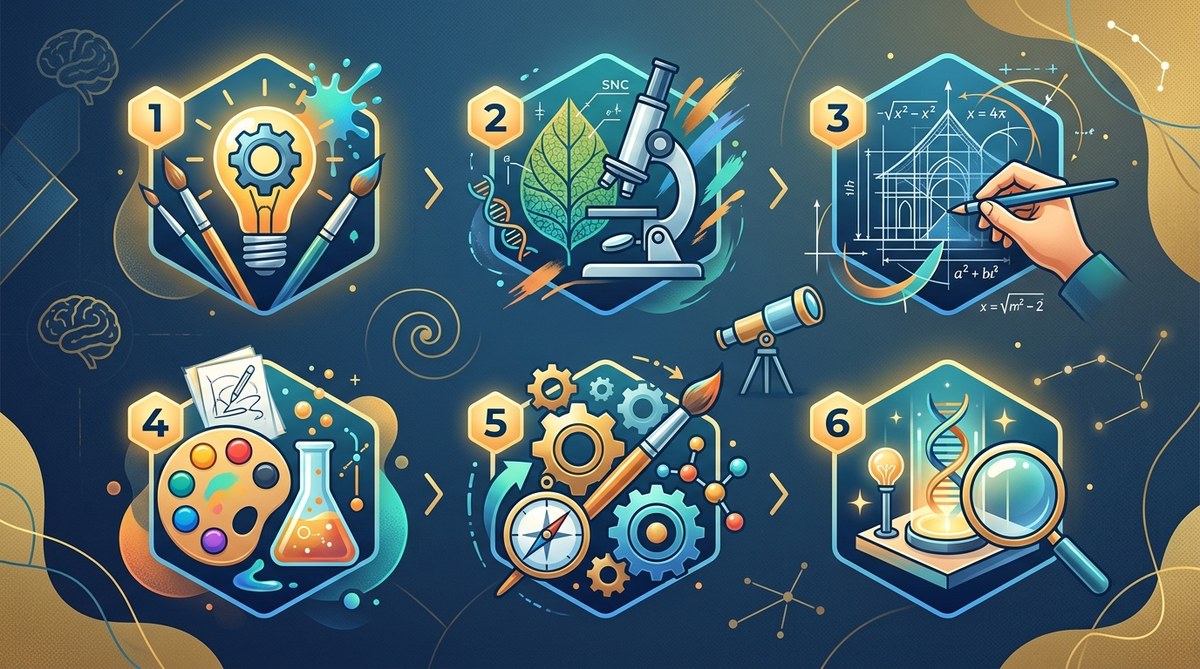
The Six-Step Method to Blend Art and Science
This framework works for any grade level or project type. You can adapt it for a week long unit or a full semester. The steps build on each other, but you can revisit earlier stages as your project evolves.
Step 1: Identify the Natural Overlap
Start by listing the core concepts you want to teach. Then look for places where artistic practice and scientific inquiry share common ground. Both fields rely on observation, pattern recognition, and iteration. A biologist observes cell division. A sculptor observes how light falls on clay. Both refine their work based on what they see.
Write down two or three intersections. For example, if you are teaching ecosystems, the overlap might be color theory in nature. If you are teaching physics, it might be the visual patterns of wave motion. If you are teaching anatomy, it might be the sculptural qualities of bone structure.
For more ideas on finding these connections, check out this guide on unlocking creativity by merging art and science in your classroom.
Step 2: Write a Driving Question That Bridges Both Fields
A good driving question cannot be answered with a single Google search. It demands investigation from multiple angles. It should feel authentic to both art and science.
Here are a few examples:
- How can we use light and shadow to model lunar phases?
- What can the color patterns of butterfly wings teach us about natural selection?
- How do sound waves shape the way we design musical instruments?
- In what ways does the structure of a leaf inspire both architectural design and plant biology?
Notice how each question requires students to gather scientific data and then express their findings creatively. The question becomes the backbone of your project.
If you want to strengthen your questioning technique, this resource on exploring the power of inquiry-based learning across disciplines will help.
Step 3: Design Parallel Skill-Building Activities
Students need direct instruction in both domains before they can integrate them. Plan separate but parallel activities that build foundational skills.
| Art-Focused Activity | Science-Focused Activity | Integrated Outcome |
|---|---|---|
| Color mixing with acrylics | Studying light refraction through prisms | A painting that demonstrates the visible spectrum |
| Observational drawing of plants | Dissecting flowers to identify parts | Annotated botanical illustrations |
| Storyboarding a narrative | Researching local water quality | A graphic novel about watershed health |
| Building a clay model of a heart | Tracing blood flow through chambers | A sculptural model with labeled pathways |
This table helps you see the rhythm of your project. Students move between artistic practice and scientific investigation, building fluency in both.
Step 4: Create a Culture of Experimentation and Iteration
Artists make sketches. Scientists run pilot studies. Both groups know that the first attempt is rarely the best. Build this mindset into your project from day one.
Give students permission to fail forward. A watercolor that turns muddy is not a mistake. It is a data point. A circuit that does not light up is not a failure. It is feedback. When students treat their creative and scientific work as prototypes, they become more willing to take risks.
Set aside time for iterative cycles. After a first attempt, ask students to reflect on what they learned and then revise. This practice mirrors how professionals in both fields actually work.
Step 5: Embed Reflection to Deepen Understanding
Reflection is where the magic of integration happens. Without it, students might finish a project without recognizing how the two subjects informed each other.
Use structured prompts like these:
- What did you notice about your topic when you studied it scientifically that you missed when you looked at it artistically?
- How did the constraints of your material (paint, clay, code) affect the way you understood the scientific concept?
- If you had to explain your project to someone who only studied art or only studied science, what would you say?
Journal entries, video reflections, or paired discussions all work well. The goal is to make the integration visible to the student themselves.
This approach aligns with methods found in harnessing curiosity to integrate art and science in education.
Step 6: Share and Celebrate the Integrated Work
The final step is public sharing. This can take many forms. A gallery walk where students display their artwork alongside their lab notebooks. A presentation to parents where students explain their process. A digital portfolio that shows the evolution of their thinking.
Public sharing does two things. It gives students a sense of purpose and audience. And it helps the school community see that interdisciplinary learning is valuable. When a principal sees a painting of a neuron with accurate dendrites and a written reflection on how memory works, they understand the power of blending disciplines.
“The most compelling student work I have seen came from a unit where students studied local bird populations and then created field guides that included watercolor illustrations, habitat maps, and population data. The students were so engaged that they continued observing birds after the unit ended. That is the kind of lasting curiosity we are aiming for.” — Maria Gonzalez, middle school STEAM coordinator in Portland, Oregon.
Common Mistakes When You Blend Art and Science
Even experienced educators run into trouble. Here are the most common pitfalls and how to avoid them.
| Mistake | Why It Happens | Better Approach |
|---|---|---|
| Forcing a connection | The two subjects feel unrelated, so you invent a weak link | Let the driving question emerge from genuine overlap |
| Prioritizing one subject | Science dominates while art becomes decorative | Give equal weight to both modes of inquiry |
| Skipping direct instruction | Students lack baseline skills in one area | Teach foundational techniques before integration |
| Overplanning the outcome | You expect a specific product and discourage detours | Leave room for student-driven discoveries |
| Neglecting assessment | You grade only the final product, not the process | Use rubrics that value experimentation and reflection |
Avoiding these mistakes will save you time and frustration. For a deeper look at structuring interdisciplinary units, read about fostering innovation through interdisciplinary approaches in education.
Tools and Materials That Support Integration
You do not need expensive equipment to blend art and science. Many tools are already in your supply closet or available for free online.
- Sketchbooks and lab notebooks — Use the same notebook for both observation and creative exploration.
- Digital cameras — Students can document scientific phenomena and then manipulate the images artistically.
- Open source software — Programs like Processing or Scratch allow students to create visual art using code.
- Modeling clay — Perfect for constructing three-dimensional representations of molecules, organs, or landforms.
- Watercolor sets — Great for studying diffusion, color theory, and natural pigments.
- Data visualization tools — Turn scientific data into infographics, charts, and abstract art.
The goal is to lower the barrier between the two subjects. When a student can reach for clay to understand plate tectonics or use code to generate a pattern, the separation between art and science dissolves.
How to Assess Projects That Blend Art and Science
Traditional tests struggle to capture the richness of integrated work. Consider using a portfolio based assessment that includes three components.
- Process documentation — Sketches, drafts, lab notes, and reflections that show the evolution of the project.
- Final product — The artwork, model, performance, or digital creation that synthesizes both disciplines.
- Written or oral defense — A student explanation of how art and science informed each other throughout the project.
Grade each component separately and then combine them. This approach values both the journey and the destination. It also gives students credit for the risks they took along the way.
If you want to see more examples of integrated assessment, this article on integrating art and science to foster creative problem-solving skills provides practical rubrics.
Bringing the Method to Life in Your Classroom
You do not need to redesign your entire curriculum overnight. Start with a single unit. Pick a topic you already teach and look for one artistic connection. Try the six steps with a small group of students first. Gather their feedback. Adjust your approach.
The best interdisciplinary projects grow over time. Your first attempt might feel clunky. That is normal. Each cycle will get smoother as you and your students become more comfortable moving between artistic and scientific ways of thinking.
Remember that you do not have to be an expert in both fields. You just need to be willing to learn alongside your students. Model curiosity. Ask questions you do not know the answer to. Let your students teach you something from their artistic or scientific perspective.
For a complete walkthrough of designing integrated units, see how to design interdisciplinary projects that ignite student curiosity in 2026.
Your Next Step Toward Integrated Learning
The world needs people who can think across boundaries. Climate change, public health, and social justice all require both scientific understanding and creative communication. When you teach students to blend art and science, you are preparing them for challenges that do not fit neatly into one subject area.
Start small. Pick one step from this guide and try it this week. Maybe you ask your students a driving question that connects two subjects. Maybe you add a reflection prompt to a lab activity. Maybe you share student work in a new way. Whatever you choose, the act of bringing these two worlds together will change how your students see themselves as learners.
The science classroom becomes a studio. The art studio becomes a laboratory. And your students become the kind of flexible, curious thinkers the future demands.