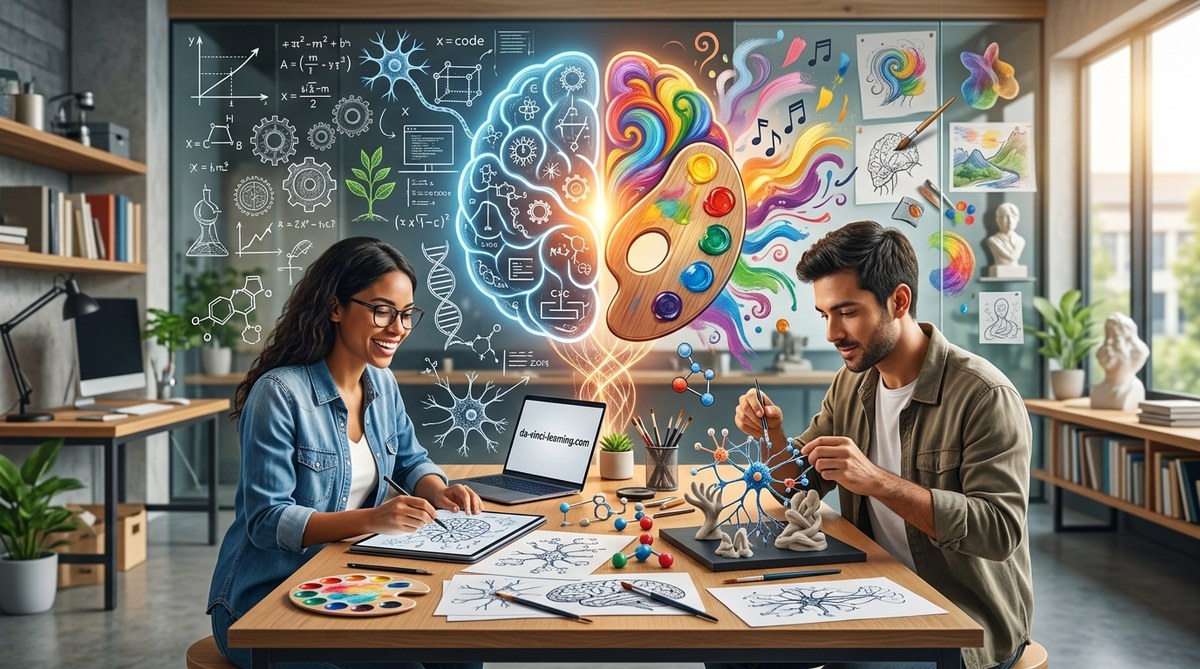
Your brain is not a single-purpose machine. It is a network of systems that talk to each other constantly. When you study biology from a textbook, certain pathways light up. When you sketch a cell from memory, entirely different regions join the conversation. The magic happens when both sides work together. That is where brain art science learning comes to life.
Integrating art and science activates more neural pathways than either subject alone. This cross-talk strengthens memory, improves focus, and builds flexible thinking. Research in neuroaesthetics shows that drawing, music, and visual design help the brain encode scientific concepts deeper. For educators and lifelong learners, this means blending disciplines is not just fun. It is biologically smart.
What Your Brain Actually Does During an Art-Science Lesson
Neuroscientists used to think the left brain handled logic and the right brain handled creativity. That idea is outdated. Modern imaging studies show that both hemispheres work together on nearly every task. When you paint a diagram of a plant cell, your visual cortex processes color and shape. Your prefrontal cortex plans the layout. Your motor cortex controls the brush. At the same time, your hippocampus links the visual image to the biological term you learned earlier.
This is called dual coding. The same information gets stored in two different formats. Later, when you need to recall the function of mitochondria, your brain can retrieve the memory through the verbal label or the visual image. Having two paths to the same file makes recall faster and more reliable.
A 2025 study from Dartmouth College found that students who took a drawing course alongside a biology course showed stronger neural connections between the visual and analytical regions of the brain. The students did not just remember facts better. They could also apply those facts to new problems more easily.
Why Memorization Fails Without a Creative Hook
Rote memorization feels productive. You read a definition. You repeat it. You move on. But the brain treats isolated facts like spam. It deletes them during sleep unless they are attached to something meaningful.
Art provides that meaning. When you turn a chemical reaction into a comic strip, your brain tags the information as important. It says, “This matters. It has emotion and color and story attached to it.” That emotional tag signals the hippocampus to move the information into long-term storage.
Consider how you learned the planets in elementary school. Did you memorize a list? Or did you sing a song? Most people remember the song because melody and rhythm create a sticky scaffold for facts. The same principle applies to adult learning.
A Practical Process for Blending Art and Science
You do not need to be a professional artist or a lab scientist to benefit from this approach. Here is a simple process that works for any subject.
- Identify the core concept you want to learn. Write it down in plain language. For example, “Photosynthesis converts sunlight into chemical energy.”
- Choose an artistic medium that feels natural. This could be drawing, collage, poetry, music, or even dance. Pick one that you enjoy or are curious about.
- Create a representation of the concept using that medium. Draw the process of photosynthesis as a cartoon. Write a short poem about electron flow. Choreograph a movement that shows energy transfer.
- Explain your creation to someone else. Teaching forces your brain to organize the information. If you cannot explain it, you have not learned it yet.
- Repeat with a different medium. Try a second version. Each new format strengthens the neural web.
This process works because it forces your brain to translate information across different codes. Translation is harder than repetition, and that difficulty is what builds lasting knowledge.
Common Mistakes That Weaken Art-Science Learning
Not every attempt to blend art and science works well. Some approaches actually reduce learning. The table below shows common pitfalls and how to fix them.
| Mistake | Why It Fails | Better Approach |
|---|---|---|
| Focusing on aesthetics over accuracy | The brain remembers the wrong details | Prioritize correct science first, then add beauty |
| Using art as a reward after learning | Art becomes a distraction, not a tool | Integrate art during the learning process |
| Forcing a medium that feels unnatural | Frustration blocks cognitive gains | Let learners choose their own artistic format |
| Skipping the explanation step | The creation stays shallow | Always pair the art with a verbal or written summary |
| Making the art too complex | Cognitive overload reduces retention | Keep it simple and focused on one concept |
What the Research Says About Neuroaesthetics
Neuroaesthetics is the study of how the brain responds to art. Researchers have found that looking at art activates the same reward pathways as eating good food or receiving a compliment. When you combine that positive feeling with a science lesson, your brain releases dopamine. Dopamine improves attention and makes learning feel satisfying.
A study from Johns Hopkins University showed that medical students who drew anatomical structures remembered them 30 percent better than students who only studied from diagrams. The act of drawing forced the students to notice details they would have otherwise missed. They had to decide where each line went. That decision-making process deepened their understanding.
The same principle applies to music. Students who compose a song about the water cycle engage multiple sensory systems. They hear the rhythm. They feel the beat. They see the lyrics. Each sensory channel adds another layer to the memory.
Tools and Techniques You Can Use Tomorrow
You do not need a fancy lab or expensive supplies. Here are six techniques that work in any setting.
- Sketch noting combines handwritten notes with simple drawings. Use icons, arrows, and labels to map out a concept visually.
- Concept mapping with color codes helps you see relationships between ideas. Assign a color to each category or theme.
- Storyboarding turns a process into a narrative. Draw a sequence of frames that show cause and effect.
- Analogies through sculpture use clay or play dough to represent abstract ideas. Build a model of a neuron or a solar system.
- Poetry for patterns forces you to choose precise words. Write a haiku about gravity or a limerick about the periodic table.
- Movement mapping uses your body to learn. Walk the path of a blood cell through the heart or act out the stages of mitosis.
Each technique works because it asks your brain to do something different. Variety prevents boredom and strengthens the neural pathways you are building.
“The best learning happens when you are not just receiving information, but transforming it. Art gives you a way to transform science into something your brain can hold onto.” Dr. Maria Gonzalez, cognitive neuroscientist at Stanford University.
How to Bring This Into a Classroom or Home Routine
Teachers and parents often worry that blending art and science takes too much time. The truth is that it saves time in the long run because students retain more and require less review.
Start small. Pick one lesson per week to add an artistic element. If you teach the water cycle, have students draw it as a comic. If you teach fractions, have them build a quilt pattern. If you teach history, have them create a newspaper front page from the era.
For adult learners, the same approach works. Learning a new language? Draw vocabulary words instead of just writing them. Studying for a certification? Create a visual map of the key concepts. Your brain will thank you.
Building a Lifelong Habit of Interdisciplinary Thinking
The most innovative thinkers in history did not stay inside one box. Leonardo da Vinci filled notebooks with anatomical sketches, engineering designs, and musical compositions. He did not separate art from science. He let them inform each other.
You can do the same. The more you practice moving between disciplines, the more flexible your thinking becomes. You start to see patterns that others miss. You ask better questions. You find solutions that a single-discipline approach would never reveal.
If you want to go deeper into this topic, check out our guide on how interdisciplinary thinking sparked breakthroughs from Da Vinci to modern innovators. It shows how the same principles apply in classrooms and workplaces today.
A Simple Weekly Plan to Get Started
Do not try to change everything at once. Pick one small habit and stick with it for a month.
- Week one: Add a sketch to your notes every day.
- Week two: Explain one concept to a friend using a drawing.
- Week three: Try a new medium. Use clay or music instead of drawing.
- Week four: Teach a full lesson or topic using an artistic format.
After a month, the habit will feel natural. You will notice that you remember more and feel more engaged. That is your brain adapting to a richer way of learning.
Why This Matters More Now Than Ever
In 2026, the world is full of information. Anyone can find a fact in seconds. But understanding that fact, connecting it to other ideas, and using it creatively is still hard. That is the skill that matters most.
Schools and workplaces are starting to recognize this. The most effective teams are not made of pure specialists. They are made of people who can think across boundaries. Artists who understand data. Scientists who can communicate visually. Engineers who appreciate design.
By training your brain to learn through both art and science, you are building the kind of flexible intelligence that lasts a lifetime. You are not just memorizing. You are making meaning.
For more practical ways to bring this into your teaching or learning routine, read about how to build a curiosity lab that merges art and science. It is full of classroom-tested ideas that work for all ages.
Start Where You Are
You do not need a degree in neuroscience or a studio full of paint. You just need a willingness to try something different. Next time you learn something new, ask yourself one question. “How could I draw this? How could I sing this? How could I move to this?”
The answer will surprise you. And your brain will remember.