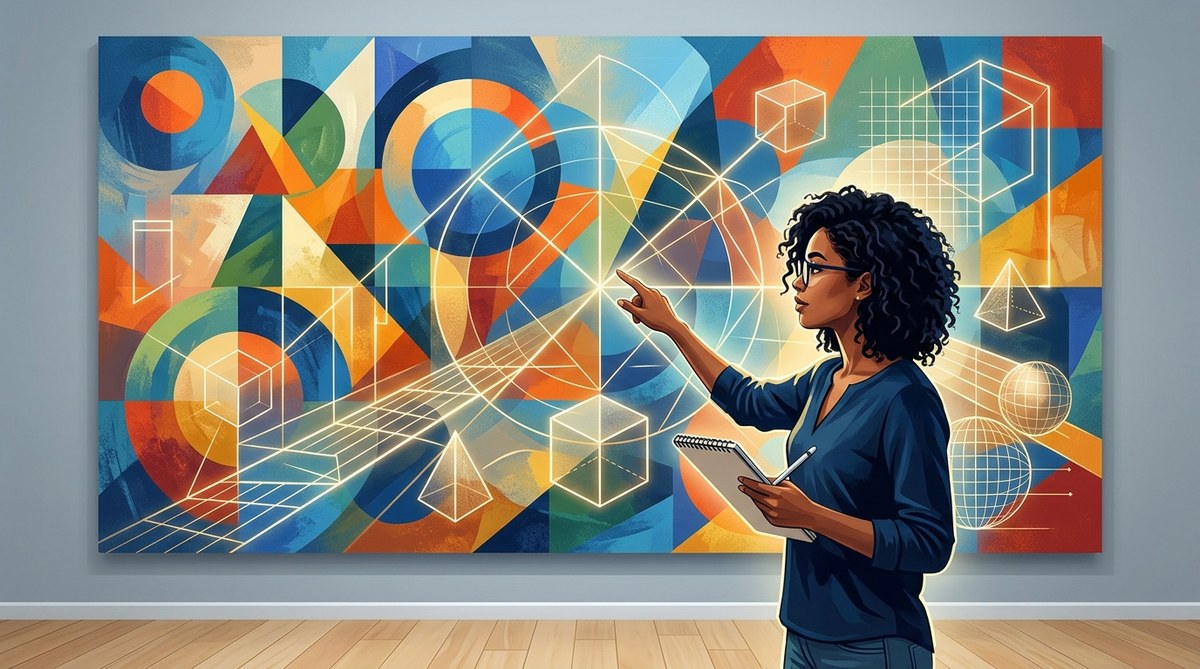
A Piet Mondrian painting is not just a grid of red, blue, and yellow rectangles. It is a spatial puzzle. When your eyes trace the black lines and balance the colored blocks, your brain is doing something remarkable. It is measuring distances, comparing proportions, and predicting where the next shape will sit. That process is called spatial reasoning, and modern art is one of the most engaging ways to train it.
Geometry in modern art is not just decoration. It is a visual workout for your brain. By studying how artists arrange shapes, you strengthen your ability to rotate objects mentally, estimate scale, and see patterns in space. These skills help with math, design, and even everyday tasks like packing a suitcase or reading a map.
The Hidden Curriculum of Abstract Shapes
Modern art often gets a reputation for being chaotic or random. But look closer at a canvas by Wassily Kandinsky or a sculpture by Barbara Hepworth. Every line and curve was placed with intention. Artists who work with abstract geometry are essentially creating spatial problems for the viewer to solve.
When you look at a painting that uses overlapping circles, your brain has to figure out which circle is in front. When you see a tilted square, your mind unconsciously rotates it to compare it with a straight one. This is not passive viewing. It is active spatial processing.
Research in cognitive science shows that people who regularly engage with visual art score higher on tests of mental rotation and spatial visualization. The link between geometry in modern art and spatial reasoning is not a coincidence. It is a direct result of training your brain to decode spatial relationships.
How Your Brain Reads a Geometric Painting
Your visual system has two main pathways. One handles object recognition (what is this?). The other handles spatial location (where is this?). Abstract geometry activates the second pathway powerfully.
A painting by Josef Albers, for example, presents nested squares of different colors. Your brain does not just see colors. It calculates the ratio of each square to the next. It judges the thickness of the borders. It decides whether the composition feels stable or unstable.
This process mirrors what architects and engineers do daily. They look at a structure and estimate load, balance, and proportion. Modern art gives you a low-stakes way to practice those same mental moves.
A Practical Process for Reading Art Like a Spatial Map
You can train your spatial reasoning by looking at any geometric artwork with intention. Follow these steps the next time you visit a gallery or scroll through an online collection.
- Start with the frame. Note the overall shape of the canvas or sculpture. Is it a square, a rectangle, a circle? The boundary sets the spatial rules.
- Identify the dominant shapes. Count how many triangles, circles, or rectangles you see. Notice if any shapes repeat.
- Map the relationships. Ask yourself which shape is closest to the edge. Which one sits in the center? How much empty space surrounds each form?
- Rotate it in your mind. Close your eyes for a moment and imagine the composition turned 90 degrees. Does it still feel balanced? This mental rotation is a key spatial skill.
- Compare scale. Estimate how many times a small shape could fit inside a larger one. This builds proportional thinking.
What to Look for in Geometric Modern Art
Not all abstract art is equally useful for spatial training. Some pieces rely more on color or texture than on structure. Here is a breakdown of techniques and common mistakes to watch for.
| Technique in Art | What It Trains | Common Mistake to Avoid |
|---|---|---|
| Overlapping planes | Depth perception and layering | Assuming the largest shape is always in front |
| Repeated grid patterns | Pattern recognition and alignment | Ignoring slight shifts in spacing |
| Asymmetric balance | Spatial weighting and tension | Thinking symmetry is the only kind of balance |
| Negative space carving | Figure-ground differentiation | Focusing only on the positive shapes |
| Tilted or rotated forms | Mental rotation ability | Judging a tilted shape as a mistake |
“When you look at a Mondrian, you are not just seeing a painting. You are doing geometry without a protractor. Your brain is measuring angles, calculating intervals, and testing hypotheses about balance.” Dr. Rebecca Kamen, artist and former professor of art and science integration.
Three Artists Who Teach Spatial Reasoning
Some modern artists are particularly effective at training the eye. Their work functions almost like a textbook for spatial thinking.
Piet Mondrian is the master of orthogonal space. His grids force you to notice how a single black line changes the weight of an entire composition. Look at his later works where the grid breaks. Your brain immediately feels the tension.
Bridget Riley uses optical patterns that trick your eye into seeing movement. Her work teaches you about edge detection and how the brain interprets contrast. Stare at one of her striped canvases long enough, and your spatial perception will start to shift.
Frank Stella creates shaped canvases that break out of the rectangle. His work challenges your assumption that a painting must be a flat window. You start to see the artwork as an object in real space, not just an image.
Why Spatial Reasoning Matters Beyond Art
The benefits of training with geometry in modern art go far beyond the gallery. Spatial reasoning is a strong predictor of success in STEM fields. Students who score high on spatial tests are more likely to pursue careers in engineering, computer science, and architecture.
But the skill also helps in daily life. You use spatial reasoning when you assemble furniture from a diagram, parallel park a car, or pack a suitcase efficiently. It helps you read a subway map, follow a recipe with layered steps, or arrange furniture in a room.
Modern art offers a low-pressure way to practice. There is no test at the end. You simply look, wonder, and let your brain do the work.
Common Misconceptions About Abstract Geometry
Many people assume that understanding geometric art requires a background in math. That is not true. You do not need to calculate angles to benefit from looking at a Frank Stella sculpture. Your brain does the math instinctively.
Another misconception is that abstract art is random. In reality, most geometric artists follow strict rules. They choose proportions based on the golden ratio, the Fibonacci sequence, or simple harmonic intervals. Your brain picks up on these patterns even if you cannot name them.
A third myth is that spatial reasoning is a fixed trait. It is not. Like any skill, it improves with practice. Spending ten minutes a week looking at geometric art can strengthen your spatial abilities over time.
How to Bring This Into a Classroom or Studio
Art educators and design students can use geometric modern art as a daily warm up. Here are a few ways to integrate it into practice.
- Use a Mondrian grid as a prompt for a drawing exercise. Ask students to copy the grid from memory after looking at it for thirty seconds. This trains visual memory and spatial recall.
- Project a Bridget Riley painting on the wall. Ask students to describe where they see movement. Then discuss how the brain interprets edges and contrast.
- Give students a set of geometric cutouts and ask them to arrange them on a blank page. Challenge them to create balance without using symmetry. This builds an intuitive sense of spatial weight.
For a deeper look at how art and science can work together in the classroom, read about unlocking creativity by merging art and science in your classroom. You can also learn about inquiry-based learning across disciplines to see how these ideas fit into a broader teaching strategy.
The Surprising Link Between Composition and Cognition
When you step back from a geometric painting, you are not just admiring it. You are running a spatial analysis in your head. Your brain measures the distance from the edge of the canvas to the nearest shape. It compares the size of one triangle to another. It decides whether the composition feels stable or off balance.
This is the same cognitive process that helps you navigate a new city or visualize how a piece of furniture will look in your living room. The more you practice with art, the sharper that skill becomes.
Art educators often notice that students who struggle with traditional geometry worksheets suddenly excel when the same concepts appear in a painting. The visual context makes the abstract ideas concrete. A right angle becomes something you see, not just something you measure.
A New Way to See the World
The next time you walk through a museum or open a book of modern art, slow down. Look at the shapes. Ask yourself why the artist placed them where they did. Notice how your eye moves across the canvas. That movement is your spatial reasoning in action.
Geometry in modern art is not a hidden code meant for experts. It is a language that everyone can learn to read. And the more you read it, the better your brain becomes at understanding space, proportion, and structure.
If you want to go further, consider how integrating art and science to foster creative problem-solving skills can transform the way you teach or learn. The connection between visual thinking and analytical thinking is one of the most powerful tools we have.
Let the Shapes Teach You
Modern artists spent decades learning how to arrange geometry in ways that feel alive. You can benefit from that work without ever picking up a brush. Just look. Let your brain do the rest.
The next time you see a geometric painting, try the numbered process from earlier. Frame it. Identify the shapes. Map the relationships. Rotate it in your mind. Compare the scale. Do this for five minutes, and you will have given your spatial reasoning a genuine workout.
Art educators, design students, and curious adults all have something to gain from this practice. It is free. It is available in every museum and art book. And it works.
Start today. Pick one geometric artwork. Spend five minutes with it. See what your brain discovers.
For more ideas on blending disciplines, check out how to design interdisciplinary projects that ignite student curiosity in 2026. You might also enjoy why your brain learns better when art and science share the spotlight. These resources will help you keep building that bridge between seeing and thinking.