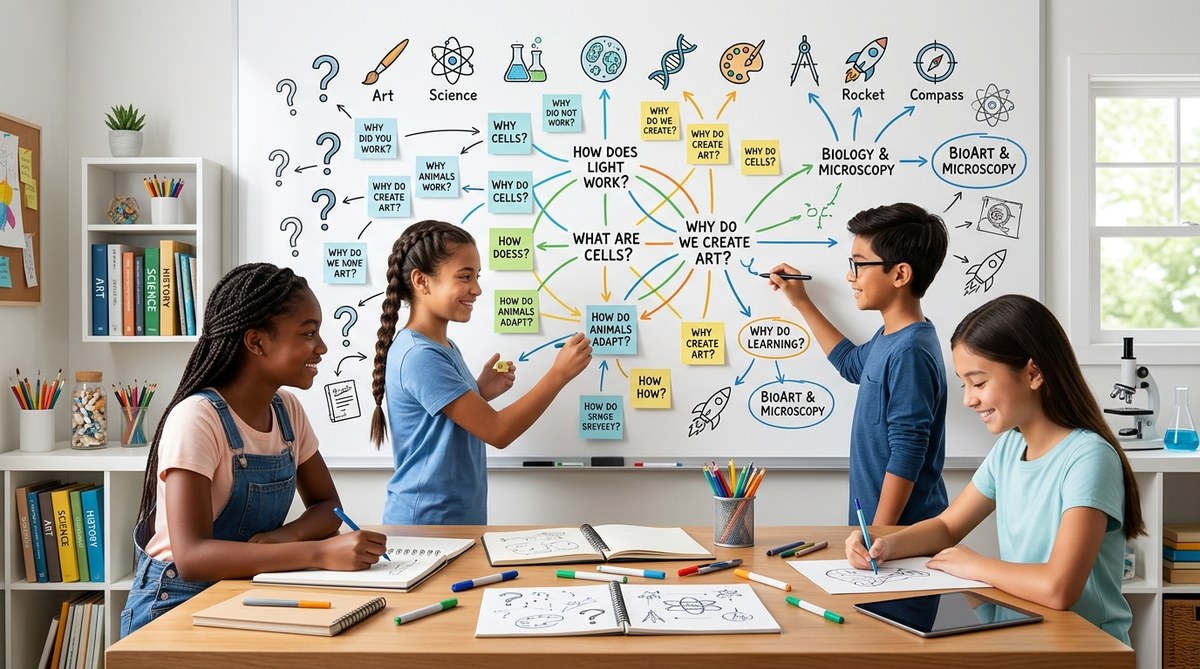
You are standing in front of a whiteboard with a blank unit map. You have standards to hit, skills to build, and a dozen subjects that usually live in separate silos. The traditional approach is to start with the standards and work backward. But what if you started with something more powerful? What if you handed the marker to your students and asked them what they want to know?
Designing an interdisciplinary unit using student questions as your curriculum map is not just possible. It is one of the most effective ways to create deep, connected learning experiences. When you let genuine curiosity guide the plan, students become co-authors of their education. The result is a unit that feels alive, relevant, and surprisingly aligned with your learning goals.
Designing an interdisciplinary unit around student questions transforms your classroom into a hub of inquiry. This guide walks you through a repeatable process: collect authentic questions, sort them by theme, map them to standards across subjects, and build a flexible curriculum that honors student voice. You will learn practical techniques to avoid common pitfalls, plus a table that compares effective and ineffective approaches. By the end, you will have a clear framework to turn any topic into a student-driven, multi-subject adventure that meets your goals and sparks lasting curiosity.
Why Student Questions Make the Best Curriculum Map
A curriculum map built from student questions does something a standard outline cannot. It creates ownership. When a student asks, “Why do some leaves turn red in fall but others just turn brown?” that question becomes a doorway into biology, chemistry, art, and even poetry. You did not have to force the connection. The student made it naturally.
This approach works because the brain is wired to seek answers to its own questions. When you honor that drive, you reduce resistance and increase retention. Students stop asking, “When will I ever use this?” They are too busy trying to find out why their local creek smells funny or how birds know when to migrate.
The best part? You do not lose rigor. You gain it. Student questions often lead to richer, more complex investigations than a pre-packaged unit ever could.
A 5-Step Process for Designing Your Unit
Here is a numbered list that walks you through the entire process. Each step builds on the last. Follow these, and you will have a working unit map in less than a week.
-
Collect questions without filters. Give students a prompt like, “What do you wonder about [topic]?” Let them write freely on sticky notes, a shared doc, or a wall. Do not judge or sort yet. Just gather everything. Aim for at least 30 questions from a class of 25.
-
Sort questions into thematic clusters. Read every question aloud. Ask students to help group them. You will see patterns emerge: questions about cause and effect, questions about design, questions about human impact. These clusters become your unit’s main topics.
-
Map each cluster to standards. Take one cluster at a time. Ask yourself: which science standards fit here? Which math standards? Which ELA or art standards? Write them next to each cluster. You will be surprised how many standards a single cluster can cover.
-
Design inquiry pathways for each cluster. For each cluster, create a driving question that ties the student questions together. Then list 3 to 5 activities that let students investigate that driving question from multiple subject angles.
-
Build a flexible timeline. Assign each cluster a rough time frame. Leave room for student detours. A good rule of thumb is to plan 70% of the time and leave 30% open for emergent questions.
What to Do When You Collect the Questions
Once you have a pile of student questions, your job shifts from planner to pattern finder. Look for questions that naturally connect multiple subjects. A question like “How do video game designers make characters move?” can lead to physics (motion and forces), art (animation and design), math (coordinate systems), and writing (storyboarding).
Here is a bulleted list of strategies to help you sort and use the questions effectively:
- Look for questions that contain a “how” or “why.” These tend to be richer for interdisciplinary work.
- Group questions by the type of thinking they require: investigative, creative, ethical, or procedural.
- Identify questions that can be answered through hands-on projects rather than just reading.
- Notice which questions get the most energy from the class. Those are your anchor questions.
- Keep a “parking lot” for questions that do not fit the current unit. They might spark the next one.
Common Mistakes and How to Avoid Them
Even experienced teachers hit snags when they first try this method. The table below compares common mistakes with more effective approaches.
| Mistake | Why It Hurts | Better Approach |
|---|---|---|
| Choosing only “easy” questions | Skips depth and avoids controversy | Include messy questions that require debate and multiple perspectives |
| Forcing every question into one subject | Loses the interdisciplinary magic | Let a single question live in two or three subjects simultaneously |
| Over-planning the entire unit before starting | Kills student ownership | Leave blank spaces in your map for student-directed paths |
| Ignoring standards until the end | Creates gaps in coverage | Map standards to clusters as soon as you sort the questions |
| Treating student questions as a one-time activity | Misses ongoing curiosity | Revisit the question wall weekly and add new wonders |
“The most powerful curriculum map is the one students help draw. When you trust their questions, you are not lowering the bar. You are raising it to a height they can actually reach.” — Dr. Maria Santos, curriculum designer and former middle school science teacher
How to Handle Tricky Questions That Seem Off-Topic
Sometimes a student asks something that feels completely unrelated to your unit. Do not discard it. Instead, use it as a bridge. If you are teaching a unit on water systems and a student asks, “Can you make a cloud in a jar?” that is not off-topic. That is a perfect entry point into evaporation, condensation, and atmospheric science. It also opens a door to art (cloud photography) and poetry (writing about weather).
If a question truly does not fit, save it for later. Start a class “Wonder Board” where off-topic questions live until they find a home. This tells students that all curiosity is valued, even if the timing is not right.
A Real-World Example from a 5th Grade Classroom
Let us look at how this worked in a real 2025-2026 school year. A 5th grade teacher in Portland, Oregon started a unit on local ecosystems by asking students one question: “What do you notice about the park near our school?” The questions that came back included:
- Why are some trees covered in moss and others are not?
- Do the squirrels have a favorite food?
- Why does the creek smell like metal after it rains?
The teacher sorted these into three clusters: plant adaptations, animal behavior, and water quality. She then mapped each cluster to science standards on ecosystems, math standards on data collection, ELA standards on informational writing, and art standards on observational drawing. The unit ran for six weeks. Students created field guides, built simple water test kits, and painted a mural of the park’s food web. The final exhibition drew parents and local park rangers.
The teacher reported that student engagement was higher than any previous unit. Test scores on the ecosystem standards actually improved by 12% compared to the year before.
Why This Method Works for Any Grade Level
You might think this approach only works for younger students or for subjects like science and social studies. That is not true. High school math teachers have used student questions to design units on statistics by asking, “What data do you wish you had about our school?” Art teachers have built units on color theory by asking, “Why do certain colors make you feel a certain way?” The method scales.
The key is to match the complexity of the questions to the developmental level of your students. A kindergartner might ask, “Why is the sky blue?” A high school senior might ask, “How does light scattering create different sky colors at sunrise and sunset?” Both questions can drive an interdisciplinary unit. The depth changes, but the structure stays the same.
How to Assess Learning in a Student-Driven Unit
Assessment looks different when the curriculum map is built from student questions. You are not testing whether students memorized your predetermined facts. You are evaluating how well they investigated their own questions and connected ideas across subjects.
Use these assessment strategies:
- Portfolio-based assessment. Have students collect their work in a digital or physical portfolio. Include sketches, data tables, written reflections, and final products.
- Student-led conferences. Let students explain their learning journey to you or to their parents. They can point to specific questions and show how they answered them.
- Rubrics that value process. Create rubrics that reward curiosity, revision, and cross-subject connections, not just correct answers.
- Peer feedback sessions. Have students review each other’s projects using a simple protocol: one thing I learned, one thing I wonder, one suggestion.
Building Your First Unit in 2026
If you are ready to try this, start small. Pick a topic you already teach. Spend 15 minutes collecting student questions. Sort them into clusters. Map just one cluster to standards. Then design a single week of activities. You do not need to overhaul your entire curriculum overnight.
Once you see how students respond, you will want to go bigger. That is when you can look at related resources like how to turn student questions into interdisciplinary research projects in 2026 or why the best interdisciplinary classrooms start with a single provocation.
You might also find it helpful to read about harnessing curiosity in the classroom to foster interdisciplinary inquiry. That article goes deeper into the mindset shifts that make this work sustainable.
The Unexpected Joy of Letting Students Lead
There is a moment that happens in every classroom that uses this method. It happens about two weeks into the unit. A student raises their hand and says, “I found something that connects to what we talked about yesterday.” They are not just following the map. They are adding to it. They are becoming cartographers of their own learning.
That moment is worth every minute of planning. It is the reason you became a teacher in the first place.
Your Turn to Map the Journey
You have the framework. You have the examples. Now it is time to put it into practice. Tomorrow, ask your students one simple question. Write down what they say. Do not edit. Do not judge. Just listen. Then take those words and start building a unit that belongs to them as much as it belongs to you.
The map is already inside their questions. All you have to do is draw it.