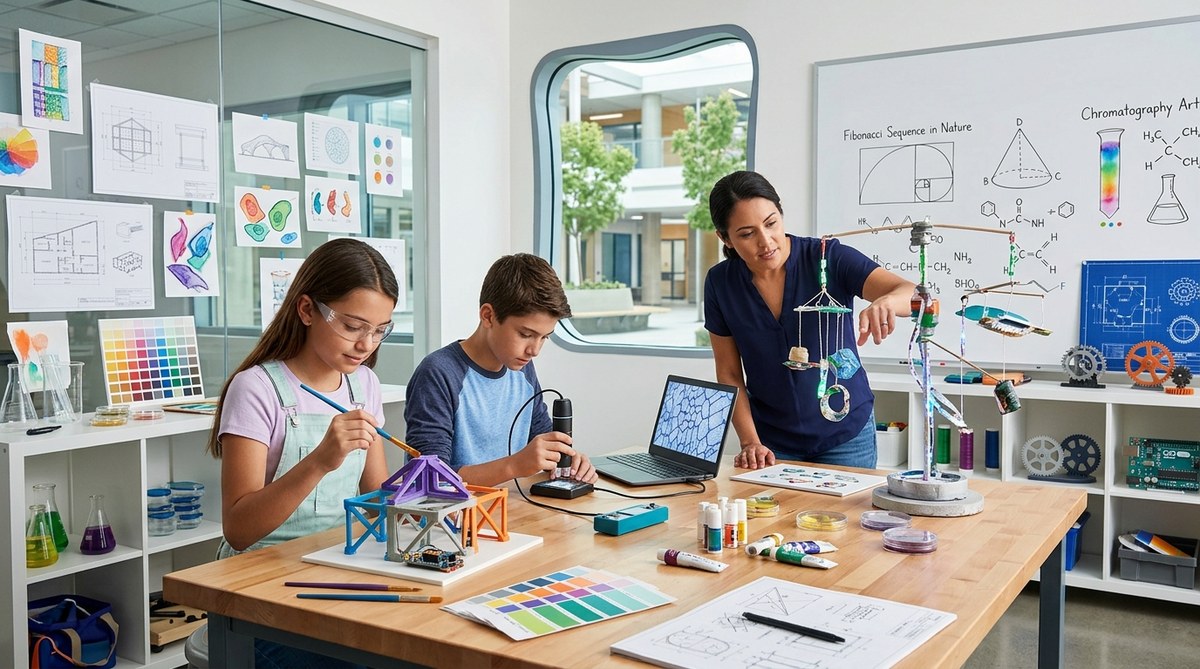
Art and science have long been viewed as distinct fields. One is often seen as a way to express feelings and imagination. The other as a method to understand the natural world through facts and experiments. Yet, when these two worlds come together, they create something extraordinary. The art and science intersection in STEM education opens doors to new ways of thinking and solving problems. It encourages students to see beyond traditional boundaries. This approach sparks curiosity, creativity, and innovation. It transforms the classroom into a dynamic space where ideas blend and evolve.
Integrating art into science education enhances creativity and engagement. It helps students develop vital problem-solving skills while making [STEM subjects](https://en.wikipedia.org/wiki/STEM_education) more accessible and inspiring.
Understanding the significance of art and science in STEM learning
The fusion of art and science in education is more than just combining two subjects. It creates a powerful learning environment that nurtures critical thinking, innovation, and empathy. This integration encourages students to approach problems from multiple perspectives. For example, designing a sustainable building involves understanding engineering principles and visualizing aesthetic appeal. Similarly, creating scientific illustrations requires both accuracy and artistic skill.
Research shows that students engaged in art-infused science activities tend to retain information better. They also develop a deeper appreciation for the interconnectedness of different fields. This approach makes learning more relevant and enjoyable, especially for students who thrive through visual or hands-on experiences.
Why the art and science integration matters
- It fosters creativity alongside analytical skills
- It makes STEM subjects more engaging and less intimidating
- It promotes collaboration across disciplines
- It nurtures innovative problem-solving abilities
Practical ways to weave art into science education
Incorporating art into science lessons doesn’t have to be complicated. Here are some strategies that teachers and educators can adopt:
- Use visual storytelling to explain scientific concepts
- Encourage students to create science-inspired artwork
- Incorporate design thinking in experiments and projects
- Utilize multimedia tools for interactive learning
- Design interdisciplinary projects that require both artistic and scientific input
Step-by-step process for integrating art and science
- Identify learning objectives that benefit from visual or creative expression.
- Select appropriate activities such as drawing, modeling, or digital media projects.
- Provide resources like art supplies, software, or scientific images.
- Facilitate collaborative work where students combine scientific data with artistic design.
- Assess both scientific understanding and creative execution to evaluate student learning.
Techniques and common pitfalls
| Technique | What to do | Common mistake |
|---|---|---|
| Scientific illustration | Encourage detailed drawings of specimens or processes | Focusing only on aesthetics, ignoring accuracy |
| Data visualization | Use charts, infographics, or animations | Overcomplicating visuals, making data hard to interpret |
| Artistic modeling | Create physical models of scientific concepts | Neglecting scale or scientific relevance |
| Digital media projects | Incorporate videos, podcasts, or interactive apps | Overloading projects with features, losing clarity |
“Blending art and science encourages students to think creatively about technical problems, resulting in more innovative solutions,” says education expert Dr. Lisa Carter. This approach also helps learners develop a more profound understanding of complex topics.
Benefits of art and science collaboration in STEM classrooms
- Enhanced engagement: Students find learning more appealing when they can express ideas visually or creatively.
- Improved retention: Artistic activities reinforce scientific concepts through active participation.
- Broader skill development: Students gain skills in communication, design, visualization, and critical thinking.
- Increased inclusivity: Art-based methods cater to diverse learning styles and abilities.
For teachers interested in deepening their understanding, resources like unlock creativity by merging art and science in your classroom provide practical guidance and inspiring examples.
Practical projects to explore the art and science intersection
- Create scientific comics to explain complex processes
- Design eco-friendly products considering both functionality and aesthetics
- Develop visual models of atoms, molecules, or ecosystems
- Produce multimedia presentations combining scientific data with artistic narration
- Organize exhibitions where students showcase art inspired by scientific themes
Example project: The science mural
Students collaborate to design a mural that illustrates a scientific concept, such as the water cycle or plant biology. They research, sketch, and paint while explaining the science behind their artwork. This activity promotes teamwork and deepens understanding.
Final thoughts on fostering creativity in STEM education
Bringing art into science classrooms transforms the learning experience. It breaks down barriers and sparks curiosity. Students learn to see science not just as facts but as a creative process. They develop skills that are vital in a world that values innovation and adaptability. Teachers can start small by integrating visual elements or encouraging artistic projects aligned with scientific topics.
Encouraging the art and science intersection in STEM education creates a vibrant, engaging, and inclusive environment. It prepares students to think outside the box and approach challenges with confidence and creativity. By embracing this blend, educators help cultivate the next generation of thinkers, inventors, and leaders.
Let your classroom be a space where imagination and inquiry meet. Try integrating artistic activities into your science lessons and watch your students thrive.
Enhance your teaching strategies by exploring more about how art and science can work together to inspire a love for STEM. It’s a simple step toward making science more accessible and exciting for every learner.