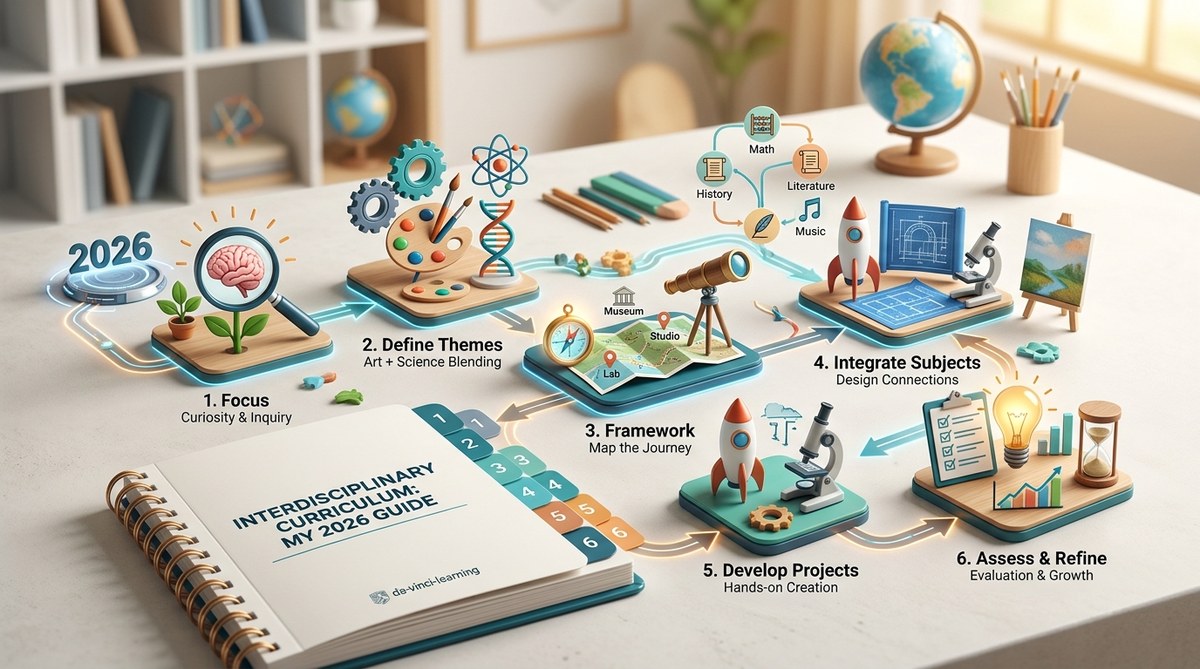
You walk into a classroom that doesn’t feel like a classroom at all. Students are clustered around a table, sketching the pattern of light bending through a glass of water. Someone is measuring angles with a protractor. Another student is writing a poem about refraction. The teacher is not lecturing. She is asking one question: “What else could light be doing right now?” This is the heart of interdisciplinary learning. It is not about squeezing two subjects into one period. It is about designing a curriculum where the boundaries between art, science, math, and language blur until they disappear. If you are ready to build something like this for the 2026 school year, here is your practical guide.
Designing an interdisciplinary curriculum starts with a central question, not a list of standards. You map skills from multiple subjects, build inquiry-based projects around a shared theme, and assess students on their ability to connect ideas. This guide gives you a repeatable process to create a curriculum that feels alive, not compartmentalized.
Start With a Question, Not a Subject
The biggest mistake new curriculum designers make is starting with a subject. “I need to teach biology and art together” is a recipe for a forced pairing. Instead, start with a question that cannot be answered by one discipline alone.
A good central question is open, messy, and interesting. For example: “How does water shape the way we live?” This question can pull in hydrology, poetry, cartography, and sculpture. It invites students to look at water as a scientific system, a cultural symbol, and an artistic medium.
When you frame your curriculum around a question, you naturally create space for multiple perspectives. Students stop asking “Is this science or art?” and start asking “How does this help me understand the question better?”
Here are a few examples of strong central questions for 2026:
- What does it mean to map something invisible?
- How do we measure growth in ways that numbers cannot show?
- Why do humans create patterns, and what do those patterns reveal?
Each of these questions can anchor a semester or a full year of learning. They give you a compass for choosing content, activities, and assessments.
Map Your Standards Across Disciplines
Once you have your central question, the next step is practical. You need to identify the learning standards or skills from each subject that naturally connect to that question. This is where curriculum design becomes a puzzle.
Make a list of the core skills you want students to build. For a project on water, that list might include:
- Scientific observation and data collection (science)
- Descriptive and persuasive writing (language arts)
- Scale, proportion, and measurement (math)
- Visual composition and use of color (art)
Do not try to force every standard from every subject into one unit. Pick three to five skills that genuinely support the central question. A small, focused set of goals is easier to assess and feels more coherent to students.
To help you visualize this process, here is a simple table showing common techniques and the mistakes that can derail them.
| Technique | Common Mistake |
|---|---|
| Start with a big question | Forcing a question that is too narrow or too academic |
| Map skills from 3 to 5 subjects | Trying to cover every standard from every subject |
| Build shared vocabulary across disciplines | Assuming students will make connections on their own |
| Use a final project as the assessment | Grading only the final product, not the process |
| Schedule collaborative planning time | Planning in isolation and hoping it aligns |
Build Projects That Demand Cross-Subject Thinking
A curriculum is only as strong as the work students do inside it. Each project should require students to use skills from at least two disciplines to complete a single task. If a project can be done using only one subject, it is not interdisciplinary.
For a curriculum centered on the question “How does water shape the way we live?”, a strong project might ask students to:
- Collect water samples from a local stream and measure pH, temperature, and turbidity.
- Create a visual field journal that documents the water’s color, movement, and surrounding plant life.
- Write a short narrative from the perspective of a creature living in that water.
This single project pulls in biology, chemistry, visual art, and creative writing. Students cannot complete it by doing only one of those tasks. They have to move between modes of thinking.
“The best interdisciplinary work happens when a student has to switch lenses. One moment they are measuring data. The next moment they are deciding how to represent that data as an image. That switch is where deep learning lives.” — Dr. Mira Patel, curriculum designer
Create a Rhythm That Supports Inquiry
Interdisciplinary learning does not mean every day looks the same. You need a rhythm that allows for direct instruction, independent exploration, and group work. A predictable structure helps students know when to zoom in on a skill and when to zoom out to see the big picture.
A sample weekly rhythm might look like this:
- Monday: Introduce a new lens. Students read a short text or watch a video that presents a new way of seeing the central question. This could be a scientific article, a poem, or a piece of art.
- Tuesday and Wednesday: Skill-building workshops. Students rotate through stations that focus on specific skills like graphing data, mixing paint, or writing a thesis statement.
- Thursday: Project work time. Students apply the skills they have practiced to their ongoing project.
- Friday: Reflection and critique. Students share work in progress, give feedback, and write a short reflection on what they are learning about the central question.
This rhythm gives you structure without rigidity. It also ensures that students get explicit instruction in each discipline before they are asked to combine them.
Assess Connections, Not Just Content
Traditional grading systems struggle with interdisciplinary work. If you give separate grades for science and art on the same project, you are reinforcing the very boundaries you are trying to erase. Instead, assess students on their ability to make connections.
Create rubrics that look for evidence of transfer. For example:
- Does the student use vocabulary from one subject to explain a concept in another?
- Does the student intentionally choose a medium (writing, drawing, data) based on what it can express?
- Can the student explain why a certain skill from math was useful in solving an art problem?
You can still give feedback on individual skills. A student may need help with watercolor technique or with calculating averages. But the final grade should reflect how well they integrated those skills to answer the central question.
For more on how to structure assessments around curiosity and inquiry, read our guide on harnessing curiosity in the classroom to foster interdisciplinary inquiry.
Plan for Collaboration and Flexibility
You cannot design an interdisciplinary curriculum alone in your classroom. It requires time to talk with colleagues, share resources, and align schedules. If you are in a school setting, ask for common planning time with teachers from other departments. If you are a solo educator or curriculum designer, build a network of peers online who can give you feedback.
Flexibility matters too. Your first attempt at a project may not work the way you expected. Students might struggle with a skill you thought they had mastered. A question that seemed rich in September might feel stale by November. That is normal. Build in checkpoints where you can adjust the curriculum based on student feedback and your own observations.
A good habit is to schedule a mid-unit “pivot day” where you ask students what is working and what is not. Their answers will tell you what to keep and what to change.
A Practical Example: The Invisible Maps Project
Let us put all of this together with a concrete example. Imagine a 6th grade interdisciplinary curriculum built around the question “What does it mean to map something invisible?”
The skills you map might include:
- Science: Understanding how sound waves travel and how echolocation works
- Math: Using coordinate systems and scale
- Art: Using value, texture, and line to create depth
- Language Arts: Writing descriptive and procedural texts
The final project asks students to create a “map” of a space using only sound. They record audio from different points in a room, measure decibel levels, and plot the data on a coordinate grid. Then they create a visual representation of the soundscape using ink and watercolor. Finally, they write a guide explaining how to read their map.
This project requires students to think like scientists, mathematicians, artists, and writers. It is not a science project with a drawing added at the end. It is a fully integrated experience.
If you want more ideas for blending subjects, check out our post on innovative methods to integrate art and science in inquiry-based education.
Your First Step for 2026
You do not need to redesign your entire curriculum overnight. Start with one unit. Pick a question that genuinely interests you and your students. Map two or three skills from different subjects. Build one project that demands cross-subject thinking. Try it. Reflect on it. Then do it again.
The educators who succeed with interdisciplinary design are not the ones with the most resources. They are the ones who start small, stay curious, and keep asking better questions. Your students will notice the difference. When they start making connections on their own, you will know the curriculum is working.
For a deeper look at how inquiry-based learning supports this kind of curriculum, read why inquiry-based learning is the key to mastering both art and science.
Keep the Questions Alive
The most important thing to remember is that an interdisciplinary curriculum is never finished. It grows as your students grow. It shifts as new questions emerge. The goal is not to create a perfect document. The goal is to create a learning environment where students see the world as a connected whole, not a collection of separate subjects.
You have the tools now. Pick your question. Map your skills. Build your first project. And trust that the process of designing an interdisciplinary curriculum will teach you as much as it teaches your students.