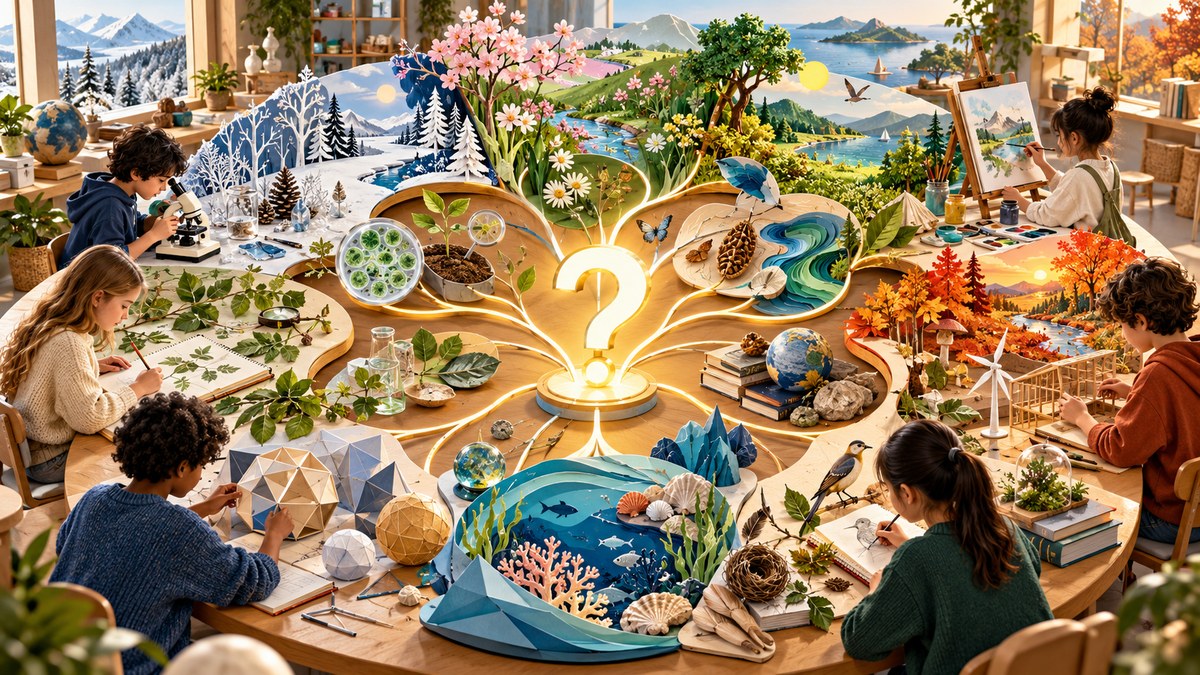
A single question can reshape an entire school year. One curious student asks, “Why do leaves change color?” and suddenly you are looking at biology, chemistry, art history, data visualization, and poetry all woven into one living project. That is the power of interdisciplinary project planning 2026. It is not about cramming subjects together. It is about letting a genuine question pull knowledge from every direction naturally.
A single driving question can structure an entire year of interdisciplinary learning. This guide shows educators and self-directed learners how to build a framework that pulls from art, science, math, and humanities naturally. You will get a step-by-step process, a table of common pitfalls, and a calendar template for 2026. The goal is depth without chaos.
Start with a Question That Has Legs
Not every question can carry a year. A good candidate feels too big for one subject. It sparks debate. It leads to more questions. Here are a few examples that have worked well in classrooms across the United States:
- What makes a city livable?
- How do we measure happiness?
- Where does our food actually come from?
- Can art change the way we see science?
The question should feel open ended. If you can answer it with a single Google search, it is too narrow. If it makes students argue about what “livable” even means, you have found a winner.
“The best driving questions are the ones that make students uncomfortable in the best way. They force you to admit you do not know something important.” — Jay McTighe, co-author of Understanding by Design
Map the Disciplines That Live Inside the Question
Once you have the question, draw a circle around it. Then draw spokes outward for each subject area that connects. For a question about food sources, the spokes might look like this:
- Biology: plant growth, soil health, genetics of crops
- Chemistry: preservatives, cooking reactions, nutrition labels
- Geography: climate zones, trade routes, food deserts
- Math: supply chain logistics, calorie calculations, statistical analysis of food waste
- Art: food photography, cultural plating traditions, packaging design
- History: agricultural revolutions, spice trade, migration of cuisines
- Writing: persuasive essays on food policy, creative menus, field journals
This map becomes your curriculum skeleton. You do not need to use every spoke every week. But having the map ensures you never force a connection that does not belong.
A Practical Process for Year-Long Interdisciplinary Project Planning 2026
Follow these six steps to move from a single question to a full year of integrated study. Adjust the timeline based on your school calendar or personal pace.
-
Select the question collaboratively. Let students vote or propose their own. Ownership matters. If you are a self-directed learner, choose something that genuinely bothers or fascinates you.
-
Build the discipline map together. Spend one week listing all the subjects that touch the question. Use sticky notes on a wall or a shared digital board. The goal is to see the project’s full shape before diving in.
-
Create quarterly focus areas. Divide the year into four phases. Each phase highlights two or three disciplines from your map. For example, Fall might focus on biology and geography, while Winter shifts to math and writing.
-
Design a signature experience per quarter. Each phase needs one memorable event. A field trip to a local farm. A guest speaker who works in food policy. A school wide taste test that generates data for math class.
-
Build in reflection weeks. Every six to eight weeks, pause for a week of synthesis. Students create something that connects what they have learned so far. It could be a visual journal, a short film, or a community presentation.
-
End with a culminating exhibition. The final month is for a public showcase. Students present their answers to the driving question. They defend their conclusions using evidence from multiple disciplines.
Common Mistakes and How to Avoid Them
Even the best interdisciplinary project planning 2026 can go off track. Here is a table of frequent mistakes and practical fixes.
| Mistake | What It Looks Like | Better Approach |
|---|---|---|
| Forcing connections | “We studied the Pythagorean theorem because it relates to everything.” | Only include a discipline if it genuinely answers a sub-question. Skip it otherwise. |
| Losing the question | By February, the class has forgotten the original prompt. | Display the question on the wall. Start each week by revisiting it. |
| Overplanning | Every day is scheduled. No room for student detours. | Leave one day per week for “curiosity catch up” where students follow new threads. |
| Grading too narrowly | Rubrics only measure content recall, not synthesis. | Use a single rubric that values connection making, evidence use, and reflection. |
| Skipping the arts | The project becomes STEM only. | The arts are not decoration. They are a way of knowing. Include visual thinking, music, or performance. |
A Sample Calendar for 2026
Here is how a year could unfold if your driving question is “How do we measure happiness?”
First Quarter (January to March): Defining Happiness
– Psychology and Philosophy: Read what ancient thinkers and modern researchers say about happiness.
– Creative Writing: Write personal definitions and short narratives about joyful moments.
– Data Collection: Design a simple survey. Ask friends and family to rate their happiness factors.
Second Quarter (April to June): Measuring Happiness
– Statistics: Analyze survey results. Create charts and find correlations.
– Neuroscience: Learn about dopamine, serotonin, and the brain’s reward system.
– Visual Art: Create infographics that communicate your findings without words.
Third Quarter (July to September): Designing for Happiness
– Urban Planning: Study how city design affects well being. Look at parks, walkability, and noise.
– Economics: Examine the relationship between income and reported happiness.
– Engineering: Build a small model of a “happiness friendly” public space.
Fourth Quarter (October to December): Sharing What We Found
– Public Speaking: Prepare a TED style talk answering the driving question.
– Film or Podcast: Produce a short documentary interviewing community members.
– Exhibition: Host an evening event where students present their models, films, and data.
Why This Approach Works Better Than Traditional Units
Traditional schooling often isolates knowledge. You learn photosynthesis in science class and never connect it to the poetry about autumn in English class. Interdisciplinary project planning 2026 forces those connections to become visible. Students stop asking “When will I ever use this?” because they are using everything right now.
A 2025 study from the American Educational Research Association found that students in interdisciplinary programs scored 18 percent higher on critical thinking assessments compared to peers in subject isolated tracks. More importantly, they reported higher engagement and lower absenteeism during project weeks.
Tools to Keep Your Project Organized
You do not need expensive software to run a year long project. Here are a few low cost tools that work well:
- A shared digital journal: Google Docs or a class blog where every student contributes weekly reflections.
- A physical question wall: A bulletin board where students pin new questions that arise during research.
- A simple timeline tool: Trello or a paper calendar with color coded phases for each discipline.
- A portfolio system: Students keep a binder or digital folder with their best work from each quarter.
For more ideas on blending art and science in these projects, check out how to design interdisciplinary projects that ignite student curiosity in 2026. You can also read about why curiosity-driven learning is the ultimate bridge between art and science.
The Role of the Teacher Changes in a Year-Long Project
You are not the lecturer anymore. You are the curator, the guide, and sometimes the co-learner. That shift can feel uncomfortable at first. But it is also liberating. You get to say “I do not know the answer to that. Let us find out together.” Students respect that honesty.
Your main job is to protect the question. When the class gets distracted by a shiny sub-topic, you gently steer them back. When a student feels lost, you help them see how their current work connects to the bigger picture. You are the keeper of the thread.
What to Do When the Question Changes Mid-Year
Sometimes the original question loses steam. That is okay. A living project adapts. If students suddenly become obsessed with the economics of happiness rather than the neuroscience, let the emphasis shift. The question itself can evolve.
You might rewrite the question together. “How do we measure happiness?” could become “Can money buy happiness?” or “What makes a neighborhood happy?” The disciplines you mapped earlier still apply. You are just adjusting the lens.
A Final Note on Assessment
Traditional tests do not capture what students learn in a year long interdisciplinary project. Instead, assess these three things:
- Depth of inquiry: Did the student ask better questions as the year went on?
- Quality of connections: Can the student explain how two disciplines informed each other?
- Quality of final product: Does the exhibition show evidence of genuine learning and reflection?
A simple portfolio review at the end of each quarter works better than a final exam. Students select their best pieces and write a short reflection on what they learned.
Your Year Starts with One Question
Interdisciplinary project planning 2026 does not require a perfect curriculum or a team of co-teachers. It requires one good question and the courage to follow it. Start small. Pick a question that matters to your students or to you. Map the disciplines. Build a loose calendar. Leave room for detours. By December, you will look back and see a year where learning felt connected, purposeful, and alive.
If you want to see more examples of how this works in practice, read about what happens when art and science collide in interdisciplinary classrooms. You might also enjoy a teacher’s blueprint for integrating art and science through inquiry in 2026.
The hardest part is asking the first question. After that, the project builds itself.