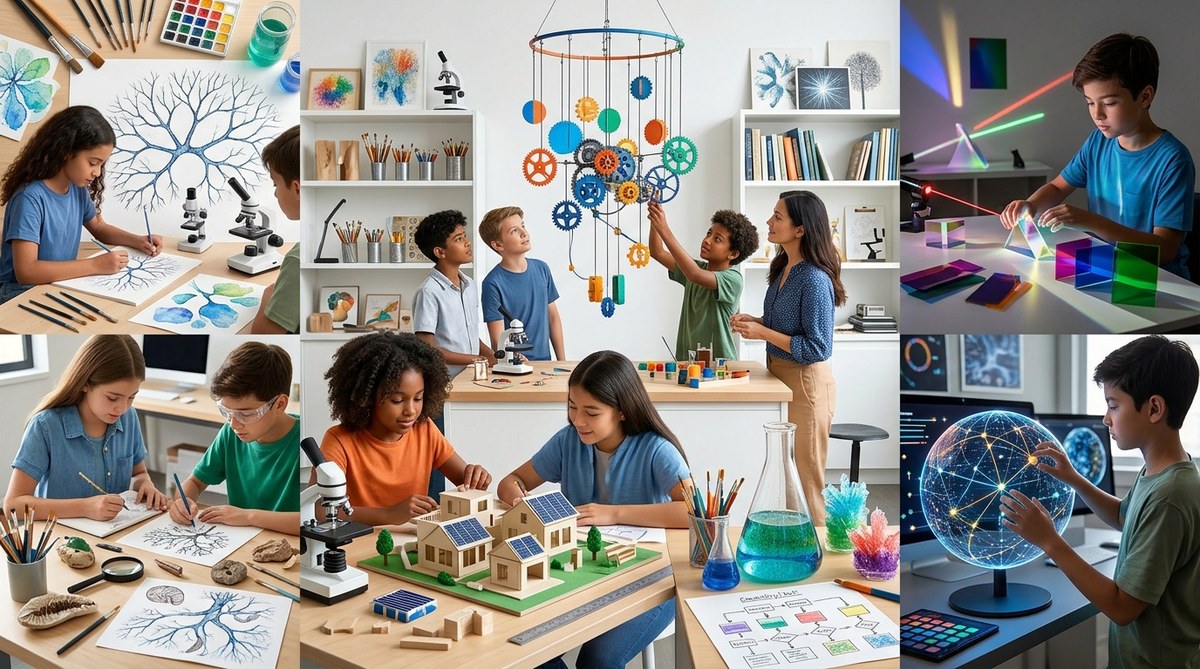
Picture a classroom where students are not just memorizing facts but painting the water cycle, building miniature ecosystems, and sketching the anatomy of a flower. That is the magic of STEAM inquiry-based activities. When you blend the curiosity of scientific inquiry with the freedom of creative art, something special happens. Students stop asking “When will I use this?” and start asking “What happens if I try this instead?” That shift in questioning is the heart of inquiry-based learning. In this guide, you will find seven hands-on, project-based activities designed for K-8 educators, STEM coordinators, and homeschool parents. Each activity merges art and science to foster deeper engagement and genuine discovery.
STEAM inquiry-based activities work best when students drive the questions. Instead of giving step-by-step instructions, let each activity begin with a provocation that sparks curiosity. The seven projects below are designed to be flexible, allowing students to choose their own artistic and scientific paths. The result is a classroom where art and science coexist naturally, and every mistake becomes a learning opportunity.
Why Art and Science Belong Together in Your Classroom
The traditional separation of subjects does not reflect how the real world works. A painter needs to understand light and chemistry. An engineer needs to visualize form and function. When you combine art and science, you teach students to think like innovators. They learn to observe closely, ask better questions, and communicate their findings visually. This is not about making science “fun” with a craft project. It is about using art as a tool for scientific thinking and using science as a lens for artistic expression.
For more on this philosophy, read about unlocking creativity by merging art and science in your classroom.
The Seven Inquiry-Based Activities
Each activity below follows a simple structure: a provocation to spark curiosity, a hands-on investigation, and a creative output that demonstrates learning. You can adapt them for grades K through 8.
1. The Living Color Wheel: Plant Pigments and Watercolor
Students extract natural pigments from leaves, berries, and spices to create their own watercolor paints. They then use these paints to create a color wheel that also serves as a pH indicator.
- Science inquiry: How do different solvents affect pigment extraction? What makes some colors change when mixed with lemon juice or baking soda?
- Art connection: Students learn color theory while experimenting with natural dyes.
- Materials: Red cabbage, turmeric, spinach, coffee filters, water, vinegar, baking soda, paper.
2. Shadow Sculptures: Light, Geometry, and Storytelling
Using simple materials like cardboard, dowels, and flashlights, students build sculptures that cast specific shadows. The challenge is to make a shadow that tells a story or shows a scientific concept like the phases of the moon.
- Science inquiry: How does the angle of light change the shape of a shadow? What happens when you use multiple light sources?
- Art connection: Students design for negative space and narrative.
- Materials: Cardboard, scissors, tape, flashlights, white paper or wall.
3. The Sound Garden: Physics of Vibration and Rhythm
Students create instruments from recycled materials and then arrange them into a “sound garden” that demonstrates principles of sound waves. They can record their compositions and analyze the waveforms.
- Science inquiry: How does the length of a string or tube affect pitch? What materials amplify sound best?
- Art connection: Students compose a piece that represents a scientific concept like a heartbeat or weather pattern.
- Materials: PVC pipes, rubber bands, cans, rice, balloons, recording device.
4. Microscope Mandalas: Pattern Hunting in Nature
After collecting leaves, insect wings, or flower petals, students examine them under a microscope or magnifying glass. They then draw or paint the patterns they see, arranging them into a mandala.
- Science inquiry: What patterns repeat in nature? How do these patterns help organisms survive?
- Art connection: Students practice close observation and create symmetrical designs.
- Materials: Magnifying glasses or microscopes, paper, colored pencils, collected natural objects.
5. The Weather Wall: Data Visualization Through Textiles
Students track local weather data for two weeks (temperature, cloud cover, wind speed) and then weave or sew a textile piece that represents the data. Each color or texture corresponds to a weather condition.
- Science inquiry: How do you collect reliable data? What patterns emerge over time?
- Art connection: Students learn about data visualization and textile arts.
- Materials: Cardboard looms, yarn in various colors, weather instruments or online data.
6. Fossil Fictions: Geology and Creative Narrative
Students create “fossils” using clay and natural objects (leaves, shells, bones). They then write a short story about the creature or plant that left the fossil, using evidence from their imprint.
- Science inquiry: How do fossils form? What can we infer about an organism from its fossil?
- Art connection: Students combine scientific observation with creative writing.
- Materials: Air-dry clay, natural objects, paper, pencils.
7. The Rube Goldberg Gallery: Simple Machines as Art
Students design and build a simple machine that performs a small task (like popping a balloon or ringing a bell). The machine must be visually interesting and include at least three simple machines.
- Science inquiry: How do levers, pulleys, and inclined planes transfer energy?
- Art connection: Students focus on aesthetics, balance, and storytelling through motion.
- Materials: Recycled materials, string, marbles, tape, cardboard.
A Practical Process for Running Any Inquiry Activity
Follow these five steps to ensure your STEAM inquiry-based activities stay student-driven and productive.
- Start with a provocation. Show a photo, play a sound, or ask a question that has no single right answer. For example: “Can you make a color from a plant?”
- Let students ask questions. Give them time to wonder aloud. Write their questions on the board. Let those questions guide the investigation.
- Provide materials, not instructions. Give students the tools and let them experiment. Resist the urge to show them “the right way.”
- Encourage documentation. Have students sketch, photograph, or write about their process. This builds observation skills.
- Celebrate the struggle. When something fails, ask: “What did you learn from that? What will you try next?”
Common Mistakes and How to Avoid Them
Even the best STEAM inquiry-based activities can fall flat if you fall into these traps. Use this table to check your approach.
| Mistake | Why It Happens | How to Fix It |
|---|---|---|
| Giving too many instructions | We want to avoid chaos | Start with just one material and one question. Add more as students gain confidence. |
| Focusing on the final product | Pressure to display work | Emphasize the process journal over the final piece. Ask students to share what they tried, not just what worked. |
| Separating art and science time | Scheduling constraints | Combine subjects into one block. Let the science question drive the art project and vice versa. |
| Ignoring student questions | Sticking to a lesson plan | Leave 10 minutes at the start for student questions. Let those questions reshape the activity. |
| Using only one medium | Limited supplies | Rotate materials each week. Try clay one week, fabric the next, digital tools the week after. |
What Students Learn When Art and Science Collide
“When a child paints a picture of a cell, they are not just memorizing the parts. They are making decisions about scale, color, and texture. That act of creation forces them to understand the structure on a deeper level than any worksheet ever could.”
* Dr. Maya Rodriguez, author of The Art of Inquiry
Students who engage in STEAM inquiry-based activities develop skills that go beyond the classroom. They learn to tolerate ambiguity, because art and science both require working with the unknown. They learn to communicate visually, because a diagram or a painting can say things that words cannot. And they learn to see the world as a place full of questions worth asking.
For a deeper look at this idea, check out why inquiry-based learning is the key to mastering both art and science.
Materials to Keep on Hand for Spontaneous Inquiry
A well-stocked classroom makes it easier to pivot when a student asks a great question. Keep these items accessible:
- Natural objects (leaves, rocks, shells, seeds)
- Basic art supplies (paper, paint, clay, markers, yarn)
- Simple tools (magnifying glasses, rulers, scissors, tape)
- Recycled materials (cardboard, plastic bottles, bottle caps, fabric scraps)
- Digital tools (tablets or cameras for documentation)
How to Adapt Activities for Different Grade Levels
Not every activity works the same way for kindergarteners and eighth graders. Here are some adjustments.
For grades K-2: Focus on one variable at a time. For the Living Color Wheel activity, use only two pigments and let children mix them. Keep the science questions simple: “What happens when we add water?”
For grades 3-5: Introduce measurement and recording. Have students create data tables for their shadow sculptures. Ask them to predict what will happen before they test.
For grades 6-8: Add variables and encourage independent inquiry. Let students design their own experiments within the activity. For the Sound Garden, have them calculate frequencies and compare them to musical notes.
Building a Year-Long STEAM Inquiry Culture
One activity can spark curiosity, but a classroom culture sustains it. Here are ways to make STEAM inquiry-based activities a regular part of your teaching.
- Start each week with a question wall. Students add questions they have about the world. Pick one to investigate together.
- Create a studio space. Designate a corner of your room for ongoing projects. Let students return to their work throughout the week.
- Invite guest artists and scientists. A local painter who works with natural pigments or a biologist who draws field sketches can inspire students.
- Celebrate process over product. Host a “failure fair” where students share what went wrong and what they learned.
For more on this approach, read about how to design interdisciplinary projects that ignite student curiosity in 2026.
The Teacher’s Role in an Inquiry-Based Classroom
Your job shifts from being the source of answers to being the curator of questions. That can feel uncomfortable at first. Here are three ways to embrace that role.
- Say “I don’t know” more often. When a student asks something you cannot answer, say it out loud. Then say, “Let us find out together.” That models intellectual honesty.
- Ask better questions. Instead of “What color is this leaf?” try “Why do you think this leaf is red instead of green?”
- Step back. Give students space to struggle. Do not rescue them too soon. Let them try, fail, and try again.
A Final Thought on the Art-Science Studio
Your classroom can be a place where students feel safe to wonder, to create, and to question. It does not require expensive equipment or a perfect curriculum. It requires a willingness to let go of control and trust the process. The seven STEAM inquiry-based activities in this guide are just a starting point. Use them, adapt them, and then invent your own. The best lessons are the ones you and your students discover together.
Start with one activity this week. Notice how your students respond. Watch for the moment when a student’s eyes light up because they just figured something out on their own. That is the moment when your classroom becomes an art-science studio. And that is where real learning happens.