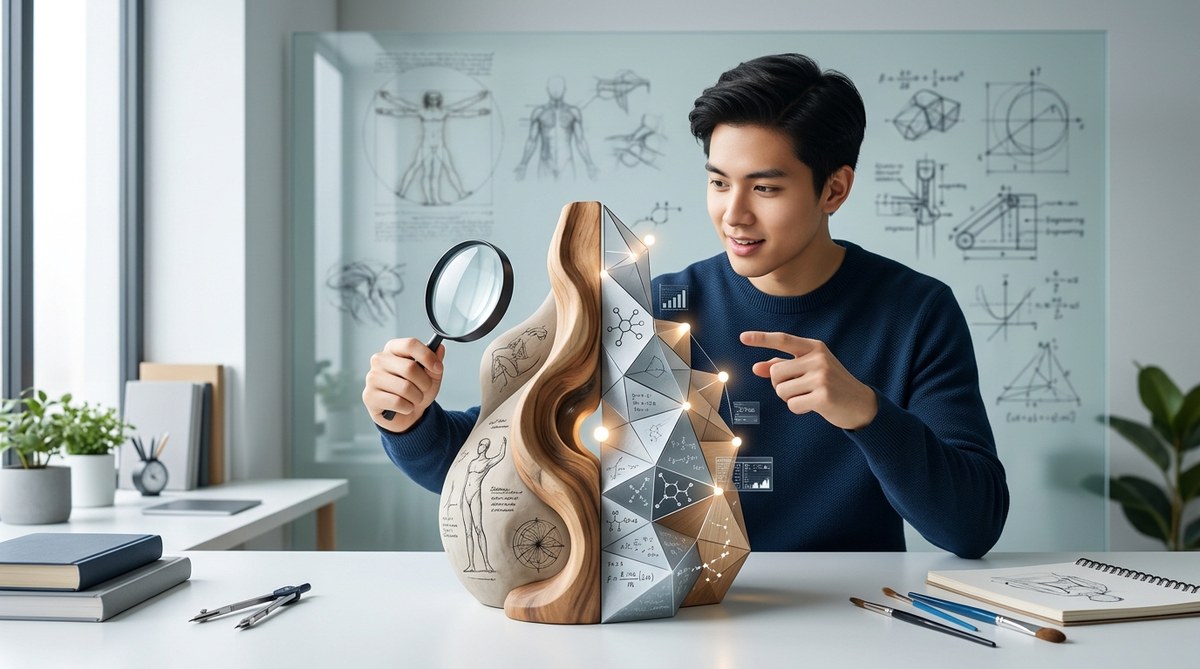
In a classroom that feels alive, a student stares at a leaf under a microscope, then picks up a brush to paint its veins. Another student sketches a gear system, then builds a working model from cardboard and string. These moments don’t happen by accident. They happen when teaching moves beyond lectures and worksheets into something deeper. That something is inquiry-based learning.
For educators and curriculum designers in 2026, the question is no longer whether to use this approach, but how to weave it naturally into lessons that bridge art and science. When done right, inquiry-based learning turns a classroom into a studio, a lab, and a think tank all at once. And it equips students with the curiosity and critical thinking they need for a world that constantly demands both creativity and logic.
Inquiry-based learning is a powerful method that helps students master both art and science by starting with questions rather than answers. It builds curiosity, autonomy, and real problem solving skills. This guide gives you practical steps, common pitfalls to avoid, and clear examples you can use in your own classroom today.
What Makes Inquiry-Based Learning a Natural Fit for Art and Science
Traditional education often separates disciplines. Art is about expression and feeling. Science is about facts and experiments. But the real world does not work that way. A painter uses chemistry to mix pigments. An engineer uses aesthetics to design a bridge. Inquiry-based learning mirrors this overlap.
Instead of handing students a formula to memorize, you hand them a question. “Why do some leaves turn red in the fall?” “How can we build a structure that is both beautiful and strong?” The student then uses tools from art and science to find an answer. They research, draw, build, test, and revise. This process feels natural because it mirrors how humans have always learned: by wondering, trying, and making sense of the world.
For curriculum designers, this approach is especially effective because it respects the whole learner. It does not force a choice between art and science. It invites students to use both. The result is deeper understanding and longer retention.
Four Steps to Build an Inquiry-Driven Lesson
Designing a lesson that blends art and science does not have to be complicated. Follow these four steps to create a strong foundation.
-
Start with a big, open question. The question should have no single correct answer. For example, “How does light shape the way we see color?” or “What makes something feel alive?” These questions invite investigation from both an artistic and scientific angle.
-
Let students guide their own investigation. Provide resources like books, videos, materials, and tools. Then step back. Allow students to choose which path to follow. Some may want to mix paints and test color theory. Others may want to study the physics of reflection. Your role is to facilitate, not dictate.
-
Create a tangible outcome. Ask students to produce something that shows what they learned. This could be a painting, a model, a short video, or a written report. The key is that the outcome connects back to the original question and incorporates both art and science.
-
Reflect on the process. After the project is done, hold a class discussion. What worked? What was surprising? How did art and science help each other? Reflection solidifies learning and prepares students for the next inquiry cycle.
Key Benefits You Will See in Your Classroom
Inquiry-based learning is not just a feel good method. It produces measurable results. Here are some of the most important benefits for students and teachers alike.
- Deeper engagement. When students own the question, they care more about the answer. They spend extra time because they want to, not because they have to.
- Improved critical thinking. Students learn to evaluate sources, test ideas, and adjust their approach when something fails.
- Natural differentiation. Every student can work at their own pace and follow their own interests within the same project.
- Stronger collaboration. Students often work in teams, sharing ideas across art and science perspectives.
- Long term retention. Concepts learned through inquiry stick around longer than facts copied from a board.
Common Mistakes and How to Fix Them
Even experienced educators can stumble when first trying inquiry-based learning. The table below shows frequent mistakes and practical solutions.
| Mistake | How to Avoid It |
|---|---|
| The question is too broad or too narrow. | Test your question with a colleague. If it can be answered with a simple yes or no, widen it. If it has no clear path, narrow it down. |
| Students feel lost without direct instructions. | Provide a simple structure or checklist. Remind them that it is okay to ask for help. Scaffolding is not the same as giving answers. |
| Art and science feel forced together. | Choose questions that naturally require both. For example, ask about patterns in nature, sound waves, or the chemistry of paint. |
| Assessment is unclear. | Create a rubric that values the process, the creativity, and the scientific reasoning equally. Grade the inquiry, not just the final product. |
| Time runs out. | Plan for a shorter first inquiry cycle. Learn from it and adjust. A two week project can be just as powerful as a semester long one. |
Expert Advice from a Veteran Curriculum Designer
“Inquiry-based learning is not about letting students do whatever they want. It is about giving them a structure where their curiosity can thrive. The best questions are the ones that force students to use both their left brain and their right brain. When a student has to draw a diagram of a chemical reaction and then write a poem about it, the concept sticks. That is the magic of blending art and science.”
* Dr. Laura Mendez, curriculum designer and former high school teacher
Putting It All Together in Your Classroom
You do not need a complete redesign of your curriculum to start. Pick one unit or one week. Replace a standard lesson with a single inquiry question. Let students explore. See what happens.
For example, in a unit on ecosystems, ask your students: “How can we represent the balance of a forest through both data and art?” Students might collect data on plant species, build a graph, and then create a mural that shows the relationships. They use science to gather facts and art to communicate meaning. That is inquiry-based learning in action.
If you want to take this further, take a look at our guide on harnessing curiosity to integrate art and science. It offers specific prompts and templates. You can also see how interdisciplinary approaches foster innovation in real classrooms. And for a step by step plan, try these six steps to blend art and science in your own projects.
The world needs people who can think like an artist and a scientist at the same time. By using inquiry-based learning, you are preparing your students for exactly that. Start small, stay curious, and watch your classroom transform into a place where every question leads to a new discovery.