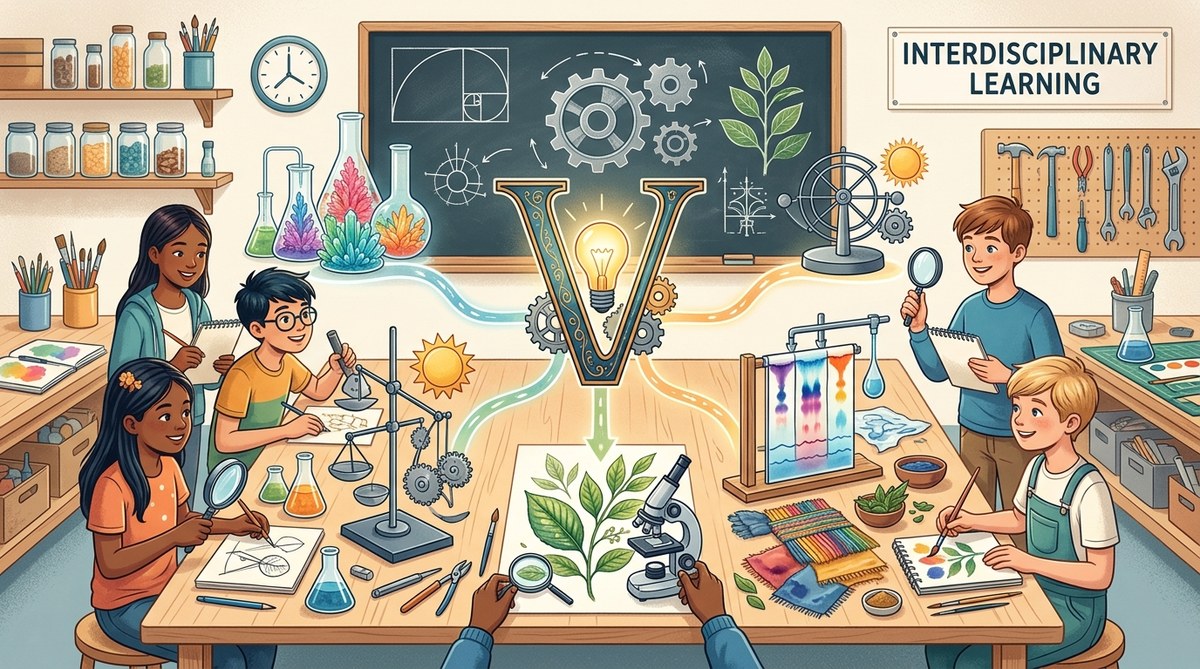
A third grader watches a puddle disappear from the playground blacktop. A middle schooler notices the way her shadow stretches long at sunset and shrinks at noon. A high school student wonders why the milk in his cereal bowl swirls into spirals when he stirs it. These moments are not distractions. They are the raw materials of science. Phenomena-based inquiry science lessons start right here, with the ordinary, the puzzling, the beautiful. By pairing these real-world observations with artistic expression, you can turn a simple question into a deep, memorable investigation. The projects below will help you do exactly that, blending science and art in ways that feel natural, not forced.
Phenomena-based inquiry science lessons work best when students can see, touch, and wonder about something real. By adding an artistic lens, you invite creativity into the scientific process. This guide provides five ready-to-use projects, a planning checklist, and practical tips to help you design lessons that boost both understanding and engagement in your K-12 classroom.
Why Phenomena Plus Art Works So Well
A phenomenon is any observable event. It can be a rainbow forming in a sprinkler, a rusting nail, or the way a tree’s branches reach toward sunlight. When you center a lesson on a phenomenon, you give students a reason to ask questions. They become investigators.
Art adds a layer of personal meaning. When a student draws the puddle shrinking over time, they are not just recording data. They are noticing texture, light, and pattern. They are making the science their own. This combination builds retention and critical thinking. A 2026 study from the National Science Teaching Association found that students in art-integrated science classrooms scored 23% higher on conceptual understanding tests than peers in traditional settings.
Five Projects That Turn Everyday Phenomena Into Artful Science Lessons
Each project below follows the same structure. You start with a common phenomenon, guide students through inquiry, and then ask them to create something artistic that shows their understanding.
1. The Disappearing Puddle: Water Cycle and Evaporation
The phenomenon. After a rain shower, puddles form on asphalt. Within hours, they vanish.
The inquiry. Ask students: Where does the water go? Let them brainstorm. They might say it sinks in, or it dries up. Guide them to test their ideas. Place measured amounts of water on different surfaces: concrete, soil, a plastic tray. Measure the time it takes for each to disappear.
The artful outcome. Have students create a series of watercolor paintings showing a puddle at ten-minute intervals. They mix colors to show the changing depth and light reflection. They label each painting with the time and temperature. This becomes a visual data set.
Why it sticks. Students connect the abstract concept of evaporation to a concrete experience. The art helps them see the process as gradual and beautiful.
2. Shadow Puppets: Light, Earth, and Time
The phenomenon. Shadows change length and direction throughout the day.
The inquiry. Take students outside at three different times: morning, noon, and afternoon. Have them trace each other’s shadows with chalk on the playground. Measure the lengths. Discuss why the sun appears to move across the sky.
The artful outcome. Students design and build shadow puppets from cardstock and craft sticks. They create a short shadow-puppet show that explains the relationship between the sun’s position and shadow length. They can perform for a younger grade.
Why it sticks. The hands-on building and performance turn a geometry and astronomy lesson into a story. Students remember the science because they acted it out.
3. Milk Swirls: Surface Tension and Chemical Reactions
The phenomenon. A drop of dish soap added to milk with food coloring creates swirling, colorful patterns.
The inquiry. Let students experiment. What happens if you use whole milk versus skim milk? What if you add the soap at different temperatures? Have them record their observations in a science journal.
The artful outcome. Each student captures a photograph of their most dramatic swirl. They print the photo and use it as the center of a mixed-media collage. They add labels, arrows, and short explanations of the science. The final piece looks like a scientific poster meets an art gallery.
Why it sticks. The visual drama of the swirl is memorable. The collage forces students to explain the chemistry in their own words.
4. Rusted Relics: Oxidation and Material Science
The phenomenon. Iron objects left in the rain develop orange-brown rust.
The inquiry. Place steel wool pads in different environments: one in a jar of water, one in a jar of saltwater, one in a jar of oil, and one left dry. Observe changes over a week. Students measure and describe the rust.
The artful outcome. Students collect rusted objects or create their own rust prints on paper. They use the rust as paint to create a landscape or abstract pattern. They write a short artist statement that explains the chemical reaction behind their material.
Why it sticks. Using rust as a medium is surprising. It makes the chemistry tangible and shows that science can be a source of art supplies.
5. Branching Out: Tree Architecture and Fractals
The phenomenon. Tree branches split into smaller and smaller branches, forming a pattern that repeats at different scales.
The inquiry. Take a nature walk. Have students sketch a single tree, paying attention to how the branches divide. Count the number of splits from the trunk to the smallest twig. Introduce the concept of fractals.
The artful outcome. Students paint or draw a fractal tree using a simple rule: each branch splits into two smaller branches. They can use ink, watercolor, or digital tools. They add labels showing the branching ratio.
Why it sticks. Fractals appear everywhere in nature: in rivers, lightning, and lungs. The art project reveals a hidden mathematical structure in the world.
How to Build Your Own Phenomena-Based Inquiry Science Lesson
You do not need a formal curriculum to design these lessons. You just need a good phenomenon and a creative question. Here is a simple process to follow.
- Notice something ordinary. Choose an event students see often but rarely think about. A candle flame. A foggy window. A spider web.
- Ask a question you don’t know the answer to. Frame it as a mystery. Why does the flame flicker? Why does fog form on the inside of the glass?
- Plan an investigation. Keep materials simple. Use rulers, jars, water, paper. Let students design the experiment when possible.
- Choose an art form. It does not have to be painting. It could be poetry, dance, photography, or sculpture. The art should help students communicate their findings.
- Reflect and share. Give students time to show their work and explain their thinking. This is where deep learning solidifies.
Common Mistakes and How to Avoid Them
Even the best lesson can fall flat if you miss a few key details. The table below shows common pitfalls and their solutions.
| Mistake | Why It Happens | How to Fix It |
|---|---|---|
| Students treat the art as separate from the science. | The art is presented as a fun add-on instead of a thinking tool. | Frame the art as a way to show evidence. Ask: “What does your drawing tell us about the data?” |
| The phenomenon is too complex or abstract. | Students cannot see or touch it directly. | Stick to phenomena that happen in the schoolyard or kitchen. Save black holes for later. |
| The investigation has no clear question. | Students feel lost or bored. | Start with a single, focused question. “How does temperature affect how fast sugar dissolves?” |
| The lesson runs out of time. | The art project takes longer than expected. | Set a strict time limit for the art. Use a timer and stick to it. |
| Students focus on making it “pretty” instead of accurate. | They misunderstand the goal of the art. | Emphasize observation and accuracy over decoration. Show examples of scientific illustration. |
“The best phenomena-based inquiry science lessons feel like a detective story. The phenomenon is the crime scene, and the students are the detectives. The art is their case file.”
* Dr. Maya Torres, K-12 Science Curriculum Specialist and author of “Wonder in the Wild”
Tools and Materials to Keep Handy
You do not need a fancy lab. Most of these items are already in your supply closet or can be found at a dollar store.
- Watercolor sets and brushes
- Chalk for pavement drawing
- Cardstock and craft sticks
- Clear jars and plastic trays
- Food coloring and dish soap
- Steel wool pads (without soap)
- Digital camera or tablets for photography
- Sketchbooks or science journals
- Rulers and measuring cups
- Magnifying glasses
How to Fit These Lessons Into Your Existing Curriculum
You may worry about standards. The good news is that phenomena-based inquiry science lessons align naturally with NGSS and most state standards. The Exploring the Power of Inquiry-Based Learning Across Disciplines guide shows how these methods meet cross-curricular goals.
For example, the shadow puppet project covers Earth’s systems (ESS1.B) and the nature of science. The milk swirl project addresses matter and its interactions (PS1.A). The rust project covers chemical reactions (PS1.B). You can find the exact standards for your grade level and map them onto each project.
If you are a coordinator planning for a whole school, consider a “phenomena week” where every grade investigates the same phenomenon at a different depth. The kindergarten class draws puddles while the fifth graders measure evaporation rates. This builds a school-wide culture of curiosity. The Create a Curiosity-Driven Classroom That Bridges Disciplines in 2026 article offers more strategies for this approach.
The Art of Asking Better Questions
The quality of your lesson depends on the questions you ask. Avoid questions with a single correct answer. Instead, use open-ended prompts.
- What do you notice?
- What do you wonder?
- What patterns do you see?
- How could you test that idea?
- What would happen if you changed one thing?
When a student says “the puddle dried up,” resist the urge to correct them. Instead, ask “What does ‘dried up’ mean exactly? Where did the water go?” Let them wrestle with the language. This is where real understanding begins.
Bringing Wonder Back to Science
The best science classrooms are not quiet. They are full of questions, arguments, and mess. They are places where students feel safe to be wrong and excited to be curious. Phenomena-based inquiry science lessons give you a way to create that environment without sacrificing rigor.
Start small. Choose one phenomenon this week. The puddle outside your school. The rust on a bike rack. The way light bends through a water glass. Give your students time to look, to wonder, and to create. You might be surprised by what they teach you.
For more ideas on blending creativity with scientific thinking, the How to Build a Curiosity Lab That Merges Art and Science guide offers a step-by-step blueprint for setting up a dedicated space in your classroom. And if you are looking for even more ready-to-use activities, the 5 Interdisciplinary Activities That Turn Students Into Creative Problem-Solvers article is a great next read.
The world is full of phenomena. Your classroom is the perfect place to investigate them. Go ahead and try one of these projects tomorrow. Your students are ready.