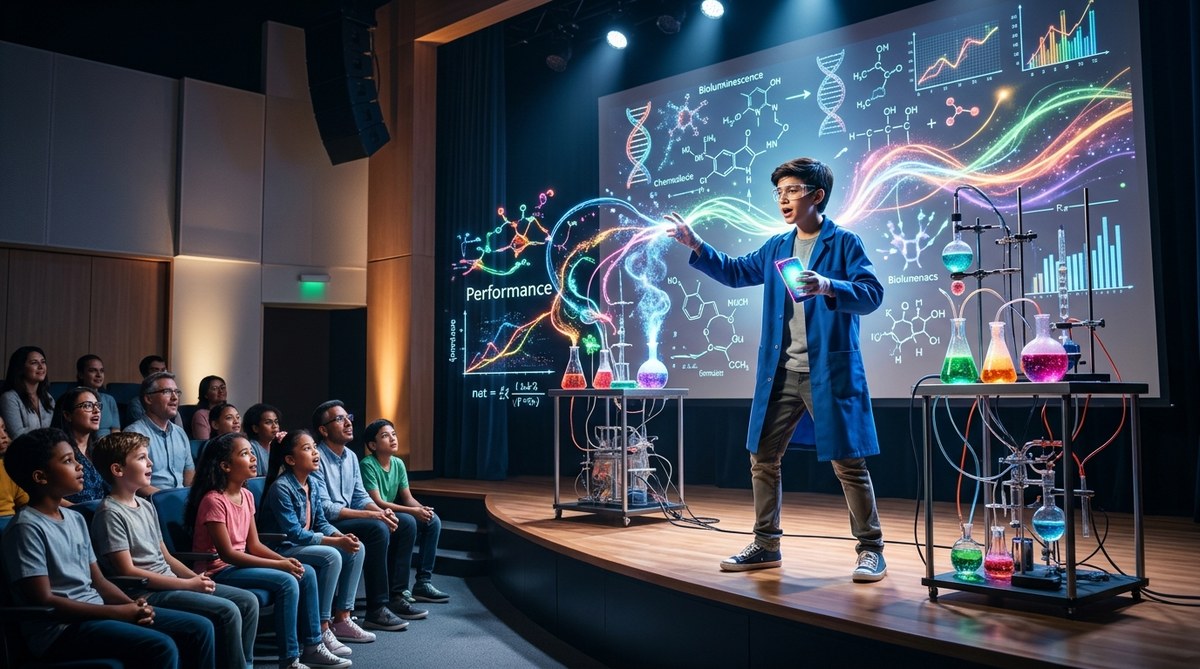
You have seen the same projects at every school fair. A baking soda volcano. A potato battery. A poster board with a tri-fold display and a title in bubble letters. These projects are fine, but they do not stick in a judge’s memory. The students who win are the ones who take a risk. They ask a weird question. They mix two subjects that do not seem related. They turn their experiment into something you cannot look away from. If you want to stand out at your next science fair, you need to stop thinking like a student and start thinking like a creator.
The most creative science fair project ideas come from blending art with science. Instead of a standard experiment, design a performance, a visual installation, or a storytelling piece that demonstrates a scientific principle. Judges remember projects that make them feel something. This guide shows you how to combine inquiry, creativity, and hands-on research to build a project that stands out in 2026.
Why blending art and science works
Science fairs reward clear data and strong conclusions. But they also reward originality. When you add an artistic element, you force yourself to think differently. You have to explain your hypothesis through color, sound, movement, or story. That process makes your understanding deeper.
Think about the last movie that made you curious about space, or the last painting that made you wonder about light. Art does not replace science. It makes science visible. When you present your project as a performance or an installation, you invite the audience to ask questions before you even speak. That is a powerful advantage.
The four categories of creative science fair projects
Not every creative idea fits the same mold. Here are four categories that work well for middle and high school students. Pick the one that matches your interests.
1. The live demonstration
This is not a typical experiment. You design a short performance that shows a scientific concept in action. For example, you could choreograph a dance that demonstrates the water cycle. Each dancer represents a molecule. Their movements show evaporation, condensation, and precipitation. You narrate the science as they perform.
Another example: use a series of pendulums to create a visual pattern on a sand tray. This shows chaos theory and harmonic motion. You can set it to music and let the audience watch the pattern emerge over time.
2. The interactive installation
Set up a station where visitors become part of the experiment. One strong idea is a color perception booth. You project different colored lights onto white objects and ask people to identify the object. Then you reveal how their brains corrected for the lighting. This teaches color constancy and visual processing.
Another option is a sound wave visualizer. Use a speaker, a membrane, and a laser to make sound waves visible. Let people speak into a microphone and watch the pattern change. You can record the patterns and compare them to known waveforms.
3. The narrative or documentary project
Tell a story with your science. Interview local experts. Collect oral histories. Then present your findings as a short film or a graphic novel. One student in 2025 created a comic book about the chemistry of local river pollution. She tested water samples and turned the data into a story about fish and families. She won first place in her regional fair.
You could also create a podcast series about a scientific mystery in your town. Research the history, conduct experiments, and release three episodes. Judges love projects that show sustained effort and real world impact.
4. The hybrid experiment
Combine two scientific fields in an unexpected way. For example, test how different wavelengths of light affect the growth of mold on bread, but present your results as a series of photographs arranged like a gallery show. Each photo is a time lapse of a bread slice under red, blue, green, and white light. The visual impact is immediate.
Another hybrid idea: measure the electrical conductivity of different fruits, but use the data to create a musical instrument. Each fruit triggers a different note when touched. You can perform a simple song and explain how the circuit works.
How to design your own creative project
Follow these five steps to turn a spark of curiosity into a full science fair project.
-
Start with a question that excites you. Do not ask “What makes ice melt faster?” Ask “How can I show the hidden patterns of sound?” or “What would a science fair look like as a theater play?” Let your passion guide the question.
-
Identify the science behind the question. Research the principles. Write down the key variables. Make sure your question has a testable hypothesis. If you want to show sound patterns, your hypothesis might be: “Different frequencies will create distinct geometric patterns on a vibrating membrane.”
-
Design the artistic element. Decide how you will present your findings. Will you perform? Build an installation? Create a film? Sketch out the experience. Think about what the audience will see, hear, and feel.
-
Build and test your prototype. Do not aim for perfection on the first try. Build a rough version. Test it. See what breaks. Adjust your variables. Keep a journal of every change you make. That journal is part of your final presentation.
-
Prepare your explanation. You need to explain the science clearly and quickly. Practice your pitch. Show your data. Then let the artistic element do the heavy lifting. A well designed performance can communicate more in two minutes than a poster can in ten.
Common mistakes and how to avoid them
Even the most creative projects can fall flat if you miss these details.
| Mistake | Why it hurts | How to fix it |
|---|---|---|
| The art overshadows the science | Judges think you care more about looks than data | Keep a visible data log or graph nearby |
| The performance is too long | People lose focus after three minutes | Time your presentation. Aim for two to three minutes |
| You forget to state your hypothesis | The project feels random, not researched | Write your hypothesis in large text near your display |
| The equipment is unreliable | A broken setup looks unprepared | Test your equipment three times before the fair |
| You work alone on a group sized project | Judges notice when one person does all the work | If you work with a partner, divide tasks clearly |
A real example: the sound wave gallery
Let us walk through one complete project idea so you can see how it all fits together.
A high school student named Maya wanted to do something different for her 2026 science fair. She loved music and physics. She asked: “Can I create a visual art piece that shows how different musical instruments produce unique sound waves?”
Her hypothesis was that string, wind, and percussion instruments would create distinct waveform patterns that could be captured and displayed as art.
She built a simple oscilloscope using a microphone, an Arduino board, and a laptop. She recorded three notes from a guitar, a flute, and a drum. Then she used a program to convert each waveform into a black and white line drawing. She printed each drawing on a large canvas. She hung the three canvases side by side.
At the fair, she also brought the instruments. Visitors could play a note and watch the waveform appear on a screen in real time. Then they could compare their own waveform to the printed art.
Maya won second place in her state. But more importantly, every person who visited her booth remembered her project. Teachers from other schools asked for her contact information.
How to frame your project for the judges
Judges look for three things: a clear question, a logical method, and meaningful results. Your creative project must still deliver these. Here is how to do it without losing the artistic spark.
-
Write a one sentence summary. Example: “I created a visual art installation that maps the sound waves of different instruments to show how frequency and amplitude shape what we hear.”
-
Display your raw data. Even if your final product is a painting, keep your lab notebook open nearby. Judges love to flip through pages of notes, sketches, and failed attempts.
-
Explain your variables. What did you change? What did you measure? How did you control for errors? Write these on a small card next to your display.
-
Connect to a real world problem. Does your project relate to hearing loss, music therapy, or acoustic engineering? Mention it. Judges want to see that you understand the bigger picture.
A note for parents and teachers
If you are helping a student, your role is to guide, not to direct. Ask questions like “What do you think will happen?” and “How could you show that in a different way?” Let the student own the idea. The most creative science fair project ideas come from students who feel free to experiment.
Help them gather materials. Help them practice their presentation. But let them make mistakes. A failed prototype is a learning opportunity. A student who rebuilds their project three times learns more than a student who gets it right on the first try.
If you want more strategies for blending subjects, check out this guide on It includes specific activities for middle school and high school classrooms.
What to do when you feel stuck
Sometimes the blank page is the hardest part. If you cannot think of an idea, try these prompts.
- Look at a household object and ask: “What science is hiding inside this?”
- Watch a nature video on mute. Describe what you see in scientific terms.
- Read a science article for kids and imagine how you would turn it into a play.
- Ask a younger sibling or cousin to explain something they are curious about. Their question might spark your project.
Still stuck? Read about It is full of question prompts that can jumpstart your thinking.
Your project at the fair
The day of the fair, arrive early. Set up your space with care. If you have a performance, mark the floor with tape so people know where to stand. If you have an installation, test every button and connection.
Dress like you care. You do not need a lab coat, but wear something that shows you are serious. A plain t-shirt with a science pun works. Or wear a color that matches your project theme.
When people stop at your booth, smile. Ask them a question first. “Have you ever seen sound?” That hooks them. Then show your work. Let them touch, listen, or watch. Then explain the science.
“The best projects do not just answer a question. They make the audience ask their own questions. That is the sign of a true scientist.” — Dr. Elena Torres, science fair judge and professor of physics
Final thoughts
Your science fair project does not have to look like everyone else’s. In fact, it should not. The students who take creative risks are the ones who grow the most. They learn how to communicate complex ideas. They learn how to recover from failure. They learn how to blend logic with imagination.
These are the skills that matter in college and in careers. Whether you become a researcher, an artist, an engineer, or a teacher, the ability to see connections between different fields will set you apart.
So ask yourself: what if your next science fair project was a performance? What if you danced the water cycle, painted sound waves, or turned data into a story? What if you made the judges feel something before they even read your conclusion?
That is the kind of project people remember. That is the kind of project that wins.
And if you want to keep exploring this idea, read about It will give you even more ways to blend creativity with scientific thinking.