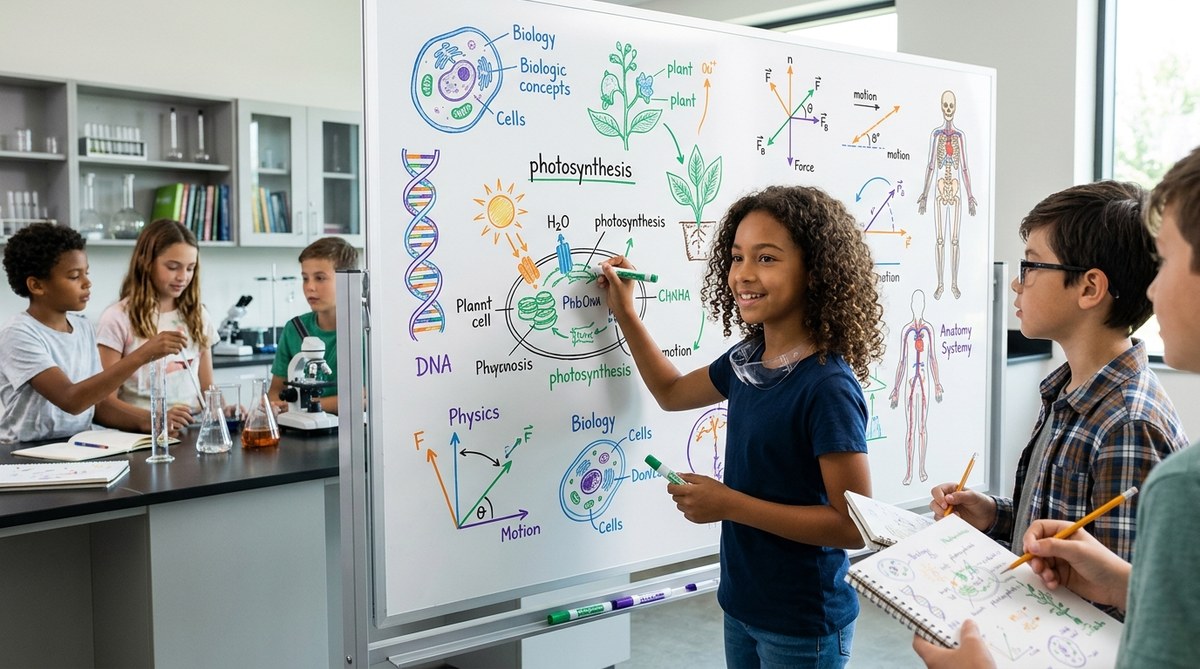
Imagine a classroom where the first thing students do when they hear a science question is pick up a pencil. Not to write a sentence. To draw. They sketch a plant cell before they learn its name. They map the path of a falling leaf before they hear the word gravity. This is not an art class. This is science class, and the pencil is a thinking tool.
Visual thinking in science education helps students slow down, notice details, and build mental models of complex ideas. Drawing activates multiple brain regions, making abstract concepts concrete. When students draw before they write, they engage in active learning that boosts retention and deepens understanding. This guide shows you how to start.
Why Drawing Belongs in Science Class
We often treat drawing as a reward for finishing real work. Color this volcano after you label it. Draw a butterfly after the test. But research from cognitive science tells us something different. Drawing is not a break from learning. It is learning.
When a student draws a diagram of the water cycle, they are forced to make decisions. Where does the arrow go? How big should the cloud be? What does evaporation actually look like? These decisions require mental effort. That effort builds stronger neural pathways.
A 2018 study from the University of Waterloo found that students who drew scientific concepts scored significantly higher on recall tests than students who simply wrote definitions. The act of drawing created a richer memory trace.
The Science Behind the Sketch
Why does drawing work so well? It comes down to dual coding theory. When you draw a concept, you encode it in two ways: visually and verbally. Your brain stores the image of the mitochondria and the word mitochondria together. Later, when you need to recall the information, you have two paths to access it.
Drawing also forces you to notice gaps in your understanding. You cannot draw something you do not understand. If a student cannot sketch how a lever works, they know exactly where their knowledge breaks. That moment of confusion is a powerful learning opportunity.
“Drawing is not just a way to record what you see. It is a way to see what you think.” — Dr. Jennifer M. Johnson, cognitive psychologist and author of The Visual Learner’s Brain
Common Mistakes Teachers Make with Visual Thinking
Even well meaning teachers can fall into traps when asking students to draw. Here is a table that contrasts common mistakes with better approaches.
| Common Mistake | Better Approach |
|---|---|
| Telling students to draw a perfect picture | Ask students to draw what they notice, not what looks good |
| Grading drawings for artistic skill | Evaluate drawings for scientific accuracy and completeness |
| Only using drawing for final projects | Use drawing as a warm up activity at the start of every lesson |
| Providing a pre made diagram to copy | Let students create their own diagrams from observation |
| Assuming drawing is only for young students | Visual thinking works for all grade levels, including high school and college |
A Simple 4 Step Process to Start Every Science Lesson with a Drawing
You do not need to redesign your whole curriculum. You just need to shift the first five minutes of class. Here is a process that works for any grade level.
-
Pose a question without giving the answer. For example, ask: “What do you think happens inside a seed when it starts to grow?” Do not explain anything yet.
-
Give students three minutes to draw their answer. Set a timer. No talking. No looking at books. The drawing can be messy. It can be wrong. The goal is to externalize their current mental model.
-
Ask students to label three things in their drawing. This forces them to name parts of their model. If they cannot label it, they cannot explain it. That is useful information.
-
Use the drawings as a discussion starter. Ask students to hold up their drawings. Compare them. What is different? What is the same? Now you have a room full of curious students ready to learn the real answer.
Tools and Materials That Support Visual Thinking
You do not need fancy supplies. But a few simple tools can make a big difference.
- Unlined paper or sketchbooks. Lines can be distracting. A blank page invites more creative thinking.
- Pencils with soft lead. Soft pencils (2B or 4B) make shading easy and reduce hand fatigue.
- Colored pencils in a limited palette. Too many colors can overwhelm. A set of eight basic colors is plenty.
- Timer or stopwatch. Time pressure helps students stop worrying about perfection and just draw.
- Document camera or projector. This lets you model your own drawing process in real time.
Visual Thinking Techniques for Different Science Topics
Not all science topics lend themselves to the same kind of drawing. Here are a few techniques matched to common subjects.
Biology: Observational Drawing
Place a real object in front of students. A leaf. A flower. A preserved insect. Ask them to draw exactly what they see. No imagination. No stylization. This trains the eye to notice details like vein patterns, segmentation, and symmetry.
Physics: Force Diagrams
When studying motion, have students draw arrows to represent forces. The length of the arrow shows the strength of the force. The direction shows where it points. This makes abstract Newtonian physics visible.
Chemistry: Particle Models
Ask students to draw what they think happens at the molecular level during a phase change. These drawings reveal common misconceptions, like the idea that atoms expand when heated. Discussing the drawings helps correct those errors.
Earth Science: Time Lapse Sketches
Have students draw a single location (like a patch of ground outside the classroom) at the same time each day for a week. They will see changes in light, moisture, and plant growth. This builds observation skills over time.
How to Handle Students Who Say They Cannot Draw
Some students will resist. They will say they are not good at art. Here is how to respond.
- Remind them that this is not art class. A stick figure is fine.
- Show them your own messy sketch. Teachers who model imperfection create a safer space.
- Use the phrase “draw what you notice, not what you think it should look like.”
- Provide templates for complex shapes. For example, a pre drawn circle for a cell lets students focus on the internal structures.
Building a Classroom Culture Around Visual Thinking
To make this stick, you need to normalize drawing as a thinking tool. Here are a few ways to build that culture.
- Keep sketchbooks on a shelf where students can grab them at any time.
- Start each unit with a “before drawing” and end with an “after drawing.” Compare them to show growth.
- Display student drawings on a bulletin board labeled “Science Thinking.”
- Invite students to draw their questions. Instead of raising a hand, they can hold up a sketch.
If you want to go deeper, you can explore how to integrate art and science through inquiry based projects. For example, building a classroom ecosystem where art and science thrive together is a natural next step.
When Visual Thinking Goes Wrong (and How to Fix It)
Sometimes a drawing activity flops. Here are common problems and solutions.
- Problem: Students draw too fast and miss details. Solution: Add a timed observation phase. Ask them to look at the object for one minute before they draw.
- Problem: Students copy from a neighbor. Solution: Give each student a different object or a different angle to observe.
- Problem: Drawings are too small to show detail. Solution: Require drawings to fill at least half the page.
- Problem: Students focus on decoration instead of science. Solution: Remove erasers. Emphasize that wrong lines are part of the process.
Measuring the Impact of Visual Thinking
How do you know if this is working? Look for these signs.
- Students use more specific vocabulary when describing observations.
- Students ask more questions about how things work.
- Students refer back to their own drawings during discussions.
- Test scores on conceptual questions improve, even if scores on factual recall stay the same.
You can also ask students to reflect on their own learning. A simple prompt like “Draw how your understanding of photosynthesis changed this week” can reveal powerful growth.
The Big Picture for 2026 and Beyond
We are in a moment where science education needs to feel more human. Students spend hours staring at screens, scrolling through information they barely process. Drawing forces them to slow down. It asks them to use their hands and their eyes and their brains together.
Visual thinking in science education is not a trend. It is a return to a fundamental way of learning. Before there were textbooks, there were cave drawings. Before there were formulas, there were diagrams. The impulse to understand the world by drawing it is deeply human.
The best part? You can start tomorrow. Pick a topic. Give your students a blank piece of paper. Ask them to draw what they think. Then watch what happens.
For more ideas on how to blend creativity with scientific discovery, check out how timed observation sketches teach scientific thinking in any grade. And if you are ready to go further, exploring creative approaches to integrate art and science in inquiry based learning will give you a full toolkit.
Your First Five Minutes Matter Most
The way you start a lesson sets the tone for everything that follows. When you start with a drawing, you send a clear message: this class is about thinking, not memorizing. This class values your ideas, even the messy ones. This class is a place where you can see your own understanding grow.
Try it for one week. Five minutes at the start of each science lesson. Just drawing. No grades. No corrections. Just thinking on paper. You might be surprised at what your students teach you.