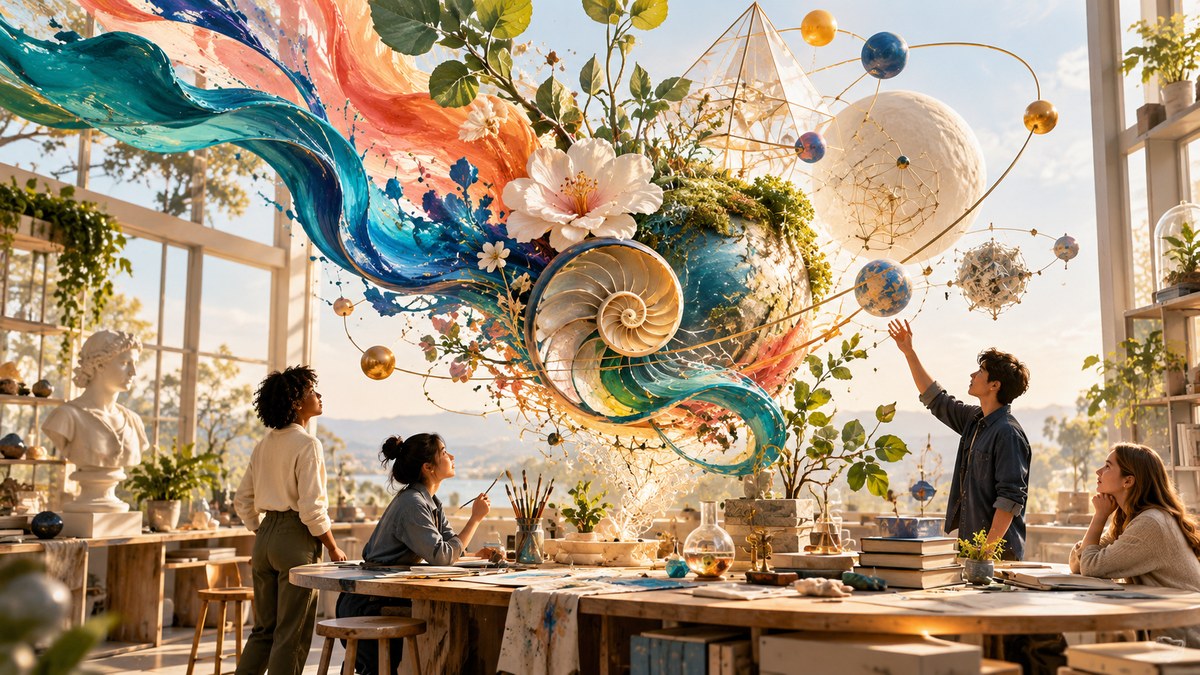
Picture a classroom where students measure the precise angle of a sunflower’s seed spiral, then draw it from memory. They calculate the Fibonacci sequence, mix paint to match the exact gold of a sunset, and write a haiku about photosynthesis. This is not a fantasy. This is what happens when we teach at the intersection of art and science.
The most memorable lessons live in that shared space. They stick because they engage the whole brain. They ask students to feel the texture of a leaf while analyzing its cellular structure. They turn abstract formulas into visible, touchable, beautiful things. And research from 2026 continues to confirm what Leonardo da Vinci knew five centuries ago: the best learning happens when we refuse to separate the head from the hand, the data from the design.
Lessons that combine art and science activate more neural pathways than single-subject teaching. Students retain information longer, develop stronger problem-solving skills, and report higher engagement. The method works for every grade level and subject. This article gives you five research-backed strategies to bring that intersection into your classroom today.
Why Your Brain Remembers Art-Science Lessons Better
Neuroscience gives us a clear answer. When you learn something through multiple senses, your brain stores that information in more than one place. A physics formula learned by rote sits in one small cluster of neurons. The same formula learned by building a kinetic sculpture that demonstrates torque gets stored in motor memory, visual memory, and semantic memory all at once.
This is called dual coding. Your brain creates two pathways to the same memory. If one fades, the other remains. That is why a student who draws the water cycle while explaining evaporation will remember it months later. The student who only read the textbook chapter likely will not.
A 2025 study from the University of California found that students in art-integrated science classrooms scored 23% higher on retention tests six weeks after instruction. The control group, which used traditional lecture and textbook methods, showed a sharp drop in recall after just two weeks.
Teachers who work at the intersection of art and science are not just being creative. They are being strategic. They are building memories that last.
The Five Core Principles of Art-Science Learning
Before we get into specific activities, it helps to understand the underlying principles. These five ideas guide every successful interdisciplinary lesson.
- Observation before interpretation. Both artists and scientists start by looking closely. A botanist studies a petal’s vein pattern. A painter studies how light falls on that same petal. The skill is identical.
- Iteration over perfection. Scientists run experiments again and again. Artists sketch the same subject from different angles. Both fields reward revision.
- Pattern recognition. Mathematics finds patterns in numbers. Visual art finds patterns in color and shape. Music finds patterns in rhythm. The brain loves patterns.
- Abstraction and representation. A graph is an abstraction of data. A painting is an abstraction of a scene. Both require the learner to decide what to include and what to leave out.
- Curiosity as fuel. The best scientists ask why. The best artists ask what if. When you combine those questions, you get innovation.
These principles apply whether you teach kindergarten or college. They apply whether you are in a physics lab or a ceramics studio.
A Practical Process: 5 Steps to Design an Art-Science Lesson
Here is a repeatable process you can use to build your own interdisciplinary lessons. It works for any topic and any grade level.
- Pick a scientific concept that has a visual or tactile component. Start simple. Light, sound, growth, patterns, forces, chemical reactions. Avoid abstract topics like quantum mechanics until you have more experience.
- Identify an artistic medium that can express that concept. Watercolor for light diffusion. Clay for geological strata. Dance for energy transfer. Poetry for life cycles. The medium should make the concept visible or feelable.
- Frame a driving question that requires both disciplines. Instead of “What is photosynthesis?” ask “How would you design a leaf that captures the most sunlight?” This forces students to understand the science and then express it creatively.
- Build in time for iteration. Let students create a first draft, test it against the scientific concept, then revise. This mirrors the scientific method and the artistic process.
- Include a reflection component. Ask students to explain their choices. Why did they use that color? How does that shape relate to the force they measured? Reflection solidifies the learning.
For a deeper look at how to structure these lessons around student questions, read our guide on running art-integrated science lessons built around student questions.
Common Mistakes and How to Avoid Them
Even experienced teachers can stumble when blending art and science. The table below shows the most common pitfalls and the straightforward fixes.
| Mistake | Why It Happens | The Fix |
|---|---|---|
| Treating art as decoration | Teachers add a drawing task at the end of a science unit without connecting it to the concept | Make the art essential to understanding the concept, not optional |
| Forcing every lesson to be interdisciplinary | Some topics do not benefit from the blend | Choose topics where the intersection is natural, not forced |
| Ignoring skill gaps | A student who struggles with drawing may feel frustrated | Offer multiple artistic options: collage, digital tools, sculpture, writing |
| Skipping the science | The lesson becomes art only, with no real scientific inquiry | Start with a scientific question and let the art answer it |
| Underestimating time | Art-science projects often take longer than expected | Build in buffer time and treat the process as the learning, not the final product |
How to Handle the Messy Middle
Interdisciplinary lessons are not neat. Students will mix the wrong colors. Their clay structures will collapse. Their poems will not rhyme. That is exactly where the learning lives.
When a student’s paper bridge fails to hold the weight, you have a chance to talk about material strength, load distribution, and the engineering design process. When the bridge fails again, you talk about iteration. When it finally holds, you celebrate the persistence.
This is why the intersection of art and science is so powerful. It teaches resilience. It teaches that failure is data, not defeat.
“The most creative scientists are the ones who are not afraid to be wrong in public. The most rigorous artists are the ones who test their materials like a chemist. We need to raise students who are both.” — Dr. Maya Chen, Professor of STEAM Education at Stanford University, 2026
A Sample Lesson: Sound Waves and Visual Patterns
Let us walk through one concrete example so you can see how the principles come together.
The scientific concept: Sound travels in waves. Frequency determines pitch. Amplitude determines volume.
The artistic medium: Drawing with a pendulum. You suspend a funnel filled with sand or paint from a string. You swing it over paper. The sand traces a pattern. As you change the length of the string, the frequency changes. The pattern changes.
The driving question: How can you predict the visual pattern a pendulum will draw based on the length of its string?
What students do:
– Measure string lengths and record the resulting patterns
– Calculate the relationship between length and frequency
– Predict what a new length will produce
– Create a final “sound portrait” that represents a musical note
What students learn:
– The physics of waves and frequency
– The math of ratios and periodic motion
– The art of pattern and symmetry
– The skill of prediction and testing
This lesson works for grades 4 through 10 with simple adjustments. Younger students focus on observation and pattern. Older students calculate exact frequencies and connect them to musical scales.
For more ideas like this, check out our collection of 8 inquiry-based activities that prove art and science are better together.
When to Go All In and When to Stay Separate
Not every topic needs an art connection. And that is okay. The goal is not to eliminate single-subject teaching. The goal is to add interdisciplinary lessons where they make the most impact.
Use the art-science intersection when:
– The concept is abstract and hard to visualize
– Students seem disengaged or bored
– You want to assess understanding in a new way
– The topic has a natural visual or tactile component
Stick with traditional methods when:
– The concept is purely procedural (like lab safety)
– Students need a foundation of basic facts first
– Time is extremely limited
The best teachers know when to blend and when to separate. That judgment comes with practice.
The Surprising Role of Failure in Art-Science Lessons
One of the biggest benefits of teaching at the intersection of art and science is how it reframes failure. In a traditional science class, a failed experiment feels like a mistake. In a traditional art class, a failed drawing feels like wasted paper. But when you combine the two, failure becomes part of the process.
Students learn that a painting can be painted over. A sculpture can be reshaped. A hypothesis can be revised. The product is not the point. The learning is the point.
This mindset shift is especially important for students who are afraid of being wrong. They often shut down in traditional settings. But in an art-science classroom, being wrong is just the first draft. And everyone knows that first drafts are never the final version.
To see how this plays out in real classrooms, read about 5 inquiry-driven projects that turn everyday phenomena into artful science lessons.
Building a Classroom Culture That Supports the Blend
You cannot just drop an art-science lesson into a traditional classroom and expect it to work. The culture has to shift first. Here are three things you can do starting tomorrow.
- Change the language you use. Replace “right answer” with “best solution so far.” Replace “mistake” with “iteration.” Replace “finished” with “ready for feedback.”
- Display process, not just product. Hang sketches, failed prototypes, and early drafts on the wall. Celebrate the journey.
- Model your own curiosity. Let students see you try something new and struggle with it. Show them that learning never stops.
A Look Ahead: Art and Science in 2026 and Beyond
The push for interdisciplinary learning is stronger than ever in 2026. More schools are adopting STEAM frameworks. More museums are offering cross-disciplinary workshops. More employers are asking for candidates who can think both analytically and creatively.
The world does not divide itself into subjects. A bridge engineer needs to understand aesthetics. A graphic designer needs to understand color physics. A doctor needs to communicate with empathy and precision.
When we teach at the intersection of art and science, we are not just preparing students for the next test. We are preparing them for a life of curiosity, creativity, and problem-solving.
Your First Step Toward the Intersection
You do not need to redesign your entire curriculum tonight. Start small. Pick one lesson next week that feels a little flat. Ask yourself: what is the artistic expression of this concept? Could my students paint it? Dance it? Build it? Sing it?
Try it. See what happens. Your students might surprise you. You might surprise yourself.
For a full blueprint on building this approach into your teaching practice, read our guide on how to design interdisciplinary projects that ignite student curiosity in 2026.
The One Question That Changes Everything
Before you plan your next unit, ask yourself one question: what would happen if I taught this like an artist and a scientist at the same time?
The answer will change how you see your subject. It will change how your students see it too. And it will create lessons that stick long after the final bell rings.
Start with one small experiment. Observe what happens. Then try another. That is the scientific method. That is the artistic process. And that is how you build a classroom where the intersection of art and science becomes the norm, not the exception.