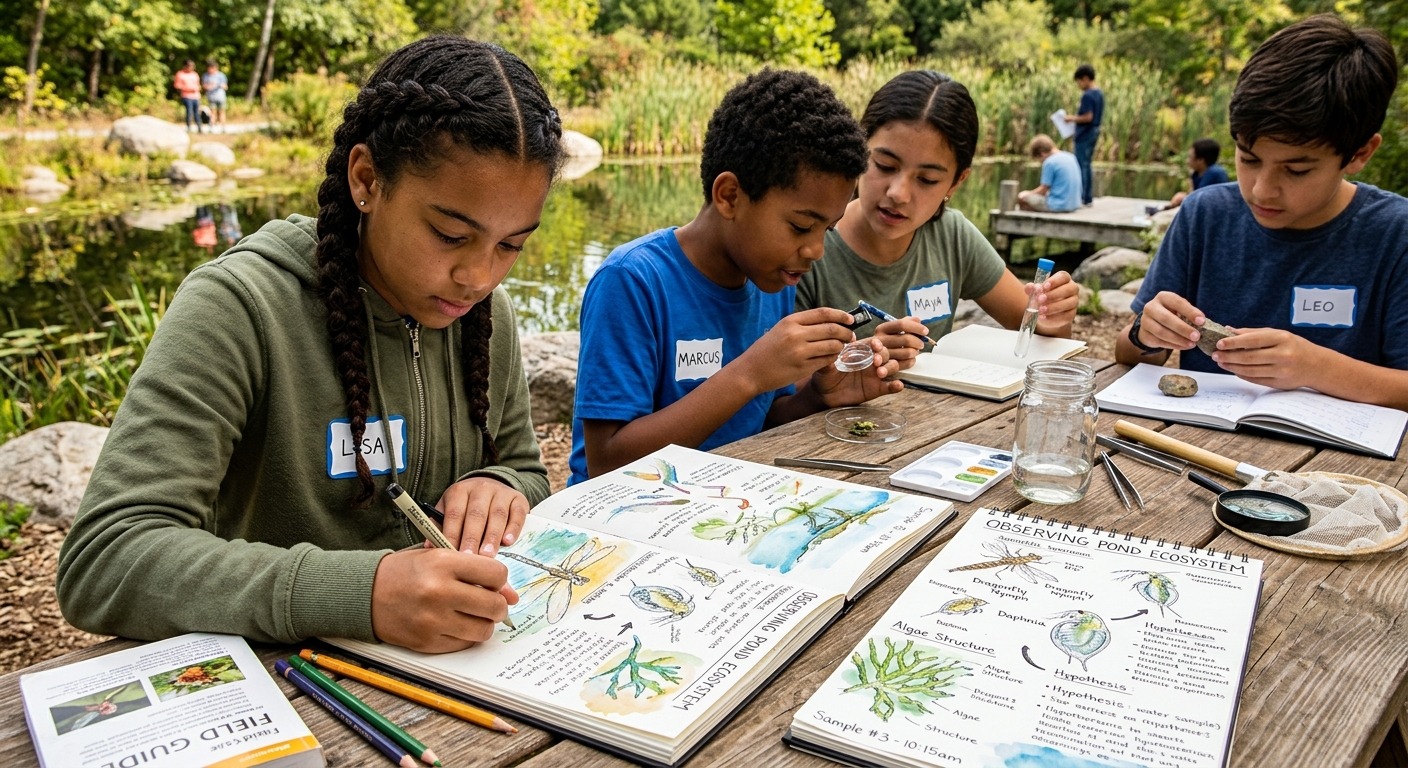
A fourth grader squints at a jar of pond water. She tilts it toward the window. Then she picks up her pencil and starts drawing. She has not said a word yet. But her hand is already working out ideas her mouth has not caught up to. That gap between looking and understanding is exactly where sketchbooks live. It is one of the most fertile spaces in any science classroom. When students draw what they observe, they think harder, notice more, and hold onto understanding far longer than any worksheet can produce.
Science Sketchbook Snapshot
Pairing observational drawing with verbal think-alouds gives students two complementary ways to document their science thinking. This article walks through a structured classroom protocol, shows how to capture and transcribe student reasoning across a multi-day investigation, and closes with a ready-to-use unit outline and assessment rubric for an ecosystems unit. Teachers leave with a complete, immediately adaptable framework for putting sketchbooks at the center of science inquiry.
Why Drawing and Observing Go Hand in Hand in Science
There is a reason naturalists have kept illustrated field journals for centuries. Leonardo da Vinci filled thousands of pages with drawings that doubled as scientific records. Charles Darwin sketched specimens before describing them in words. Drawing is not decoration. It is a cognitive tool.
When students draw what they observe, they are forced to look twice, three times, more. A drawing of a leaf requires noticing the exact shape of the veins, the way the edge curves, the variation in color across a single surface. A written description can be vague. A drawing cannot be. That specificity sharpens scientific thinking in a way that feels almost invisible while it is happening.
Visual documentation naturally supports science inquiry practices at the heart of modern K-12 science education, which ask students to obtain, evaluate, and communicate information through multiple means. A sketchbook, used with intention, is a science notebook and an art portfolio rolled into one living record of student thinking.
Setting Up the Sketchbook Protocol Before the Investigation Begins
The protocol starts before students ever touch a specimen. You will spend one class session introducing the sketchbook as a thinking tool, not an art portfolio.
Tell students their drawings do not need to look polished. They need to look accurate. There is a real difference. A polished drawing worries about beauty. An accurate drawing worries about what is actually there.
Give each student a blank or lightly gridded journal. Set up a consistent page structure. One half of the page is for drawing. The other half is for written observations, questions, and ideas. At the bottom of each page, leave a small space labeled “What I noticed out loud.” That space will make more sense once you introduce think-alouds in the next session.
Walk students through a practice observation with something familiar: a houseplant, a rock, a seed. Let them try the page layout before the real investigation begins. Students who have already practiced the format are freed to focus on the science content when the actual work starts. That rehearsal session is worth every minute you spend on it.
Structuring Think-Alouds During the Drawing Process
Think-alouds are simple to introduce but surprisingly rich in practice. Ask students to narrate what they are seeing and thinking as they draw. Not as a performance. As a habit.
In the first few sessions, model the behavior yourself. Lean over a specimen and say, out loud, things like: “This looks smoother than I expected. The edges are uneven. I wonder if that changes after it dries.” Students hear that your spoken observations include uncertainty. That matters. Science thinking includes a lot of not knowing yet, and students need permission to voice that out loud.
Once students try it themselves, keep the format informal. They can whisper. They can talk to a partner who is also drawing. They can speak quietly into a phone or tablet. The goal is to make thinking audible during the act of observation, not to produce a polished verbal report.
What you will notice within a few sessions is that students catch more detail. They correct their own drawings mid-stroke. They ask questions they would never have written down, because the act of speaking surfaces ideas that stay buried when students work in silence. The think-aloud becomes a scaffold for deeper observation rather than a separate task layered on top of it.
Capturing Student Reasoning With Audio and Transcription
This is where the protocol becomes especially useful for a specific group of students. Some students hold rich, sophisticated scientific ideas but cannot write fast enough to capture them. Their writing fluency lags behind their thinking. The result is sparse written entries that do not reflect what they actually understood.
Audio recording changes that equation entirely.
During think-aloud sessions, have students record their narration using a phone, tablet, or classroom device. After the session, run those recordings through a lecture to text tool. The tool produces a verbatim transcript in minutes. Students then read through the transcript, clean up any rough language, and paste or glue the edited version directly into their sketchbooks next to the corresponding drawing.
This is not about bypassing the writing process. It is about removing a barrier that gets between a student’s thinking and their documentation. The sketchbook entry reflects what the student actually thought, not just what they could spell and punctuate fast enough to record in the time available.
It functions as a genuine accessibility support for students with dysgraphia, English language learners still building written fluency, and any student whose verbal processing outruns their handwriting. And it works at every grade level, from second grade through high school, without changing the sketchbook protocol at all.
A Sample Ecosystems Unit Outline Teachers Can Adapt
A five-day ecosystems investigation gives enough time to run the full protocol and collect meaningful student work. This outline targets grades 3 through 6 and scales up or down with small adjustments.
- Day 1: Students receive sketchbooks and practice observational drawing with a single organism or artifact. Teacher models think-aloud narration. Students record their first short audio clip and listen back to hear themselves thinking out loud.
- Day 2: Students examine two or three components of an ecosystem (soil, water, plant matter, decomposers). They draw each component, narrate observations aloud, and note any connections they notice forming between the parts.
- Day 3: Students review their Day 2 transcripts, edit them for clarity, and add the text to the corresponding sketchbook pages. Class discussion focuses on one thing each student said aloud that surprised them.
- Day 4: Students return to their drawings and add a second layer of detail after learning new vocabulary (producer, consumer, decomposer, food web). They annotate drawings with labels and revision notes, ideally in a second color to show the update clearly.
- Day 5: Students write a synthesis entry at the back of their sketchbook answering the investigation question using evidence drawn from both their drawings and written text. Sketchbooks are collected for assessment.
This same outline adapts well to a unit on properties of light. Swap the organisms and soil samples for prisms, translucent materials, and light sources. The sketchbook page structure and the think-aloud protocol stay exactly the same, which means students carry the routine from unit to unit rather than learning a new format each time.
Assessing Both the Visual and Written Components
A strong rubric holds both modes of documentation to the same standard. Visual entries should not carry more weight just because they take more time. Written entries should not be penalized for unconventional structure when they contain strong scientific reasoning.
The rubric below gives equal weight to four criteria: observational accuracy in drawing, depth of written reflection, scientific vocabulary use, and evidence of reasoning across both components.
Ecosystems Sketchbook Investigation: Assessment Rubric
| Criterion | Developing (1) | Approaching (2) | Proficient (3) |
|---|---|---|---|
| Observational Drawing | Drawing is present but shows few observable details. Little evidence of close looking. | Drawing includes some accurate details. Some features are generalized or missing. | Drawing is detailed and accurate. Key features are labeled. Evidence of careful observation is clear throughout. |
| Written Reflection | Entry is brief or copied. Little evidence of original thinking or personal observation. | Entry describes observations with some specificity. Student ideas are present but underdeveloped. | Entry is detailed and reflects genuine student thinking. Observations connect to larger ideas or questions. |
| Scientific Vocabulary | Unit vocabulary is absent or used incorrectly throughout the entry. | One or two vocabulary terms are used, sometimes accurately. | Multiple vocabulary terms are used accurately and in context across both drawing and written text. |
| Evidence of Reasoning | Student records observations but draws no conclusions and poses no questions. | Student connects two or more observations or poses a question related to the investigation. | Student makes clear connections across observations, uses evidence to reason, and poses thoughtful follow-up questions. |
A few practical notes for using this rubric effectively in the classroom:
- Score drawings on accuracy and detail, not artistic skill. A technically precise sketch of a decomposer earns full marks even if it looks rough around the edges.
- Written entries generated from audio transcripts should be assessed the same way as handwritten ones. The thinking is what the rubric measures, not the method of production.
- Use the rubric as a conversation tool. Sit with a student and talk through their sketchbook before assigning a score. You will often find more evidence of understanding than the entries alone suggest.
- Let students self-assess first using the same rubric. Their ratings, compared to yours, open up meaningful metacognitive conversations about what counts as evidence in science.
The Evidence That Lives in the Margins
The margins of a science sketchbook hold things that almost never show up anywhere else. A student crosses out a drawing and tries again from a different angle. Another adds a question mark next to something she drew on Day 2 and then circles it on Day 4 with a note that reads, “I think I know now.” Those moments of revision and return are the exact moves scientists make. Students are doing science, not just recording it.
Sketchbooks do not just capture what students learned. They document how students learned it. That distinction matters more than it might first appear. A final test shows a snapshot. A sketchbook shows a film.
When you pair that visual record with verbatim think-aloud transcripts, you gain something rare in classroom documentation: access to the actual process of student thinking, in real time, in the student’s own words and hand. That is a powerful thing to have as a teacher. And it is a powerful thing for students to have about themselves.
Start with one unit. One sketchbook. One student you have been trying to reach. What you find in the margins may change how you think about science documentation entirely.