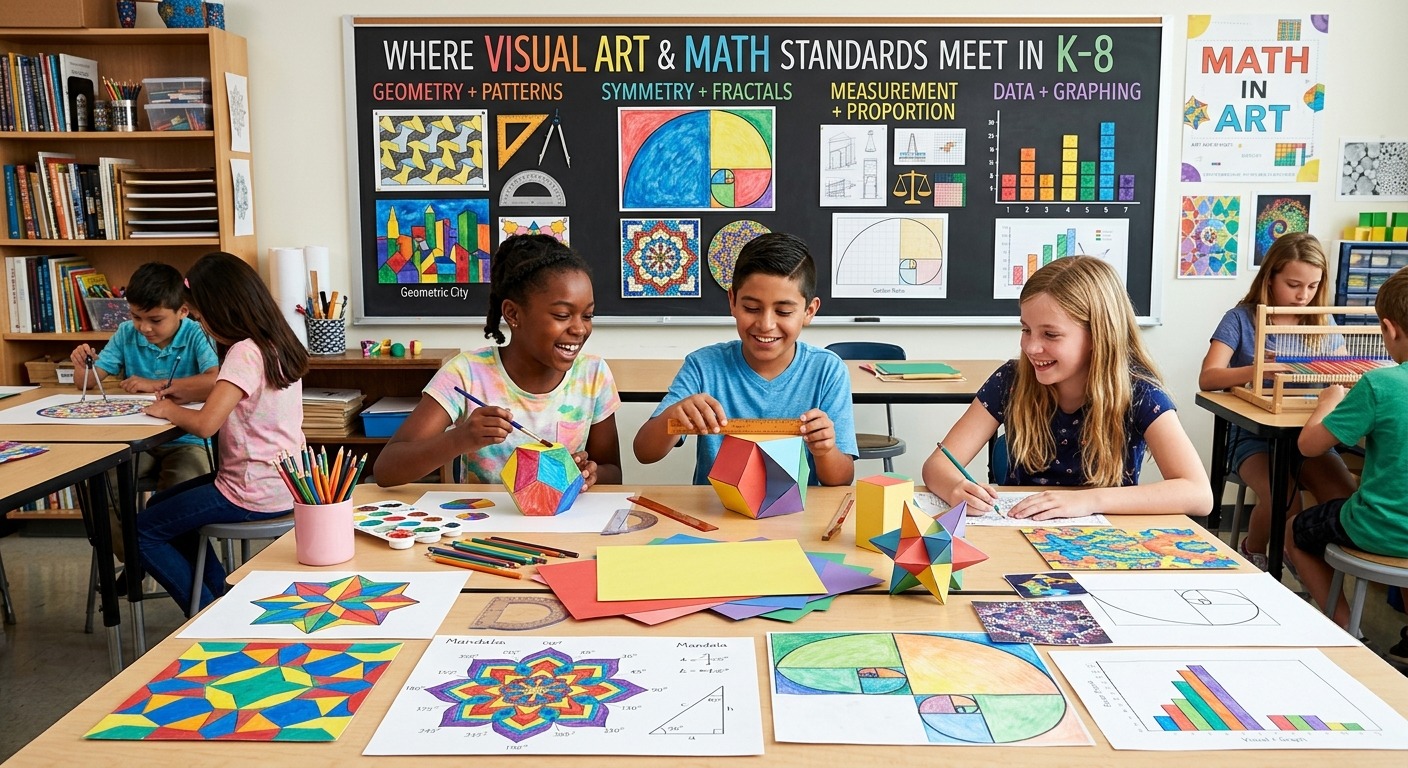
A third grader holds up a tile she has just cut from construction paper. She does not yet know she has demonstrated a core principle of plane geometry. She only knows her shape fits perfectly against its neighbors, with no gaps and no overlaps. Her teacher, watching from across the room, knows more: that child just internalized a concept most students spend weeks trying to memorize from a textbook. That moment is exactly why studio art and math belong in the same unit plan.
Artful Math at a Glance
- Geometric pattern design, tessellations, and proportion-based portraiture align directly with K-8 math standards.
- Hands-on studio work gives students immediate, tactile feedback that printed practice problems cannot match.
- Tessellations address transformational geometry and symmetry standards across grades three through seven.
- Proportion-based portraiture builds ratio and scale reasoning naturally in the middle grades.
- A three-step planning framework makes this interdisciplinary approach adaptable for any K-8 classroom.
The Geometry That Lives Inside Every Pattern
When young students arrange pattern blocks into repeating designs or cut shapes that lock together like puzzle pieces, they are doing geometry. They are reasoning about space, attributes, and relationships in exactly the way that K-8 math standards require. The art room and the math classroom have never been as far apart as school schedules suggest.
The connection is not just theoretical. When students create something with their hands, they have to think through a concept rather than simply read about it. A tessellation tile that does not fit tells a student immediately that something is wrong with the angle or the rotation. No multiple-choice problem delivers that kind of real-time, tactile feedback. The student adjusts, tries again, and in doing so builds genuine understanding.
For K-8 teachers trying to connect studio work to documented learning outcomes, the alignment is already built into the standards. The geometry and measurement goals that govern most state frameworks describe exactly the visual and spatial concepts that artists work with every day. The job is not to force math into art. The job is to make the existing connection visible.
Tessellations and What They Actually Teach
Tessellations are one of the most powerful bridges between studio art and math standards in the elementary and middle grades. A tessellation covers a flat surface completely with one or more repeating shapes, leaving no gaps and no overlaps. Artists from medieval Islamic tile makers to twentieth-century printmakers have used them with striking results. For students, designing one requires direct engagement with geometric transformation.
When a student slides, flips, or rotates a shape to build a repeating pattern, they are performing the exact operations that upper elementary and middle school geometry standards describe. The activity is not an analogy for transformation. It is transformation, carried out with paper and scissors and a ruler.
In grades three through five, the work focuses on symmetry and shape properties. Students figure out which polygons tile and which do not, and why. That inquiry puts them in direct contact with the geometric reasoning those grade levels require. In the middle grades, the same tessellation project can shift toward angle measurement and area calculation. Students who figure out how many custom tiles cover a defined surface are working with area, scale, and proportional reasoning at the same time.
Which Standards Does Tessellation Work Address?
Tessellation projects are a direct instructional match for published geometry standards covering symmetry, shape attributes, and transformations from the upper elementary grades through middle school. The fourth-grade requirement for students to recognize lines of symmetry in two-dimensional figures is met every time a student tests whether their tile design flips onto itself. The fifth-grade work of classifying shapes by their properties happens naturally when students analyze which polygons tile a plane and which create gaps. By sixth and seventh grade, angle measurement and area standards fit directly into a tessellation unit that asks students to calculate, predict, and verify.
Grade-by-Grade Art Projects Mapped to Math Standards
| Grade Band | Studio Art Focus | Primary Math Standards Addressed |
|---|---|---|
| K-2 | Shape collages, block printing, repeating pattern borders | Identifying and composing 2D shapes, equal partitioning, describing patterns |
| 3-5 | Tessellation design with custom cut shapes | Symmetry, geometric transformations (slide, flip, turn), angle classification |
| 6-8 | Proportion-based self-portraiture and scale drawings | Ratios, proportional relationships, scale factor, similar figures |
This alignment makes explicit something many teachers sense intuitively: the math is not hidden inside the art project. It is the project. When lesson planning starts from the standard and works toward the studio challenge, the connection becomes something students can feel in their hands and see in the work they produce.
Proportion-Based Portraiture in the Middle Grades
Geometric pattern work is a strong fit for elementary students. In the middle grades, proportion-based portraiture opens a different set of standards and a different kind of thinking.
Portrait drawing has its own internal logic. The eyes sit at the midpoint of the face, not near the top as most beginning artists instinctively place them. The width of the mouth aligns with the distance between the inner corners of the eyes. The ear spans from the eyebrow line to the base of the nose. These relationships are ratios. Measuring them, comparing them, and applying them to a drawing is precisely the proportional reasoning that sixth and seventh grade math standards require.
A portraiture unit built around these measurements gives students a reason to care about ratios that goes beyond the word problem on a page. They are not calculating an abstract relationship between two numbers. They are figuring out why a face looks right or wrong, and adjusting until it does. That feedback loop is powerful. Students who struggle to stay engaged with ratio problems in a traditional setting often find entirely new focus when the outcome is a self-portrait they want to look accurate.
Teachers can document the math explicitly by having students record their measurements, calculate each ratio, and write a brief note explaining how they applied it to the drawing. The studio work becomes assessable against math standards, not just art rubrics. That dual accountability is what turns an art project into a genuine interdisciplinary unit.
Making the Math Visible and Assessable
One concern teachers raise about art-integrated math is assessment. How do you assign a math grade to a studio project? The answer is that the math has to be visible from the start, and that means building documentation into the unit design before students pick up a single tool.
Before students begin making, ask them to write a prediction. In a tessellation unit, this might be: “I think a regular hexagon will tile because…” At the midpoint, students record measurements or label their work with the geometric terms that apply. At the end, they write a short reflection connecting what they made to the concept it demonstrates. These checkpoints do not interrupt the creative process. They anchor it to the learning targets that administrators and families need to see.
A rubric that scores the math documentation separately from the visual outcome makes grading straightforward. Students learn early that both the thinking and the making matter. That expectation aligns naturally with an inquiry-based, student-centered approach that treats process as equally important as product. The making is the evidence, and the documentation is the argument.
Supporting Students Who Need Extra Practice
Studio projects build deep understanding, but some students need additional repetition with the underlying math skills to feel confident. A child who struggles with identifying types of angles will have a harder time making deliberate choices in a tessellation design. Filling that gap matters, and it does not always happen within a single studio session.
Teachers have found that pairing studio units with targeted independent practice works well, especially when that practice can be assigned as homework or shared directly with families. Pointing caregivers toward accessible free math lessons gives families a low-barrier way to reinforce the same concepts at home, without requiring them to purchase materials or hold a strong math background themselves. Students who arrive at the next studio session with a firmer grasp of the underlying concept can focus their energy on the creative challenge rather than getting stuck on the mathematical mechanics.
This pairing also addresses equity in a practical way. Not every student has a home environment that supports extended creative projects. Most families, however, have some access to a screen. Pairing hands-on making during school with accessible digital practice outside it helps reduce the gap between what students can do in class and what they carry forward into the next lesson.
A Three-Step Framework Any Teacher Can Adapt
The most common obstacle to art-integrated math units is the planning process. Teachers know the connection is real, but translating it into a unit with clear goals, assessable outcomes, and a manageable timeline takes sustained effort. A simple framework helps move from idea to implementation without getting lost in the details.
Start with the Standard, Not the Project Idea
Open the math standards document for your grade level and identify a geometry or measurement concept that students typically find abstract. Symmetry, transformation, ratio, scale: all of these have direct visual counterparts in studio art. Write the standard at the top of your planning page before you think about the art activity. This keeps the academic goal central and prevents the unit from drifting toward a project that is visually appealing but mathematically thin.
Design a Making Challenge Around That Standard
Ask yourself what a student would have to do physically to demonstrate that standard. If the standard involves geometric transformation, they need to perform a transformation, not just define one. Choose a studio medium that fits the age group and the materials you have available. Construction paper, rulers, graph paper, and basic drawing tools are enough for most of the projects described here. The constraint of limited materials often pushes students toward more careful thinking, which is exactly the point.
Build in Visible Math Checkpoints
Plan three moments in the project where students document their math thinking in writing or in labeled diagrams: a prediction before they start, a measurement record at the midpoint, and a reflection at the end. These checkpoints give you the assessment data you need and give students a language for what they are doing. They also make the math visible to administrators, families, and the students themselves. That visibility matters when you need to defend an interdisciplinary unit at a curriculum review or a parent conference.
When the Studio Becomes the Proof
A classroom that pairs studio art with math standards is doing something important. It is treating students as thinkers who need to understand ideas deeply, not just recall them for a test. The tile that tessellates proves the geometry is right. The portrait that looks proportional proves the ratios were applied correctly. The student knows it before the teacher says a word, because the evidence is right there in their hands.
Inquiry-based learning works best when students have a genuine question and a real way to test their thinking. Studio art provides that test in a way that few other classroom activities can. A shape either fits or it does not. A face either looks proportional or it does not. That immediate, honest feedback is the engine of real learning, and it runs at every grade level from kindergarten through eighth grade.
The standards are already written. The art is already there. Bringing them together is not a workaround. It is exactly what good teaching looks like.