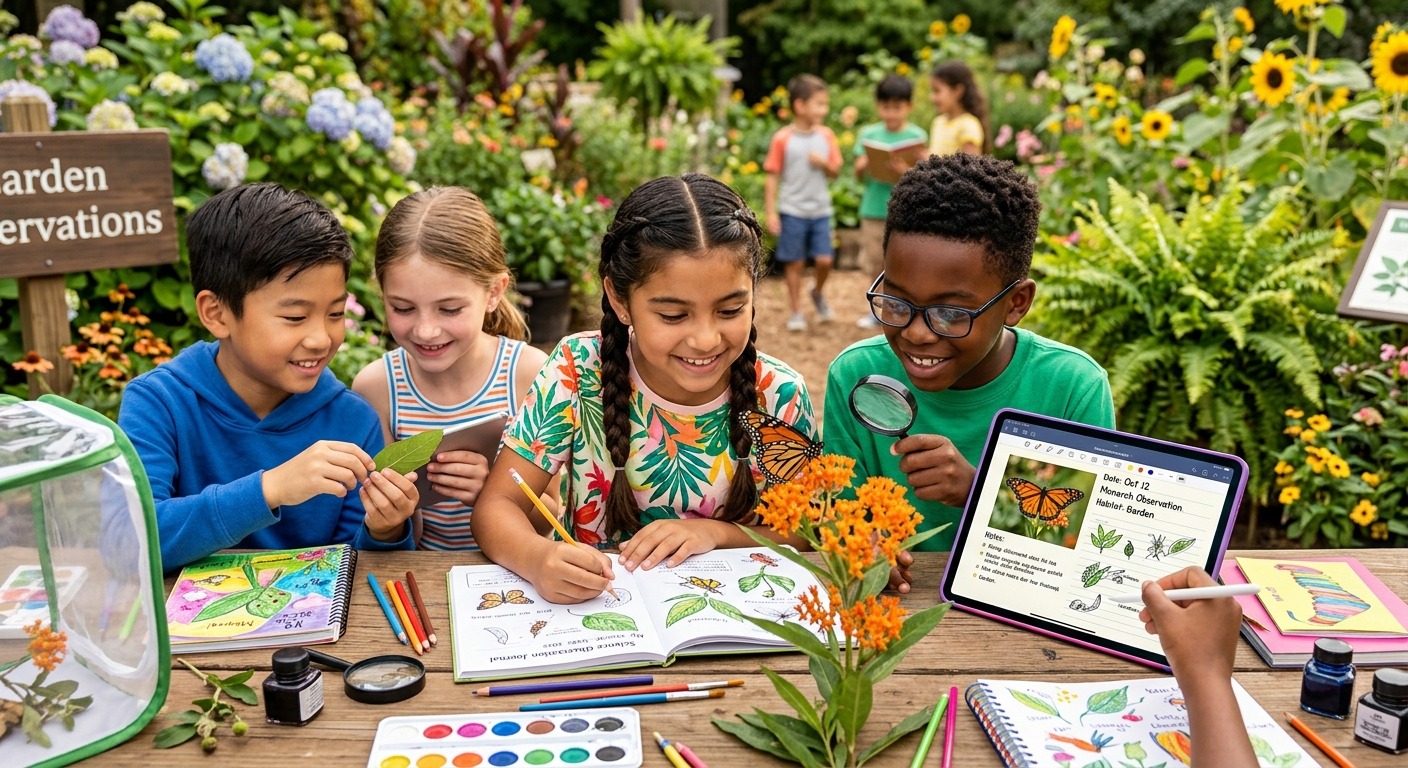
Twelve-year-old Maya holds a magnifying glass over a monarch butterfly wing. She traces the veins onto her paper in pencil, then adds tiny labels: “feels like paper,” “orange fades to rust at edges,” “triangle shapes at border.” That sketch will become her first digital journal entry before lunch. This is science documentation, and it looks nothing like filling in a worksheet. Teachers who have made this shift say it changes how students relate to science entirely.
Classroom Snapshot
This routine pairs observational sketching with typed digital journaling to build both science inquiry and writing fluency in grades 3 through 8. Students draw first, annotate what they notice, then translate their sketches into digital entries. Gauging typing readiness before the unit begins helps teachers group students by fluency and set realistic pacing. The result is a classroom where art and science genuinely reinforce each other, week after week.
Why Observation Is the Foundation of Real Science
Science begins with looking. Before hypotheses, before experiments, before data tables, there is the quiet act of noticing. When students develop careful observation habits, they build the cognitive muscle that every branch of science depends on. Observation threads through all eight of the science and engineering practices identified by the Next Generation Science Standards, from asking questions and planning investigations to analyzing data and constructing explanations.
The problem is that observation is genuinely hard to teach in the abstract. Telling a student to “look carefully” rarely produces anything useful. But giving that same student a blank piece of paper, a pencil, and five minutes changes everything. Drawing forces the eye to slow down. Students notice details they would otherwise skim right past: the exact shape of a leaf vein, the gradient of color on a beetle’s shell, the way water beads on a waxy surface. The paper becomes a thinking tool, not just a recording surface.
How Annotated Sketches Turn Looking Into Thinking
An annotated sketch is not art for art’s sake. It is a labeled, detailed drawing that functions as a scientific record. In grades 3 through 8, this tool bridges the gap between what students see and what they can eventually write about. Many students, especially at the younger end of this range, struggle to translate complex observations into sentences. Drawing gives them a place to begin, with confidence already built in.
Teachers who use this method consistently describe a shift in classroom energy. Students lean over their specimens or nature scenes with genuine focus. They debate whether a line should go here or there. They ask for magnifying glasses and rulers. The act of drawing creates real engagement with the subject, and that engagement carries forward into the documentation that follows.
The annotation layer is what gives the sketch scientific weight. Labels should describe not just what a thing is, but what the student actually notices: texture, color gradients, relative size, movement, or sound. Many teachers print a small scaffold with sentence stems like “I notice,” “I wonder,” and “This is different from” to help students stay observationally specific rather than drifting into vague generalities.
Knowing Your Students Before the Unit Begins
Once students have sketched and annotated their observations on paper, the next step is translating those notes into a typed digital journal. This is where many teachers encounter an unexpected hurdle. Students vary widely in typing fluency, particularly in grades 3 through 5. A student who types comfortably at 25 words per minute will find the digital journal step natural and even satisfying. A student who hunts for each letter may lose the thread of their observation entirely, and the frustration can overshadow the science itself.
The fix is to assess before you assign. Before launching the unit, have students complete a beginner typing test to measure their current fluency. A five-minute test gives a clear picture of each student’s words-per-minute rate and accuracy. Use that data to group students by fluency and to set realistic expectations. Students who type with confidence can write full paragraphs drawn from their sketches. Students still building speed can type two or three key sentences and expand their entry using a voice-to-text tool instead.
This grouping does not need to be visible to students. Build it into the digital platform by creating tiered response templates: longer open-ended prompts for fluent typists, shorter structured frames with sentence starters for developing ones. Every student should experience the digital journal step as achievable. The goal is growth in both science documentation and keyboard fluency, not a performance ranking.
A Weekly Cadence That Makes Journaling Feel Natural
The sketch-to-journal routine works best as a predictable weekly structure. When students know exactly what to expect each day, they can focus their energy on the observation itself rather than navigating logistics. The following five-step cycle has been used successfully across grades 3 through 8:
- Monday: The teacher introduces the specimen, phenomenon, or outdoor site. Students make a five-minute silent observation with no tools, using only their eyes and full attention.
- Tuesday: Students create their annotated sketch in pencil first, then add color and detail. Teachers circulate and ask prompting questions without giving answers away.
- Wednesday: Students review their sketches, add any missing labels, and compare notes with a partner. Class discussion happens here, after individual thinking is already on paper.
- Thursday: Students open their digital journals and type their observations using the sketch as their primary source. Voice-to-text is available for students who need it.
- Friday: Students share one sentence from their digital entry with the class. The teacher highlights specific vocabulary, precise descriptions, and strong scientific language as models for the group.
This structure is predictable without being rigid. Teachers working with older students can collapse the cycle into three days. Teachers in grades 3 and 4 may extend it across two weeks without losing momentum. The essential constraint is keeping the sketch step before the digital step every single time. The drawing is the scaffold. The journal is the documentation.
Sample Prompts That Connect Observation to Science Concepts
Open-ended prompts work best during the sketch phase. “Draw what you see as carefully as you can” is genuinely enough to start. For the digital journal, prompts need a little more structure to help students connect their visual observations to the science concepts at play in the unit.
Grades 3 and 4 respond well to: “What does your specimen look like up close? Describe three details you only noticed once you started drawing it.” This keeps the focus on observation while pushing students to articulate what the act of drawing revealed to them.
Grades 5 and 6 can handle more conceptual reach: “How does what you observe connect to what you know about how this organism or material survives or functions? Use your sketch labels to support your answer.” This asks students to shift from description into explanation, a significant cognitive step.
Grades 7 and 8 are ready to ask investigable questions: “What question does your observation raise that you could design a test around? What would you need to measure, change, or control?” This prompt bridges observation directly into experimental design, making the journal a launching pad rather than an endpoint.
A Rubric That Honors Both Art and Science
Grading an interdisciplinary routine requires a rubric that recognizes both observational precision and the quality of written documentation. This is the piece that concerns teachers most, and it does not need to be complicated. The guide below offers a ready-to-adapt framework across all three grade bands.
Annotated Sketch and Digital Journal Entry: Scoring Guide
| Criterion | 3 , Strong | 2 , Developing | 1 , Beginning |
|---|---|---|---|
| Observational Detail | Sketch includes four or more specific, accurate labels describing what is actually seen. | Sketch includes two to three labels; some are general rather than precise. | Sketch has one label, or labels name the object rather than describe it. |
| Scientific Language | Digital entry uses two or more science vocabulary terms correctly in context. | One science term is used; it may not be fully accurate in context. | Everyday language only; no science vocabulary is present. |
| Sketch-to-Journal Connection | Journal clearly references specific details from the sketch; the two align and support each other. | Journal mentions the specimen but does not draw directly from sketch labels. | Journal appears unrelated to or contradicts what is shown in the sketch. |
| Depth of Thinking | Entry includes a question, inference, or connection to a science concept beyond pure description. | Entry describes accurately but stays at the surface; no inference or question is raised. | Entry is very brief or simply repeats sketch labels without any elaboration. |
Share this rubric with students at the start of the unit. When students see the expectations up front, they approach both the sketch and the journal with far more intentionality. The criterion that surprises teachers most is the third one: the connection between sketch and journal. This is actually the most important habit in the whole routine. It trains students to treat their own visual record as evidence, which is precisely how working scientists use field sketches.
Where the Pencil and the Keyboard Start to Think Alike
By the fourth or fifth week of this routine, something shifts. Students stop waiting to be told what to draw. They reach for their sketchbooks when a question crosses their mind during another subject. They type their journal entries with more speed and less hesitation. The pencil and the keyboard begin to feel like the same kind of thinking, just expressed in different forms.
That is the real outcome of this approach. Not a portfolio of pretty drawings or a folder of neatly typed documents, but a student who knows how to record what they observe, think about what it means, and communicate it in more than one way. Science journals have always been personal records of wonder. Giving students a visual layer before the written one honors the way many of them actually think. It meets them where their confidence already lives and builds from there.
The routine is low-cost and high-yield. It requires paper, pencils, access to a device, and a consistent weekly structure. What it produces, over time, is a class of students who approach the observable world with patience, precision, and genuine curiosity. That is exactly what science education is meant to do.