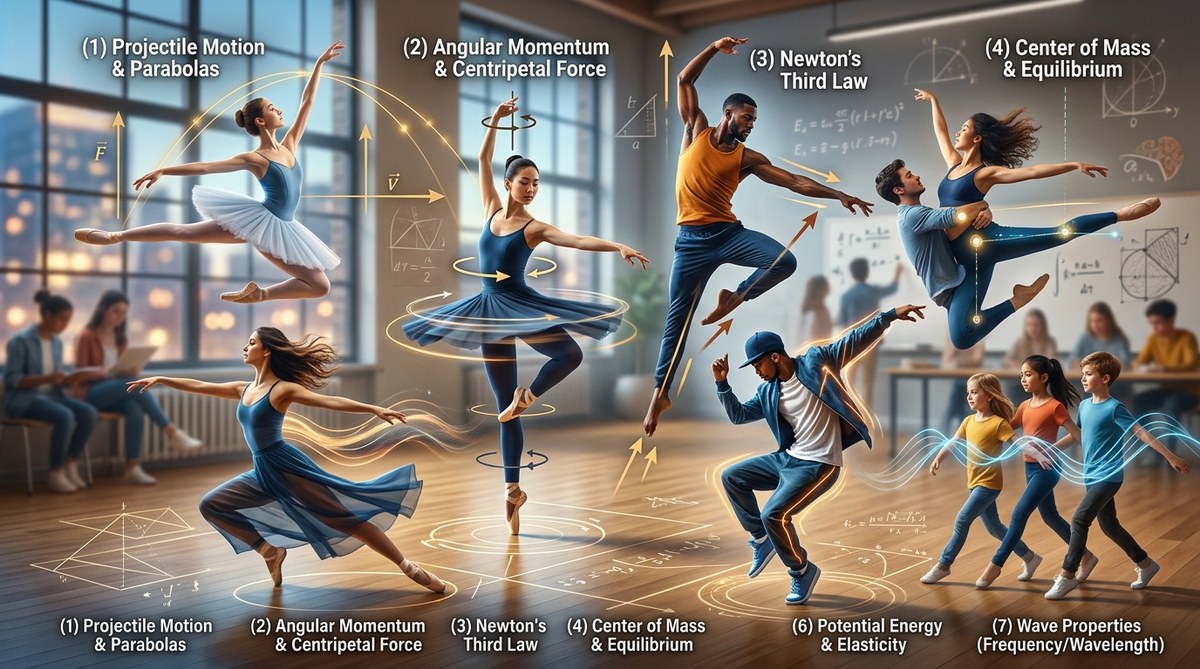
A dancer launches into a grand jete. For a split second, they seem to float across the stage. That moment of suspension is not magic. It is pure physics in action. Every turn, lift, and fall follows rules that govern planets, rockets, and your morning commute. When you watch a dancer, you are watching Newton’s laws, conservation of energy, and rotational dynamics play out in real time. The physics of dance turns abstract equations into something you can feel in your own body. And that makes it one of the most powerful teaching tools available.
Dance is a living physics lab. A pirouette demonstrates conservation of angular momentum. A grand jete shows projectile motion. A partnered lift illustrates force pairs. By moving through these concepts physically, learners of any age grasp ideas that often feel stuck on a page. This guide breaks down seven specific ways dance makes physics intuitive and memorable.
Why the Body Is the Best Physics Lab
Think about how most people learn physics. They stare at diagrams of vectors. They solve word problems about falling apples. These methods work, but they miss something essential: the body. When you spin with your arms pulled in, you feel yourself speed up. That feeling sticks. The physics of dance turns abstract symbols into lived experience.
Classrooms that blend movement with science see higher engagement across age groups. A student who struggles with a textbook equation often lights up when they can walk through the same concept. Dance does not replace traditional learning. It anchors it in muscle memory.
The Science Behind a Pirouette
A pirouette is a perfect example of conservation of angular momentum. Start spinning with your arms extended. Pull your arms in toward your chest. You spin faster. That is not a trick. It is a law of nature.
Angular momentum depends on two things: rotational speed and the distribution of mass around the axis of rotation. When a dancer pulls their arms in, they move mass closer to the axis. To keep the total angular momentum constant, the rotational speed must increase.
Here is a breakdown of what happens during a successful pirouette:
| Phase | Action | Physics Concept |
|---|---|---|
| Preparation | Plie and push off the floor | Ground reaction force and torque |
| Initiation | Arms extended, leg lifts | Low moment of inertia for control |
| Rotation | Arms pull in toward chest | Moment of inertia decreases, speed increases |
| Completion | Arms open, foot returns to floor | Moment of inertia increases, speed decreases |
Common mistakes in pirouettes often come from poor understanding of these principles.
- Leaning off center: If your axis of rotation is not vertical, gravity creates a torque that pulls you off balance.
- Dropping the arms too late: The change in speed only happens when mass moves closer to the axis. Timing matters.
- Forgetting the spot: The head whips around to keep the eyes focused on one point. This reduces dizziness by stabilizing the vestibular system.
“A dancer who understands angular momentum will turn more consistently than one who just hopes for the best. The physics gives them control.” — Dr. Sarah Chen, biomechanics researcher and former professional ballet dancer.
How a Grand Jete Explains Projectile Motion
A grand jete is a leap where the dancer splits in the air. It looks like they are flying. In reality, they are following a parabolic path just like a basketball or a thrown baseball.
The dancer’s center of mass follows a predictable curve. Once they leave the ground, nothing can change that path until they land. The dancer can move their arms and legs relative to their center of mass, but the center itself follows the laws of projectile motion.
Here are the key factors that determine how far and how high a dancer travels:
- Takeoff angle: The angle of the push off the floor determines the shape of the parabola. A 45 degree angle gives maximum horizontal distance.
- Takeoff speed: More speed at launch means a longer flight time and greater height.
- Air resistance: At dance speeds, air resistance is small but noticeable. A streamlined body position helps maintain distance.
- Landing mechanics: The dancer must absorb the impact by bending their knees. This increases the time over which the force is applied, reducing peak force on the joints.
Educators can use this to teach the independence of horizontal and vertical motion. The dancer’s horizontal speed stays constant (ignoring air resistance) while gravity pulls them down.
Force Pairs in Partner Work
When a dancer lifts a partner, they are demonstrating Newton’s third law. For every action, there is an equal and opposite reaction. The lifter pushes up on the flyer. The flyer pushes down on the lifter. If the lifter stops pushing, the flyer falls.
But good partnering is more subtle than just pushing hard. The flyer must engage their core and maintain a rigid body position. This turns them into a rigid object that the lifter can control. A limp flyer is much harder to lift because energy gets lost in the bending of joints.
A practical way to teach this in a classroom:
- Have two students stand facing each other, palms touching.
- One student slowly pushes forward while the other resists.
- Ask them to describe what they feel. Both feel the push.
- Repeat with one student pushing and the other relaxing their arms. The relaxed student falls backward.
- Discuss how the rigid body transfers force more efficiently.
This simple exercise makes the abstract concept of force pairs tangible.
The Physics of Falling and Recovery
Dance is full of controlled falls. A dancer tips off balance, then steps or rolls to recover. This is a lesson in torque, center of mass, and base of support.
Your center of mass is roughly at your belly button. When you stand, it sits above your feet. When you lean forward, your center of mass moves toward the edge of your base. If it goes past your toes, you fall. Dancers learn to feel that edge and use it.
A dancer performing a arabesque leans forward while extending one leg back. The leg acts as a counterweight. It shifts the center of mass back toward the supporting foot. Without that counterweight, the dancer would tip over.
This concept applies directly to real world safety. Teaching students about center of mass through dance helps them understand why they should not carry heavy boxes with their arms extended. It also explains why a person carrying a heavy load leans backward.
Momentum Transfer in Contact Improvisation
Contact improvisation is a dance form based on physical contact and weight sharing. Two dancers roll, slide, and lift each other. It is a masterclass in momentum transfer.
When one dancer pushes another, momentum moves from one body to the other. The receiving dancer can absorb that momentum by bending their knees and rolling with the push. Or they can redirect it by using the momentum to spin or lift.
This is the same physics that explains pool balls colliding. A moving ball hits a stationary ball. The first ball stops, and the second ball moves. The momentum transfers. In dance, the transfer is rarely perfect because bodies are not rigid spheres. But the principle is identical.
A classroom activity to demonstrate this:
- Students pair up and stand facing each other.
- One student gently pushes the other’s shoulders.
- The receiving student tries to absorb the push without moving their feet.
- Then they try to redirect the push into a turn.
- Discuss how the momentum changed direction but was not lost.
Rhythm and Frequency
Dance is tied to music. The beat provides a tempo. That tempo is a frequency measured in beats per minute. When a dancer moves to the beat, they are synchronizing their motion to an external oscillator.
This connects to wave physics. Sound waves travel through the air. The dancer’s ears detect the frequency. Their brain sends signals to their muscles to move at that rate. The whole system is a feedback loop of wave detection and mechanical response.
Teachers can use this to explain concepts like frequency, period, and resonance. A dancer who matches the beat is in resonance with the music. A dancer who fights the beat experiences interference. Their motion cancels out the intended rhythm.
A Simple Framework for Teaching Physics Through Dance
If you want to bring the physics of dance into your classroom or home, follow this process.
- Choose a single move: Pick one dance move like a pirouette, a leap, or a lift.
- Demonstrate the move: Show it at full speed, then in slow motion.
- Identify the physics concept: Name the law or principle at work.
- Let students try: Have them attempt the move, focusing on the physics.
- Debrief together: Ask what they felt and how it matches the theory.
- Connect to other contexts: Show how the same physics applies to sports, vehicles, or nature.
This method works for elementary students through adults. The key is to keep the focus on the feeling. Physics is not something you memorize. It is something you experience.
Common Misconceptions About Dance and Physics
Some people think dance is purely artistic. Others think physics is too rigid for creative expression. Both views miss the point. The physics of dance shows that structure and creativity work together.
- Misconception: Dancers do not need to think about science.
- Reality: Professional dancers use physics intuitively. Understanding it consciously improves their technique.
- Misconception: Physics is only for advanced students.
- Reality: A five year old can understand balance and motion through play.
- Misconception: You need equipment to teach physics.
- Reality: The human body is the most accessible lab there is.
How to Take This Further
If you are an educator, consider building a full lesson around one dance move. Have students film themselves and analyze the trajectory. Use free video analysis software to measure speed and angle. Let them compare their results to theoretical predictions.
For parents, try a simple game at home. Put on music and ask your child to find a move that uses balance. Then ask them to find a move that uses speed. Talk about why each move works. You might be surprised at how naturally kids understand these concepts when they are moving.
If you want to see more examples of how art and science come together in the classroom, check out this guide on unlocking creativity by merging art and science in your classroom. It offers practical strategies for blending disciplines without losing depth.
The Art of Seeing Physics Everywhere
Dance is not the only place physics shows up. It is everywhere. But dance has a unique advantage. It is intentional. A dancer chooses every motion. That choice is a hypothesis. Will this turn work? Will this lift hold? The dancer tests their hypothesis with every performance.
When you learn to see physics in dance, you start to see it in everything. A child on a swing is a pendulum. A car turning a corner is centripetal force. A falling leaf is air resistance in action. The physics of dance opens your eyes to the physics of the world.
Start small. Watch a dancer spin. Notice the arms. Notice the speed change. That one moment holds centuries of scientific discovery in a single motion. And now you can see it too.