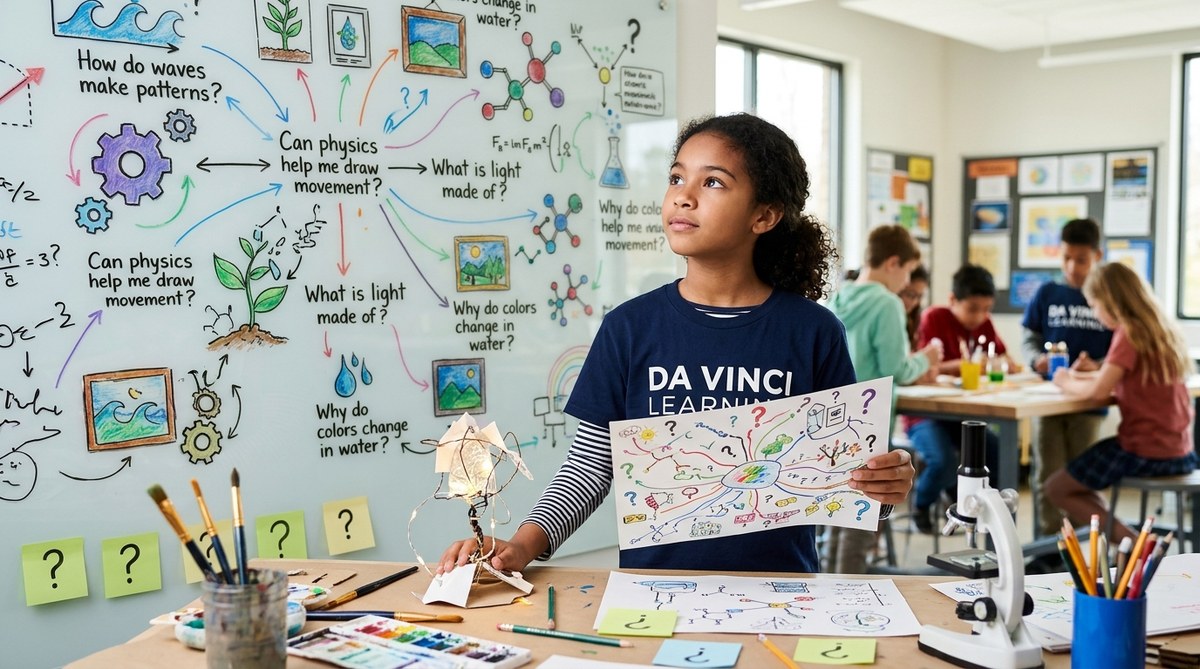
When a student asks why the sky is blue, they are doing something remarkable. They are blending curiosity with a need for explanation. That single question sits right at the crossroads of art and science. The poet wants to describe the color. The physicist wants to measure the wavelength. The artist wants to mix the pigment. The educator wants to nurture both impulses. The art and science connection in education is not a nice to have. It is the engine that drives deep, lasting understanding. When we separate these two ways of knowing, we rob students of the full picture. When we bring them together, we unlock a richer, more engaged kind of learning.
Integrating art and science transforms passive lessons into active investigations. Students who draw a cell before labeling it remember its structure longer. Those who design a bridge model learn physics principles intuitively. This guide gives you practical strategies to blend disciplines, foster inquiry, and build a classroom where creativity and logic work together every single day.
Why the Divide Between Art and Science Hurts Learning
Schools often teach art and science as separate subjects. Art happens in a studio with paint. Science happens in a lab with beakers. This separation feels natural because of how we organize schedules, but it does not reflect how the real world works. A graphic designer uses color theory and computer code. An architect uses physics and aesthetic proportion. A medical illustrator needs anatomy knowledge and drawing skill.
When students see these subjects as disconnected, they miss the chance to build flexible thinking. They learn to memorize facts for science class and save creativity for art class. The art and science connection in education breaks down this false wall. It helps students see that observation, pattern recognition, and iteration are skills that cross every boundary.
What the Research Says About Combining Art and Science
Studies from the last decade show that students in integrated programs perform better on tests of critical thinking and creative problem solving. A 2024 report from the National Endowment for the Arts found that students who engaged in arts-integrated science lessons scored 18 percent higher on measures of scientific reasoning than peers in traditional classrooms. The reason is not magic. Drawing a diagram forces a student to notice details they might skip while reading. Building a clay model of a molecule requires understanding its structure in a tactile way.
Neuroscience backs this up. When students use both hemispheres of the brain, they form stronger neural connections. The art and science connection in education is literally a brain-building strategy.
A Practical Framework for Blending Art and Science
You do not need to overhaul your entire curriculum to start. The goal is to find natural overlaps and build from there. Here is a simple numbered process to guide your planning.
- Start with a student question. Listen for what they wonder about. A question like “Why do leaves change color?” leads naturally to pigment chromatography and watercolor painting.
- Identify the science standard. Match the question to a specific concept. For leaf color, that is photosynthesis and chemical change.
- Choose an art form that fits. Watercolor, collage, observational drawing, or even dance can express the concept. For chemical change, a series of paintings showing the progression of color works well.
- Design the investigation. Let students explore the science through the art. They can extract pigments from leaves, then paint a scientific illustration.
- Reflect on both outcomes. Ask students what they learned about the science and what they learned about the artistic process. This reflection solidifies the art and science connection in education.
Common Mistakes Teachers Make (And How to Fix Them)
Even well-meaning integration can fall flat. The table below shows three common pitfalls and the simple shifts that fix them.
| Mistake | What It Looks Like | The Fix |
|---|---|---|
| Art as decoration | Students color a worksheet after a lecture. They do not engage with the concept. | Make the art the method of discovery. Have students sketch a leaf before you explain how it works. |
| Forcing a connection | You try to fit a song into every science lesson. It feels random. | Only connect when the art form genuinely illuminates the science. A song about the water cycle works. A song about multiplication does not. |
| Ignoring student choice | You assign a specific art project. Students who do not see themselves as artists shut down. | Offer options. Let them choose between drawing, writing a poem, or building a model. Choice increases buy in. |
Three Classroom Activities That Work Right Now
You can try these activities tomorrow. They require minimal materials and work across grade levels.
Activity one: Nature observation journals. Give each student a small notebook. Go outside for ten minutes. Ask them to draw one leaf, one rock, and one cloud as accurately as possible. Then ask them to write three questions about what they observed. This builds scientific observation skills and artistic attention to detail. It is a pure example of the art and science connection in education in action.
Activity two: Color mixing and light. Use watercolor paints to mix secondary colors from primaries. Then use prisms to split white light. Ask students to compare the color wheel they painted with the spectrum they saw. The science of light waves meets the art of color theory.
Activity three: Build a bird beak. Give students common materials like paper clips, straws, and clay. Challenge them to build a tool that mimics a bird beak. Then test it with different foods like seeds and worms. This combines engineering design, biology, and sculpture.
“The best scientists are often the most creative thinkers. They see patterns others miss because they approach problems with an artist’s eye.” – Dr. Maya Rivers, STEAM education researcher
How to Handle Pushback from Colleagues or Administrators
You might hear comments like “We do not have time for art” or “This feels like fluff.” These objections come from a misunderstanding of what integration means. The art and science connection in education is not an add on. It is a more efficient way to teach. When students draw a diagram, they are practicing observation and fine motor skills. When they build a model, they are applying physics and geometry.
Point to the evidence. Share the research. Offer to pilot one lesson and share the results. Most administrators respond well to data showing increased engagement and retention. You can also show them how this approach aligns with the Next Generation Science Standards, which emphasize modeling and communication.
Building a Classroom Culture That Supports Both Disciplines
The physical space matters. Set up a corner for observation with magnifying glasses, sketch pads, and natural objects. Rotate materials to keep curiosity fresh. Hang student work that shows both the process and the product. A messy sketch with annotations is more valuable than a polished final piece.
Celebrate questions as much as answers. When a student asks “What if we mixed this with that?” treat it as a scientific hypothesis and an artistic experiment. The art and science connection in education thrives when inquiry is the star.
Why This Approach Prepares Students for the Future
Employers in 2026 are looking for people who can think across boundaries. A software company needs designers who understand user psychology. A hospital needs doctors who can communicate with empathy and precision. A museum needs curators who understand conservation chemistry. The jobs that will exist in ten years do not fit neatly into one subject silo.
Students who learn to integrate art and science develop adaptability. They learn that there is more than one way to solve a problem. They learn to communicate ideas visually and verbally. They learn to iterate, to try again when something does not work, and to see failure as data. These are not soft skills. They are survival skills.
Your Next Steps for Bringing Art and Science Together
You do not have to do everything at once. Pick one small change and try it this week. Maybe that means adding a five minute sketch to your science lesson. Maybe it means asking students to write a short poem about a chemical reaction. Maybe it means letting them choose a creative way to show what they learned.
The art and science connection in education is not a curriculum. It is a mindset. It says that every subject has room for wonder. Every lesson can include a moment of making. Every student has the right to see the world as both a laboratory and a studio.
The One Question That Changes Everything
Ask your students this tomorrow: “What do you notice?” Give them an object, a plant, a photograph, a piece of music. Just ask them to notice. Then ask them to record what they see. That single question opens the door to both scientific observation and artistic appreciation. It is the simplest and most powerful way to start building the bridge.
When you teach from the art and science connection, you give students permission to be whole thinkers. You show them that logic and creativity are not enemies. They are partners. And that partnership is what makes learning unforgettable.