Your students walk in, sit down, and within sixty seconds they are arguing about their own brains. Not because you told them to. Because the numbers on the screen do not make sense to them yet. One student named a color in 0.8 seconds. Another took nearly twice as long on the exact same task. The room fills with questions before you have said a single word about neurons or pigment. That is exactly how this two-period STEAM lesson begins, and it is one of the more memorable classroom openings you will ever run.
The Stroop effect places color theory and brain science in the same room without forcing either discipline. Students generate real data about their own minds, then use what they know about color to explain why that data looks the way it does. The result is an interdisciplinary unit that feels urgent because it is personal.
Lesson at a Glance
- Students take an online Stroop test at the start of class and log their own reaction times, turning personal data into the entry point for both color theory and brain science.
- Color mixing exercises in Period Two give students hands-on studio practice that connects directly to how the brain handles competing visual signals.
- A closing sketch reflection asks students to visualize cognitive interference as a composition, completing an arc from data collection to artistic expression.
Why the Brain Gets Tripped Up by Color
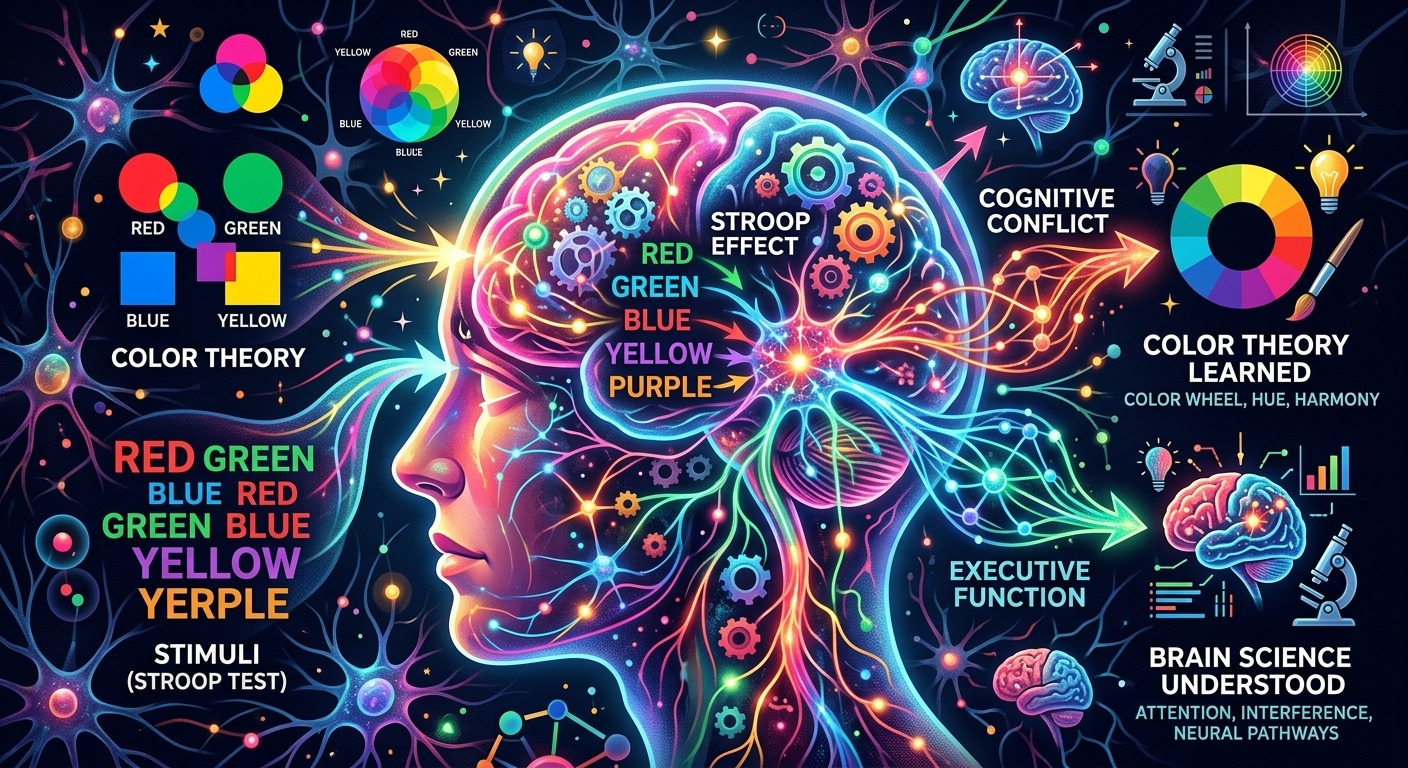
In the 1930s, psychologist John Ridley Stroop documented something quietly unsettling: people take noticeably longer to name the ink color of a word when that word spells out a different color. The word RED printed in blue ink slows the reader down. The word BLUE printed in green ink does the same. The brain’s reading process is so well-practiced that it fires before the color-naming process has a chance to catch up. This is what researchers call cognitive interference, and it remains one of the most replicated findings in the history of psychology.
For teachers, the beautiful thing about this phenomenon is that it needs no special equipment and no lab. It happens in the brain, in real time, in front of everyone. Students experience it directly. That immediacy makes it a near-perfect anchor for inquiry-based instruction.
Period One: Starting With Your Own Data
Bring up a stroop test on the projector the moment students arrive. Give them no explanation at first. Tell them simply to complete the task as quickly and accurately as they can, and to record their score. Let the confusion happen on its own. Students will notice almost immediately that something feels wrong, even if they cannot name it yet.
After everyone has logged a score, open the data to the whole group. Write times on the board. Ask students what patterns they notice. Some scores will cluster close together. Others will be outliers in one direction or another. Ask the class to hypothesize why. Most students will guess that it has something to do with reading speed or divided attention. That is a reasonable starting point, and you can build on it from there.
Run through the lesson sequence in this order to give students a clear arc from data to theory:
- Each student completes the test individually and records their personal reaction time.
- Class data is compiled on the board and students share initial observations about the spread of scores.
- The teacher introduces the term “cognitive interference” and connects it to what students just experienced firsthand.
- Students are shown two complementary color pairs and asked to describe what happens visually when those colors sit side by side.
- Discussion bridges the visual tension of complementary colors to the mental tension of the Stroop task itself.
That fifth step is where art walks through the door. When you place a saturated orange next to a saturated blue, something strange happens. The colors seem to vibrate against each other. Students who have never studied color theory will feel this before they can explain it. That feeling is the bridge. The brain is working to resolve competing signals in both cases, whether the input is color plus language or color placed against color.
Color Theory As the Art Anchor
Complementary colors sit across from each other on the color wheel. Red and green. Yellow and violet. Blue and orange. When placed next to each other at full saturation, they create what painters call simultaneous contrast. Each color appears to intensify the other. The eye moves back and forth between them because neither one visually dominates. The brain keeps trying to settle the conflict and cannot manage it cleanly.
Visual weight is a closely related idea. A small patch of bright red can feel as heavy as a much larger block of muted gray. Color commands attention in ways that shape and size alone cannot. Artists use this deliberately to draw the eye, create tension, or force a specific kind of focus. In a classroom context, these are not abstract principles. They are observable and directly connected to what students just measured during the Stroop warm-up.
Pause here to draw the connection explicitly for students. Those who took longer on the Stroop task were not slower or less capable. They were dealing with higher levels of interference between two competing automatic systems. In exactly the same way, a composition that places poorly matched complementary colors in conflict creates interference for the viewer. The eye does not know where to land. The discomfort is real, and now students have a scientific vocabulary to describe why it feels that way.
Period Two: Mixing Colors and Building a Brain Vocabulary
Period Two moves into the studio. Students begin a color mixing exercise using a limited palette, typically the three primaries plus white. The goal is not to produce a finished piece. The goal is to create deliberate examples of simultaneous contrast and visual weight, guided by everything they discussed in Period One.
As students work, introduce vocabulary that matches their grade level. For students in grades three through five, words like “brain message,” “signal,” and “conflict signal” work well without feeling clinical. Middle school students can handle “cognitive load,” “automaticity,” and “processing conflict” once those terms are anchored to something they experienced directly. High school students can engage with “anterior cingulate cortex,” “attentional control,” and “response inhibition,” particularly when those phrases arrive alongside the visual evidence in their own painted swatches.
The timing of vocabulary introduction matters more than the vocabulary itself. Bring each term in at the moment it becomes relevant, not during a lecture before students have touched a brush. When a student holds up orange next to blue and the colors immediately start pushing against each other, that is the moment to say, “Your visual cortex is receiving two competing signals right now and trying to resolve a conflict. That is almost exactly what happened during the Stroop test.” The word sticks because it arrives with proof the student made with their own hands.
How Period One and Period Two Compare in Focus and Output
| Focus Area | Period One | Period Two |
|---|---|---|
| Primary Mode | Data collection and class discussion | Hands-on studio work and vocabulary building |
| Art Concept | Complementary colors and simultaneous contrast | Color mixing and visual weight in composition |
| Science Concept | Cognitive interference and the Stroop effect | Automaticity, processing conflict, attentional control |
| Student Output | Personal reaction time data and initial hypotheses | Color study paintings, vocabulary notes, and reflection sketch |
| Teacher Role | Facilitator of inquiry and data recorder | Vocabulary introducer and studio coach |
The Closing Reflection That Connects Everything
At the end of Period Two, give students a prompt they have not encountered before: sketch what cognitive interference would look like if it had a visible form. They are not drawing a brain diagram. They are not illustrating a textbook definition. They are making a composition that expresses the feeling of two competing signals fighting for dominance.
Some students will reach for jarring complementary contrasts. Others will use chaotic overlapping lines or fragmented shapes that refuse to settle. Some will make something surprisingly calm and resolved, representing the moment after the brain finally sorts the conflict out and commits to an answer. There is no wrong response here. The range of interpretations is itself part of the lesson, and it will tell you a great deal about how individual students are processing both the art concepts and the science vocabulary.
Ask several students to share their sketches and explain their choices. The language they use will almost always blend art vocabulary and science vocabulary without being prompted to do so. That is the payoff. When a student says, “I used simultaneous contrast here because the two signals never stop fighting each other,” they have done something genuinely cross-disciplinary. They have not borrowed language from another subject. They have built a framework that holds both at the same time, and that kind of thinking does not disappear when class ends.
When Two Disciplines Share One Classroom
The deepest learning in this unit tends to happen not during the Stroop test or the color mixing exercise in isolation, but in the moments when students make the connection themselves. When they realize that the brain’s struggle with a mismatched word and ink color is structurally the same as the eye’s struggle with high-contrast complementary pairs, something real shifts. Art is not decoration. Science is not abstract. Both are tools for understanding how human perception actually works, and students leave this unit holding evidence of that in their own data logs and their own painted swatches.
Teachers who run this unit often find that students carry the vocabulary with them long after the lesson. They point out color tension in logos, in murals, in traffic signs. They use the word “interference” the way scientists use it and the way painters use it, because they have learned that those two uses describe the same underlying experience. That kind of transfer is what makes interdisciplinary instruction worth the planning time.
This lesson does not require a specialized room, a large materials budget, or weeks of prep. It requires a projector, some paint, and a willingness to let students sit with confusion for a few minutes at the start. That confusion is not a problem to solve before class. It is the lesson. The moment students begin explaining their own reaction times using color theory, you will know the two periods were worth every minute of them.